

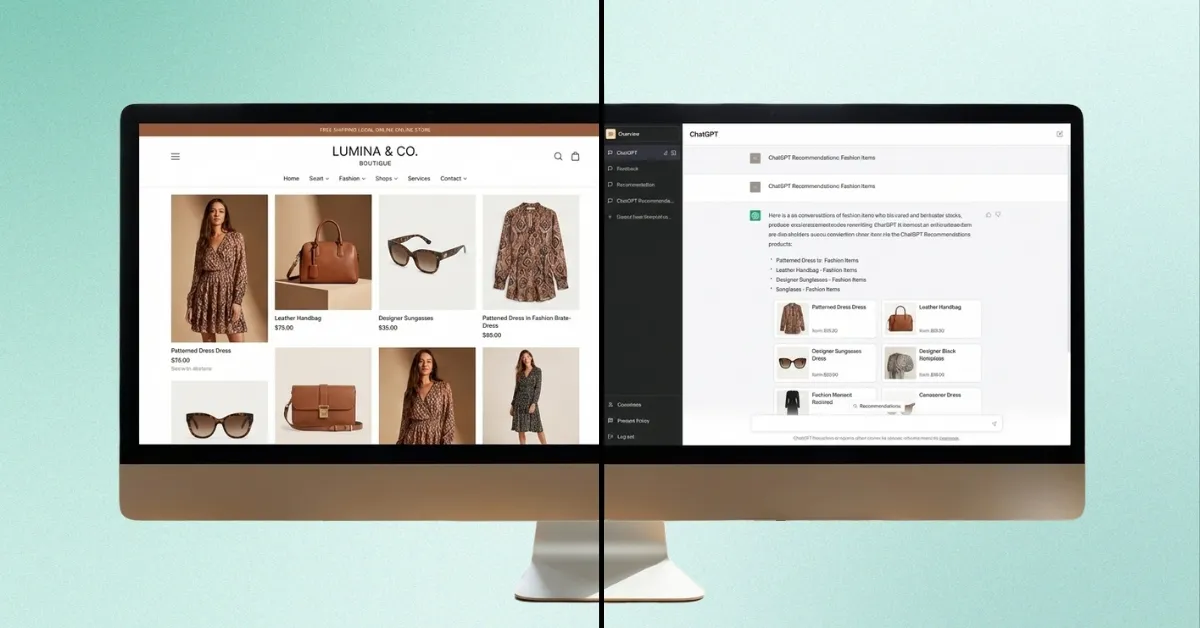
This article is part of our Master Guide to Shopify Agentic Commerce in 2026, focused on moving from third-party LLM syndication to a Sovereign Inside Agent model that protects brand equity, first-party data, and boosts conversions.
Close your eyes and picture your Shopify fashion store.
You likely visualize a specific mood. Maybe it is the grainy, cinematic texture of your hero video. Maybe it is the generous whitespace that screams “luxury.” Or perhaps it is the rebellious, bold typography that defines your streetwear label.
You have spent years (and a fortune) perfecting this “Brand Theater.” It is the reason a customer feels justified paying $200 for your denim instead of $40 for a generic pair.
Now, open your eyes and look at a standard ChatGPT response.
What do you see? 12-point font. Grey text. A white background. Zero emotion.
This is the “Grey Goo” of Branding.
As Shopify fashion stores rush to list their products on “Agentic Storefronts” like ChatGPT and Perplexity, we are facing a dangerous paradox. The easier we make it for AI to sell our products, the harder it becomes to build our brand.
Are we walking into a trap where we trade our soul for a little bit of efficiency?
The Chanel vs. Shein Problem
In the physical world, or even on the visual web, there is a clear hierarchy of brands. You know instinctively that Chanel is not Shein because of the experience. The lighting is better. The paper stock is thicker. The website moves slower and more elegantly.
But inside a Large Language Model (LLM), that hierarchy collapses.
The Great Flattening is what happens when your product is stripped of its visual context and converted into pure text.
If a user asks an AI agent for a “black cocktail dress,” the agent retrieves options from a database. In that text-based interface, a high-end sustainable brand looks identical to a fast-fashion giant. The “signal” of quality—your carefully curated aesthetic—is lost in the noise of grey text.
If your Shopify fashion store relies on storytelling to sell, can you afford to exist in a world where your story is deleted?
The Economics of “Brand Theater” (Why You Need Visuals to Charge a Premium)
Fashion has never been just about utility. If it were, we would all wear burlap sacks. Fashion is about identity.
When a customer visits your online store, they are not just buying a garment. They are buying into a lifestyle. That “vibe” is what allows you to command a healthy margin. It is the “Brand Theater” that turns a commodity into a craveable asset.
Agentic Storefronts threaten to destroy this pricing power.
When a third-party AI recommends your product, it frames it as a solution to a problem (“Here is a shirt”). It focuses on specs: fabric weight, shipping time, and price.
When you compete purely on specs, you are in a race to the bottom. Without the emotional layer of your visual brand, the customer has no reason to choose the more expensive option. By handing your sales process over to a text-based bot, you are voluntarily entering a commodity market.
The “Zero-Click” Threat: Losing the Direct Relationship
Analysts at BCG and Envive have already warned about the risks of “zero-click” commerce. The danger is simple: if an AI agent answers every question a user has, the user never needs to visit your website.
- They don’t see your new Lookbook.
- They don’t read your “About Us” page.
- They don’t sign up for your newsletter.
Your Shopify fashion store risks becoming a “ghost kitchen”—a hidden warehouse that fulfills orders for an AI interface that owns the customer relationship. You get the sale, but you lose the customer.
The Solution: Brand-Safe AI (Bring the Agent to You)
Does this mean fashion brands should reject AI? Absolutely not.
The desire for “Agentic Commerce” is real. Customers want guidance. They want to be styled. They want to ask questions like “What shoes go with this?”
The solution is not to send your products out to a generic agent. The solution is to bring a Sovereign AI Agent into your own store.
This is the philosophy behind iWAND.
iWAND allows Shopify fashion stores to deploy an Agentic Stylist that lives directly on your site. This approach solves the “Grey Goo” problem instantly:
- You Keep the Visuals: iWAND operates as a layer over your existing store. The customer chats with the AI, but they are still immersed in your photography, your fonts, and your world.
- You Keep the Theater: The AI doesn’t just list specs. It acts as a stylist, showing how items look together and reinforcing your brand narrative.
- You Keep the Data: The conversation happens on your domain. You learn what your customers want, and you own that relationship forever.
Don’t Let Your Brand Fade to Grey. The future of fashion is undoubtedly intelligent. But that intelligence should enhance your brand, not erase it.
By choosing an internal agentic layer like iWAND, you ensure that your Shopify fashion store remains a destination, not just a database entry.
Level-up Your Store with an Internal Agentic Stylist Layer
AI stylist for Shopify fashion stores that turns browsers into loyal buyers.
Free, no code, no setup stress