

At a glance
An AI stylist for a Shopify fashion store is an app that asks each shopper about her occasion, size and taste, then answers with complete outfits from your own catalogue. To choose one, check that it styles only from your products, names her size, works on product pages and charges in a way that fits your sales.
Stages: 6
AI styling guides: 4
Free: Styling Score
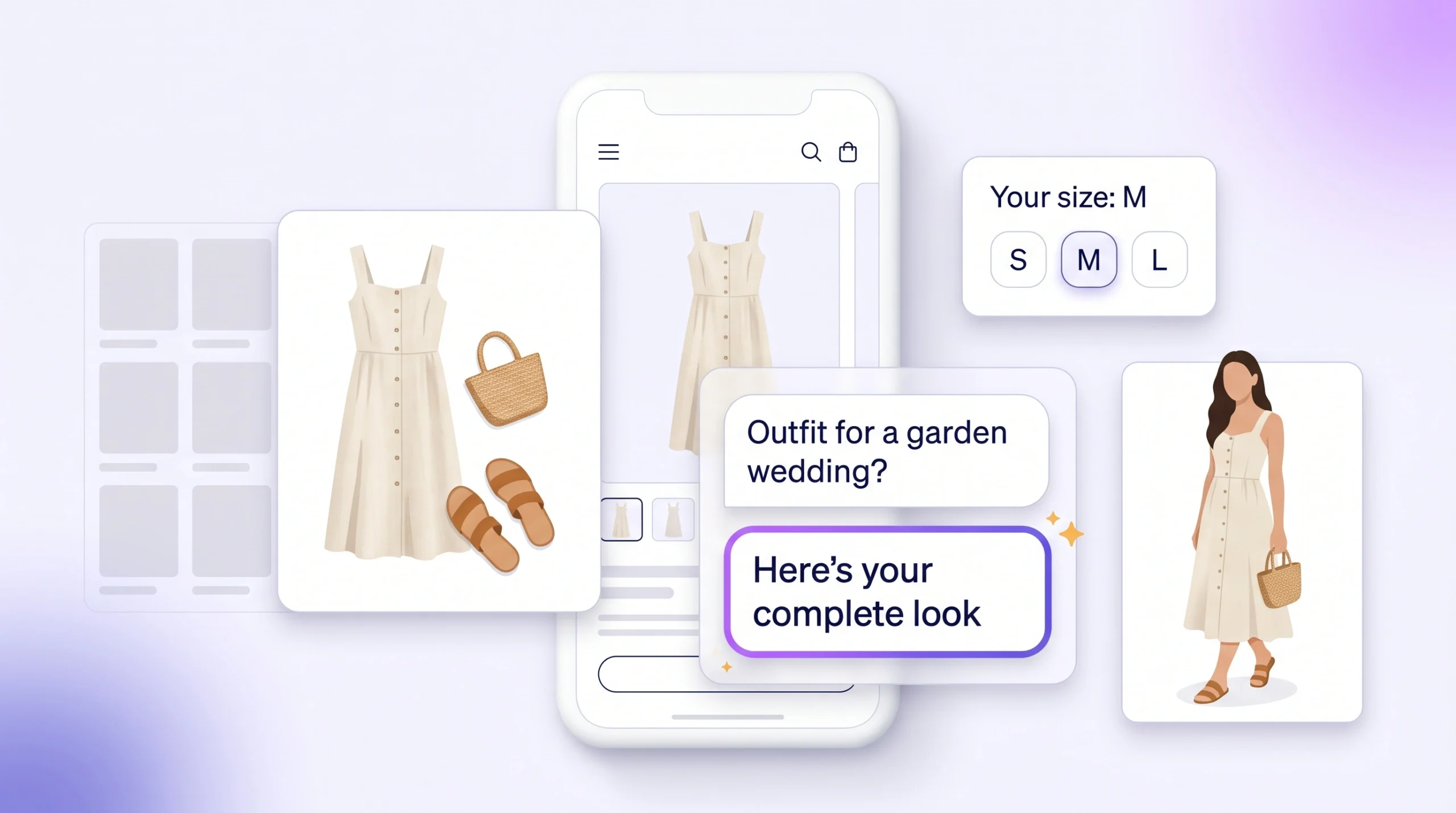
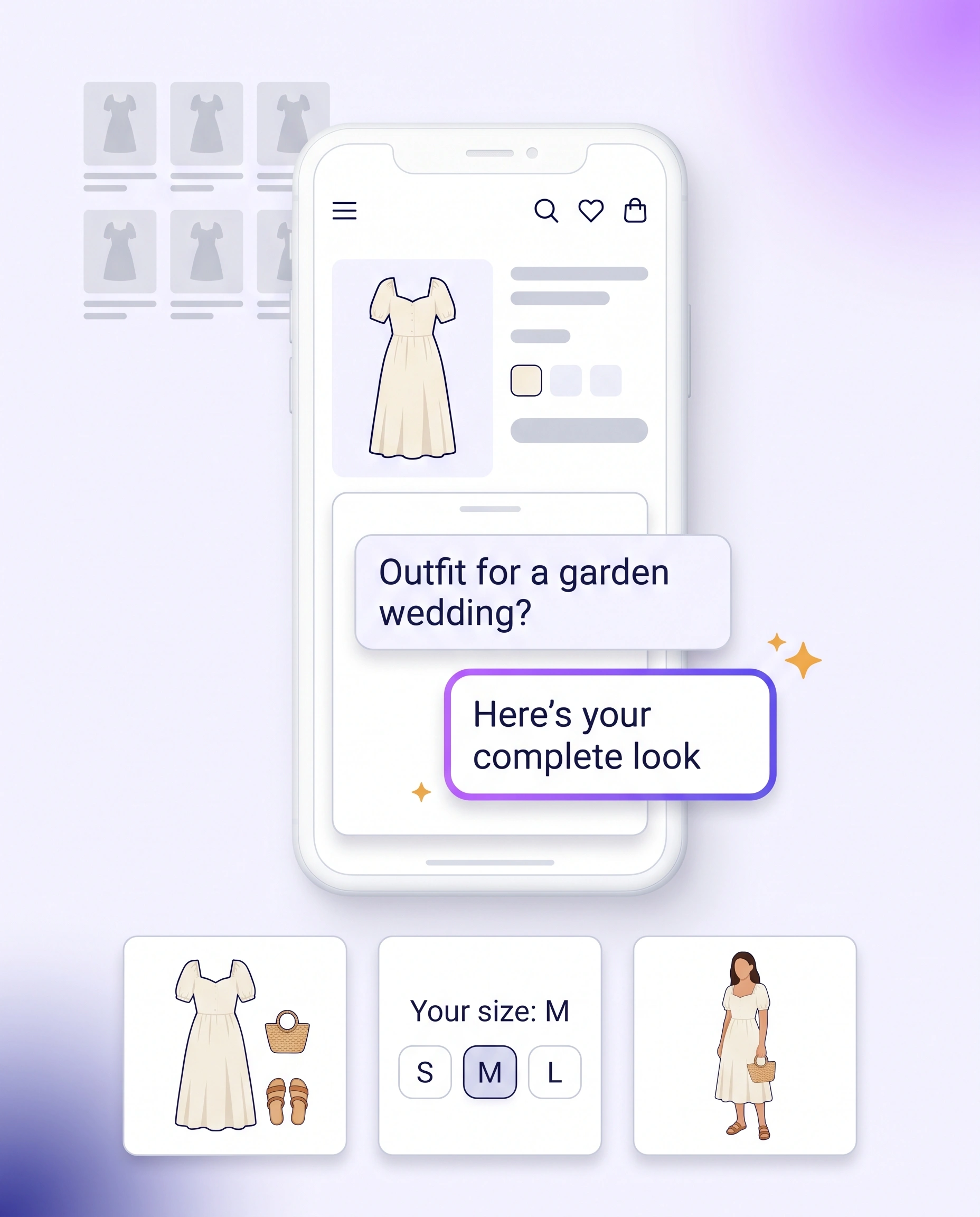
She is on a product page, looking at a cream linen dress for a friend’s garden wedding. She wants three answers before she buys: will it suit her, which size should she order, and what should she wear with it. In a boutique someone would answer. On most online stores nobody does, so she scrolls, orders two sizes, or leaves.
An AI stylist is the online version of that someone, a conversational agent that styles each shopper from the store’s own catalogue. Read the one-page definition of an AI stylist if you only need the term.
This guide covers what an AI stylist does, how it works on Shopify, what it changes at each of the six stages of a fashion store, which brands already use one, and how to choose and add one. It is written for an owner who may never install iWAND, so the checklist works for any app.
Part of Grow Your Shopify Fashion Store with Styling: Salesperson to Stylist, our guide to the six stages of a Shopify fashion store.
In this guide
A salesperson
shows her the dress, the grid and the size chart.
A stylist
asks about her, builds the look and names her size.
What does an AI stylist do on a Shopify fashion store?
An AI stylist answers the questions a shopper would ask a stylist in a shop, using only pieces your store sells.
| She asks | The stylist does | Stage it moves | Read |
|---|---|---|---|
| What should I wear to this? | Builds complete outfits for the occasion, the dress code or the weather | Engagement | Personalized outfit recommendations |
| Which size am I in this? | Asks her height, usual size and how she likes clothes to fit, then names her size in that piece | Return | Personal size and fit advice |
| Will this suit me? | Judges colour, cut and occasion, and suggests a better piece when the honest answer is no | Conversion Rate | Answering will this suit me |
| What goes with this? | Builds an outfit around the piece on screen, or around a piece she already owns | AOV | A personal outfit around every product |
| Can you change it? | Swaps one piece, such as a longer hem or another colour, and keeps the rest of the look | Conversion Rate | Part of each guide above |
| How would it look on me? | Shows the outfit on a model matched to the shopper, so she can judge the look before she buys | Return | Part of each guide above |
Why do fashion shoppers need a stylist, not just a product page?
Because the doubts that stop an order, or send it back, are questions about the shopper herself: her size, her body, her occasion and what to wear with the piece.
Most visits end without an order
1.0%
is the median conversion rate for fashion and apparel stores on Shopify, in a sample of 76 stores over 90 days to October 24, 2026.
Source: Littledata, 2026, average website performance
Many of the other 99 visits ended on a question nobody answered. The Conversion Rate hub shows how to find those questions on your own product pages.
A grid asks her to do the narrowing
A catalogue of hundreds of look-alike pieces with a search bar that matches words, not occasions, leaves the shopper to filter alone. “Dress for a garden party that covers my arms” is three requests at once, and a keyword search matches none of them. A stylist narrows the catalogue to a few complete looks. The Engagement hub covers why shoppers leave after one page and what keeps them exploring.
Doubt about size sends orders back
23.4%
is the estimated return rate for US online apparel in 2025, and nearly 70% of shoppers who returned clothing bought online gave size and fit as the reason.
Source: Coresight Research with Alvanon, 2026, Shifting the Size and Fit Paradigm
A size chart gives every shopper the same answer. A stylist gives each shopper her own, before she orders. The Return hub lists the fixes, from a size guide for each piece to personal size advice.
See which styling jobs your store already does
Bots walk your store like a shopper. You get a score out of 100, a tier and a report that shows which styling factors are done, stage by stage.
How does an AI stylist work on a Shopify store?
It installs as a Shopify app, reads your catalogue and talks to shoppers on your storefront, so every answer links to a piece she can buy.
- It reads your catalogueProduct titles, descriptions, images and sizes come from your Shopify store, so it suggests only pieces you sell.
- She opens it and asksOn the homepage or a product page, she says what she needs in her own words, such as an outfit for a garden wedding.
- It asks backLike a stylist, it asks a question or two: the occasion, her usual size, how she likes clothes to fit, her colouring.
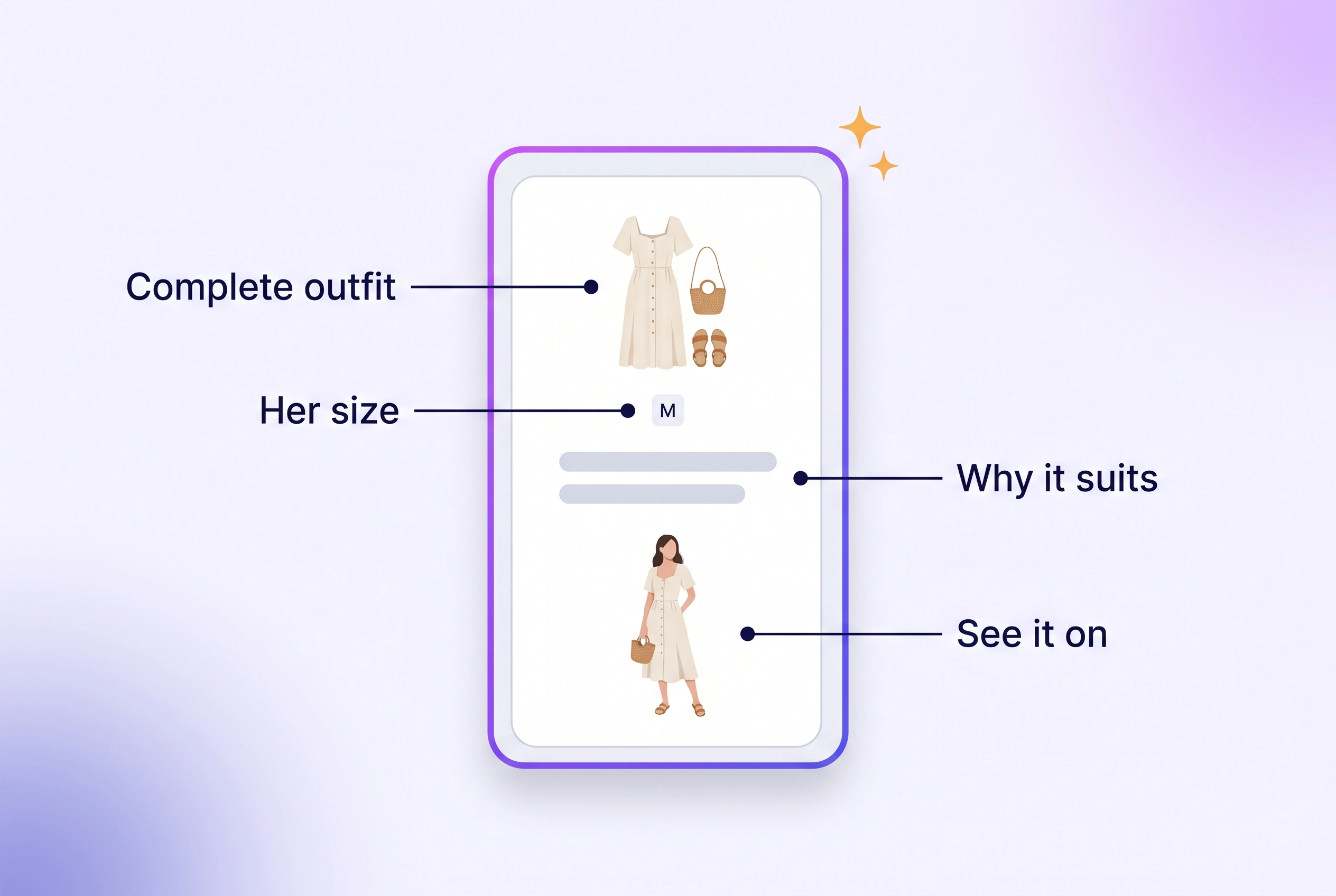
- It answers with a lookShe gets a complete outfit, her size in each piece and a reason it suits her, shown on a model matched to the shopper, with a link to each product.
- She adjusts itShe asks for a longer hem or another colour, and it swaps one piece and keeps the rest.
Its advice is only as good as your product data
Clear fabric, fit, length and size facts on each product make every answer more accurate. The Stylist Store guides help you add those facts, whether or not you install a stylist.
How is an AI stylist different from a support chatbot, a recommendation widget or a try-on app?
A support chatbot answers questions about orders and a recommendation widget shows set suggestions; an AI stylist asks about the shopper and answers what she should wear.
| Tool | Answers questions like | When it acts | Asks about her? |
|---|---|---|---|
| AI stylist | What should I wear to a garden wedding? Which size am I in this? | While she chooses | Yes: occasion, size, fit and taste |
| Support chatbot | Where is my order? Can I return this? | After she buys, or when something goes wrong | No |
| Recommendation widget, such as You may also like | None: it shows a set of products | Passively, on the page | No |
| Size recommendation widget | Which size should I order? | While she picks a size | Yes: measurements or past orders |
| Virtual try-on app | How does this look on a body? | Once she has a piece in mind | Sometimes: a photo or a few details |
Two comparisons go deeper: AI stylist or support chatbot, and AI stylist vs a generic AI agent such as an assistant that shops across many stores.
What can an AI stylist change at each stage of my store?
An AI stylist does a different job at each of the six stages of a Shopify fashion store, so measure each stage separately.
| Stage | The stylist’s job | What you measure | Read next |
|---|---|---|---|
| AI Traffic | Meets a shopper who arrives from an AI assistant with a styled answer on your own page | Visits from AI assistants | Agentic commerce for Shopify fashion brands |
| Engagement | Narrows a wide catalogue to a few complete looks | Shoppers exploring looks | Engagement hub |
| Conversion Rate | Answers “will this suit me?” before she leaves the product page | Share of visits that buy | Conversion Rate hub |
| AOV | Builds a complete look around the piece she is viewing | Average order value | AOV hub |
| Return | Names her size in that piece | Return rate | Return hub |
| Repeat Purchase | Builds a new look around a piece she already owns, from a photo she uploads | Repeat purchases | Repeat Purchase hub |
For a normal number at each stage, see Shopify fashion store benchmarks. No independent benchmark yet shows how much an AI stylist moves any stage, so compare the same products before and after, over the same length of time.
Which fashion brands already use AI stylists?
Ralph Lauren, Zalando, Mango and ASOS have all launched conversational stylists since 2023, and each builds complete looks instead of listing single products.
| Brand | Launched | What it does | Source |
|---|---|---|---|
| Ralph Lauren, Ask Ralph | September 9, 2025 | Answers open prompts, such as what to wear to a concert, with shoppable outfit layouts; available in its US app and built with Microsoft’s Azure OpenAI | Ralph Lauren, 2025 |
| Zalando, Assistant | 2023, now 25 markets | Answers fashion questions in the shopper’s language; in Zalando’s case study, product clicks in the recommendation carousel rose 23% and wishlist additions rose over 40% against its previous version | OpenAI, Zalando case study |
| Mango, Mango Stylist | July 2025 | Recommends products and suggests complete looks in chat on Mango’s site and Instagram; Woman line, nine markets | FashionNetwork, 2025 |
| ASOS, ASOS Stylist | May 20, 2026 | Builds outfits by category, occasion or trend inside ChatGPT for UK and US shoppers, who then buy on ASOS.com | Retail Gazette, 2026 |
What changed is who can have one. In 2025 it took a Microsoft partnership or an in-house team; now an independent Shopify store can install an AI stylist as an app. Note where each conversation happens: ASOS meets shoppers inside ChatGPT, while Ralph Lauren and Mango keep theirs on their own channels. For the full breakdown, read how top fashion brands use AI stylists.
How do I choose an AI stylist for my Shopify store?
Choose the one that styles only from your catalogue, asks about each shopper, builds complete outfits, names her size, works on product pages and charges in a way that follows your sales.
| Check | Why it matters | Ask the vendor |
|---|---|---|
| Styles only from your catalogue | A suggestion for a piece you don’t sell is a lost sale | Can it recommend anything that is not in my store? |
| Asks about her before it answers | Advice without her occasion, size and taste is a recommendation widget | What does it ask each shopper? |
| Builds complete outfits | A look is a bigger sale than one piece | Does one answer hold several pieces from my catalogue? |
| Names her size in that piece | Size and fit is the main reason clothes come back (Coresight, 2026) | How does it decide a size, and from what data? |
| Shows the look on a model matched to the shopper | Seeing the outfit removes the guess a product photo leaves | What exactly does she see, and how is the model chosen? |
| Works on product pages and store-wide | Doubt happens at the product, but discovery starts on the homepage | Where can it appear, and does it open only when she opens it? |
| Keeps the conversation and data in your store | Who owns the styling data decides who owns the customer; see who owns your shoppers’ style data | Who owns the conversations and the shopper data? |
| Lets you read the conversations | They show what shoppers doubt, in their words | Can I read every conversation? |
| Charges in a way that follows your sales | A fixed fee costs the same in a slow month | What do I pay in a month with few sales? |
| Installs without code and can be tested on a few products first | You can judge it on your own catalogue before it reaches every shopper | What does set-up involve, and can I start with my best sellers? |
Skip an app that can’t show you what it told shoppers
If you can’t read its conversations, or it answers from the open web instead of your catalogue, you can’t check its advice or learn from your shoppers.
How do I add an AI stylist to my Shopify store?
Install it as a Shopify app, but do the catalogue work first, because a stylist is only as good as the images and product facts it reads.
- Check your product imagesClean, consistent photos on every product, because the stylist reasons from what it can see.
- Add the product factsFabric, fit, length and colour family on each product record, since these are the details shoppers ask about before buying.
- Install the app and connect your catalogueThe stylist reads your own inventory, so its answers stay inside what you can ship.
- Choose where it appearsStart with your product pages and homepage, where shoppers hesitate and where they start.
- Test on your best sellers, then measure each stageCompare conversion rate, AOV and return rate on the same products before and after, once enough shoppers have used it. The hubs above show how to read each one in Shopify.
A store with thin product data gets thin styling. Steps one and two pay off whether or not you install anything: they also help search engines and AI assistants understand your products.
What is iWAND, and what do its styling agents do?
iWAND is our product.
iWAND is an AI stylist for independent fashion brands on Shopify. Its styling agents give every shopper personal outfit, fit and styling advice from the brand’s own catalogue. It is free to install, and brands pay 5% only on sales iWAND makes.
| Agent | What it does | Where |
|---|---|---|
| Style | Asks about body type, skin tone, occasion and taste, then curates complete outfits | Store-wide |
| Pair | Takes a photo of a piece she already owns and builds a complete outfit around it | Store-wide |
| Find | Conversational search that replaces keyword filters | Store-wide |
| Snap | Visual search from an inspiration photo | Store-wide |
| Consult | Answers whether a piece suits her, and suggests a better one when it doesn’t | Product page |
| Complete | Builds an outfit or finds matching pieces for the item she is viewing | Product page |
| Refine | Swaps a colour, cut or detail and keeps the rest of the look | Product page |
| Size advice | Asks height, usual size and fit preference, then names her size in that piece | In the conversation |
| Try-On | Shows the outfit on a model matched to the shopper | Inside the styling conversation |
Judge any stylist on your own catalogue, not on a demo. You can still see how it feels from the shopper’s side.
Which AI stylist guides should I read next?
Read the posts below in this order: definition, then agentic commerce, then the two comparisons, then the data question.
- 01What Is an AI Stylist? Definition for Shopify Fashion StoresThe one-page definition, with how it differs from a chatbot.Glossary
- 02Agentic Commerce for Shopify Fashion Brands: How It Works and How to Win the SaleWhat happens when an AI assistant sends the shopper to your store.AI Stylist
- 03AI Stylist vs Support Chatbot for a Shopify Fashion Store: Which Do You Need?What each does, and which your store needs.Compare
- 04AI Stylist vs Generic AI Shopping Agent: Which Does a Shopify Fashion Store Need?Why a stylist inside your store is not the same as an agent that shops many stores.Compare
- 05Who Owns Your Shoppers’ Style Data When AI Sells for Your Shopify Fashion Store?What AI channels hand back to your store, and what stays with the platform.AI Stylist
- 06How Top Fashion Brands Use AI Stylists: 10 Examples for Shopify Fashion StoresWhat the big retailers shipped and what independent stores can copy.AI Stylist
What else do owners ask about AI stylists?
Owners most often ask these six questions.
Is an AI stylist worth it for a small Shopify fashion store?
Often, because a small store has no one on the page to answer will this suit me or which size am I. The risk is lower when the app is free to install and charges only on the sales it makes. Test it on your best sellers and compare conversion rate, AOV and return rate before and after.
Will an AI stylist suggest products I don’t sell?
It should not. A stylist built on your catalogue recommends only pieces in your store, and every answer links to a product. Ask each vendor to confirm that it never suggests items outside your catalogue.
Does an AI stylist replace my size chart and product photos?
No, it reads them. Its answers are only as good as your images and product facts, so keep a size guide for each piece, fit notes and clear photos. They also help shoppers who never open the stylist.
Do I need a developer to add an AI stylist?
Usually not: an AI stylist installs as a Shopify app. Ask the vendor what set-up involves, and have your product data ready, since the catalogue work matters more than the installation.
How long before I see results from an AI stylist?
It depends on your traffic. No independent benchmark yet shows how much an AI stylist moves conversion rate, AOV or returns, so measure it yourself: compare the same products before and after, and read return rate only once the return window has closed.
Can an AI stylist work alongside my support chatbot?
Yes. They do different jobs: a support chatbot answers questions about orders after she buys, and an AI stylist helps her choose before she buys. Most stores keep both.
Sources
- Coresight Research with Alvanon. Shifting the Size and Fit Paradigm: A Three-Pillar Framework To Reduce Returns and Future-Proof for Agentic Commerce. May 2026. coresight.com
- FashionUnited. Sizing intelligence is strategic priority as brands prepare for AI-driven commerce. June 30, 2026. fashionunited.com
- Littledata. Average website performance: fashion and apparel conversion rate, 90 days to October 24, 2026. Checked October 29, 2026. littledata.io
- Ralph Lauren. Ralph Lauren launches Ask Ralph. September 9, 2025. corporate.ralphlauren.com
- OpenAI. Zalando case study: AI assistant results. openai.com
- FashionNetwork. Mango boosts AI offer with new Mango Stylist personalisation tool. July 2, 2025. fashionnetwork.com
- Retail Gazette. ASOS launches AI stylist app in ChatGPT. May 20, 2026. retailgazette.co.uk
See iWAND style your own catalogue: free private preview
Ask iWAND the questions your shoppers ask, on your own products, in a free private preview before any shopper sees it.
Free Styling Score
See how much styling your store gives shoppers
The free Styling Score walks your store like a shopper and shows which styling factors are Done, Halfway or Not yet, stage by stage.
Next read
See all six stages in one place
An AI stylist is one tool across six stages. The six-stage guide shows where a Shopify fashion store loses the most, and which stage to fix first.