

This article is part of our Master Guide to Shopify Agentic Commerce in 2026, focused on moving from third-party LLM syndication to a Sovereign Inside Agent model that protects brand equity, first-party data, and boosts conversions.
In the new era of Agentic Commerce, your AI can be a polite “Yes Man” or a revenue-generating Expert. Here is why the difference will define your brand’s future.
Imagine walking into a high-end boutique. You tell the staff member you need a dress for a party.
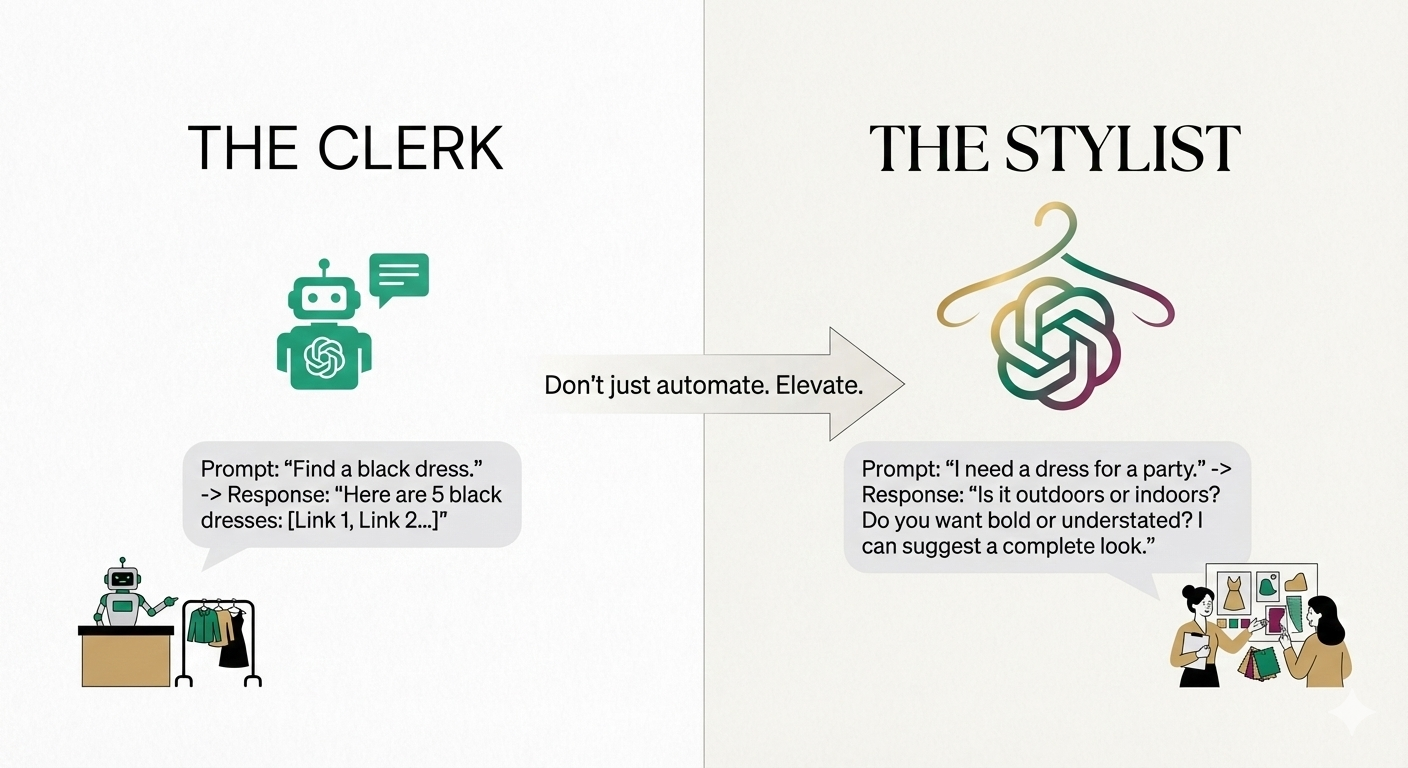
Scenario A: The staff member points silently to a rack of 50 dresses and walks away. Scenario B: The staff member pauses, looks at you, and asks: “Is the party indoors or outdoors? Are you looking to make a bold statement or something more understated? And what heels are you planning to wear?”
Scenario A is a Clerk. Scenario B is a Stylist.
For the last decade, e-commerce has been stuck in Scenario A. We built better search bars and faster filters, but we never built a relationship. Now, as we enter the age of “Agentic Storefronts,” Shopify brands face a critical choice. Do you deploy a generic LLM that acts like a vending machine? Or do you employ an expert agent that acts like a stylist?
The “One-Size-Fits-All” Trap
Generic Large Language Models (LLMs) are miracles of efficiency. They are designed to be “task-completion engines.” If a shopper asks for “black jeans,” the AI finds black jeans. It is transactional. It is efficient. And for fashion, it is a disaster.
Generic agents function as “Yes Men.” They answer the user’s explicit question but ignore the implicit need. They treat a fashion purchase like a grocery run. They facilitate the transaction, but they kill the discovery.
By relying on these generalist bots, brands risk becoming “Clerk-run” stores. You get the sale if the customer knows exactly what they want. But you lose the customer who needs guidance, inspiration, and confidence.
The Art of the Question: A Stylist’s Superpower
A good advisor does not just answer questions. They ask them. This is the core philosophy behind iWAND, the AI Stylist built specifically for Shopify fashion brands.
Consider the “Party Dress” scenario.
When a shopper asks a generic AI for a party dress, it dumps a list of links based on keywords. It is a “blind suggestion.”
When a shopper asks iWAND, the interaction transforms into a consultation.
- Context: “Is the event a garden party or a formal dinner?” (To ensure the fabric is breathable or appropriate).
- Body & Goals: “Do you want a cut that makes you look taller, or are you highlighting your waist today?”
- Wardrobe Integration: “Do you have a specific jacket or bag you want to pair this with?”
iWAND does not just fetch items. It filters out what doesn’t work and highlights what does. It guides the user to purchase items that truly suit them, rather than just letting them buy something that will end up in the return pile.
The “Consult” Agent: Closing the Confidence Gap
The biggest killer of conversion rates in fashion is not price. It is uncertainty. “I love this top, but will it be too tight on the arms? Is the fabric itchy?”
A search bar cannot hear that whisper of doubt. A generic bot might hallucinate an answer.
iWAND’s specialized Product Agent lives on the product page to handle exactly this moment. It acts as a dedicated consultant for that specific item. When a user hesitates, the agent steps in to address their specific concerns. It validates fabric details, discusses fit based on their stated body type, and offers honest advice.
This leads to a powerful formula for growth: Trust + Styling Advice = Higher Confidence = Bigger Baskets.
The “AOV Engine” vs. The Return Rate
When you replace a Clerk with a Stylist, the economics of your store change.
1. You Stop Being a Vending Machine Generic agents sell single items. Stylists sell looks. By understanding the user’s intent (e.g., “I need this for a date”), iWAND can recommend the complete outfit—the belt, the shoes, the earrings—that turns a $80 cart into a $250 experience. This is how you engineer serendipity back into the digital experience.
2. You Slash Return Rates A generic AI is happy if you buy the wrong size. It completed its task. iWAND is only successful if you keep the item. By consulting on fit and suitability before the checkout, iWAND ensures the product matches the person. High-confidence purchases rarely come back.
Conclusion: Don’t Just Automate, Elevate
The promise of AI isn’t just to do things faster. It is to do things better.
Your Shopify store does not need another tool to help people search. It needs a way to help people feel confident. Don’t settle for a generic “Clerk” that points to the aisle. Upgrade to iWAND and give every visitor the high-touch, expert Stylist experience they deserve.
Hire an Agentic Stylist Instead of a Generic Clerk
AI stylist for Shopify fashion stores that turns browsers into loyal buyers.
Free, no code, no setup stress