

Part of: AI Styling & Virtual Try-On. See the full guide, The AI Stylist for Shopify Fashion Stores. Updated October 1, 2026: rewritten with Virtual Try-On, current Shopify tools, general AI assistants, new pricing and a 30-day test plan.
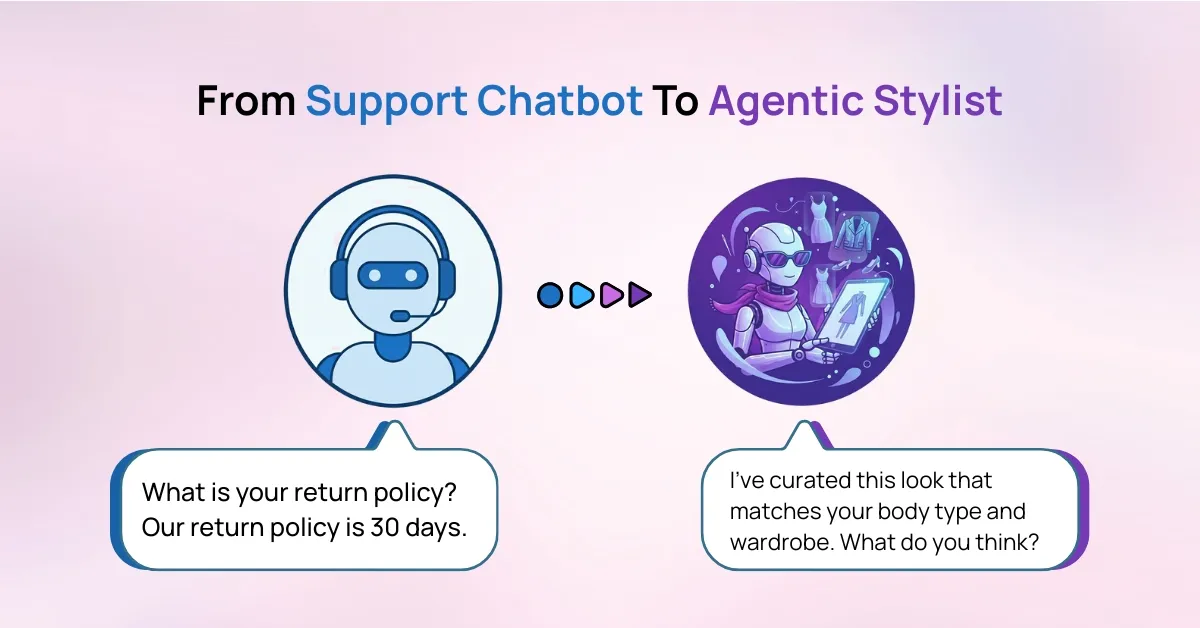
A support chatbot answers questions about orders, shipping and returns. An AI stylist helps shoppers decide what to buy, with outfit suggestions, size advice and virtual try-on. They do different jobs. In 2025, 19.3% of online sales were returned (NRF and Happy Returns), the cost a stylist targets. iWAND is an AI stylist for Shopify fashion stores.
At a glance
- A support chatbot handles after-purchase questions: order status, shipping, return policy. An AI stylist handles before-purchase decisions: what to wear, which size, whether it suits me.
- 19.3% of online sales were returned in 2025, against 15.8% across all retail (NRF and Happy Returns, 2025).
- 80% of 1,000 surveyed consumers aged 18 to 64 said they are more likely to do business with a company that personalizes. This is stated intent, not measured sales (Epsilon, 2018).
- iWAND is free to install and charges 5% of the sales it attributes to itself, with returns credited back.
What is a support chatbot on a Shopify fashion store?
A support chatbot answers shoppers’ questions in a chat window, mostly about things that are already fixed: order status, shipping times, return policy, sizing charts. It is a cost tool. It answers repeat questions instantly and hands harder ones to a person.
On Shopify this ranges from Shopify Inbox, Shopify’s free live chat app, whose AI features suggest instant answers and replies from a store’s catalog and FAQ content for a team member to review, to help desks such as Gorgias and Zendesk, which pull order, shipping and return data into the conversation (Shopify, 2026).
A support chatbot reacts to what the shopper types. It knows your policies and order data. It does not know the shopper’s size, colouring, occasion or what is already in their wardrobe, so “What should I wear to a summer wedding?” is outside its job.
What is an AI stylist for a Shopify fashion store?
An AI stylist is a conversational assistant that helps fashion shoppers decide what to buy: it recommends outfits, suggests a size, answers doubts about a product and shows the item on a model. iWAND is an AI stylist for Shopify fashion stores, built from eight agents that each do one styling job, plus Virtual Try-On.
The stylist sits on product pages, collection pages and search, where the decision happens, not in the help widget. It asks about the occasion, fit and what the shopper already owns, then recommends from your catalog.
| iWAND agent | Its job | Static tool it replaces |
|---|---|---|
| Complete Agent | Builds an outfit around the item in the cart | “Frequently bought together” and complementary-products blocks |
| Size Agent | Recommends a size from the shopper’s answers | Size chart, fit quiz |
| Style Agent | Learns taste and occasion, suggests looks | Style quiz, “You may also like” rails |
| Find Agent | Turns a request into a product search | Collection filters, keyword search |
| Snap Agent | Finds matching products from a shopper’s photo | Shoppable lookbook images |
| Pair Agent | Styles a new item with what the shopper already owns | Styling blog posts, lookbook pages |
| Consult Agent | Answers questions about fabric, fit and use | FAQ tab, live chat |
| Refine Agent | Finds variations such as “the same dress with sleeves” | Colour swatches, “similar items” |
| Virtual Try-On | Shows the item on a model matched to the shopper | Studio photos on one model size |
What is the difference between a support chatbot and an AI stylist?
The difference is the decision each one supports. A support chatbot resolves questions about an order or a policy. An AI stylist helps a shopper choose a product, a size and an outfit before the cart exists.
| Criterion | Support chatbot | AI stylist (iWAND) |
|---|---|---|
| Shopper’s question | “Where is my order?” | “What should I wear to a summer wedding?” |
| Stage of the journey | After purchase, or a policy check | Discovery and choice, before the cart |
| Where it sits on the store | Help widget, contact page | Product pages, collection pages, search |
| What it knows | Policies, order and shipping data, FAQ | Catalog, occasion, fit, what the shopper owns |
| Behaviour | Answers when asked | Asks about the occasion and suggests looks |
| Output | A fact or a ticket | Outfits, a size, a search result, a try-on view |
| Main metric | Tickets resolved, response time | Conversion, average order value, fit returns |
| Business role | Cost saver | Revenue and returns lever |
What can Shopify’s built-in tools do before I add an app?
Shopify’s built-in tools cover the support side well and the styling side only in a fixed, manual way. Use them first: they cost nothing extra, and they show you which gaps are worth paying to close.
| What you need | Built-in Shopify option | Where it stops |
|---|---|---|
| Answer shipping and return questions | Shopify Inbox, a free live chat app with AI-suggested replies and instant answers (Shopify, 2026) | Reactive. Gives the same answer to every shopper |
| Help shoppers find products | Shopify Search & Discovery: filters, search synonyms | Matches keywords and attributes, not an occasion such as “beach brunch” |
| “Complete the look” | Complementary products, set per product in Search & Discovery and shown by the theme’s complementary-products block | Set by hand, the same look for every shopper, and it needs upkeep when stock changes |
| Reduce fit returns | A size chart and fit notes on the product page | Shoppers must read the chart and translate it to their own body |
| Run the store faster | Shopify Sidekick, the AI assistant in the admin, included with every plan (Shopify, 2026) | Built for the merchant, not for talking to shoppers |
The common limit is that each tool gives every shopper the same answer. Small catalogs of basics can live with that. A fashion catalog with occasions, fits and fabrics usually cannot.
Does my fashion store need a support chatbot, an AI stylist, or both?
Most fashion stores end up with both, because the two answer different questions and do not overlap. If you can only start with one, pick by your biggest problem: support tickets point to a chatbot, and low conversion, one-item baskets or fit returns point to an AI stylist.
| If your problem is | Start with | Why |
|---|---|---|
| Most tickets are “where is my order” and return-policy questions | Support chatbot | These answers are fixed and repetitive |
| Shoppers leave product pages asking “will this suit me?” | AI stylist | The doubt comes before the cart |
| Orders contain one item | AI stylist (Complete Agent) | Outfit suggestions add a second piece |
| Size and fit are your top return reason | AI stylist (Size Agent, Virtual Try-On) | The fix has to happen before purchase |
| Small catalog of basics, few fit issues, low ticket volume | Shopify’s built-in tools | Extra tools may not earn their cost |
A chatbot alone is enough when your catalog is small, your products are basics with little fit or occasion choice, and most shopper messages are about orders. An AI stylist pays off when choice is the problem.
Does an AI stylist reduce returns and raise order value?
It can, but the published evidence is thinner than vendor claims suggest, so measure it on your own store. What is solid is the size of the problem: an estimated 19.3% of online sales were returned in 2025, against 15.8% across all retail (NRF and Happy Returns). Research on high-end fashion retail also identifies poor size and fit as the main reason for online fashion returns (ScienceDirect, 2025).
That is why an AI stylist works on the decision, not the ticket. It answers “will this fit me?” and “what goes with this?” before the order, where a support chatbot only sees the problem after the parcel is back.
| Claim | What the evidence supports | How to check it on your store |
|---|---|---|
| Fewer fit returns | Fit uncertainty is a leading return driver. Reported cuts from try-on and size tools mostly come from vendors and vary widely | Compare the return rate of orders from sessions with and without the stylist |
| Higher average order value | A second piece suggested as part of a look is the mechanism. Results depend on your catalog | Compare items per order and order value in a holdout test |
| Higher conversion | Shoppers say personalization makes them more likely to buy (Epsilon, 2018). That is stated intent, not measured sales | Compare conversion rate for sessions with and without the stylist |
Be careful with before-and-after comparisons of shoppers who used the assistant and shoppers who did not. The ones who chat are usually more motivated to begin with. A holdout test, described below, removes that bias.
What does virtual try-on add to an AI stylist?
Virtual try-on lets a shopper see how a garment looks before buying, which a support chatbot cannot do at all. In iWAND it shows the item on a model matched to the shopper, instead of only the single model in the studio photos, and it works alongside the stylist’s advice.
The two answer different doubts. The Size Agent answers “which size should I order?”. Virtual Try-On answers “how will this look on me?”. The Complete Agent and Pair Agent then answer “what goes with it?”. Together they cover the three doubts that hold fashion shoppers back: fit, appearance and styling.
The research is still mostly about what shoppers expect. A 2026 survey-based study found shoppers rate virtual try-on as likely to reduce wrong-size and wrong-fit choices (ScienceDirect, 2026). That measures perception, not actual returns, so test the effect on your own store with the method below.
How do ChatGPT, Copilot and Shopify Sidekick fit in?
General AI assistants are a third tool, and they work at a different point: they send shoppers to your store, while your own chatbot and AI stylist serve the shopper once they arrive. Shopify lists eligible products in Shopify Catalog by default. Through Agentic Storefronts they can appear in ChatGPT and Microsoft Copilot for merchants selling to US buyers, and in Google AI Mode and the Gemini app for select US shops (Shopify, June 2026).
The demand is growing fast. In Q1 2026, AI-driven traffic to Shopify stores grew 8 times year over year, and orders from AI-powered searches rose nearly 13 times (Shopify, June 2026). Orders from these channels reach your admin with the AI channel shown, and you stay the merchant of record.
Shopify Sidekick is a different thing again. It is the assistant in your admin that helps you run the store, not one that talks to shoppers (Shopify, 2026).
| Feature | Support chatbot | AI stylist on your store | General AI assistant (ChatGPT, Copilot) |
|---|---|---|---|
| Where it lives | Your store | Your store | The AI platform |
| What it draws on | Your policies and order data | Your catalog and the shopper’s answers | Product data from Shopify Catalog |
| Main job | Resolve questions | Help the shopper choose | Discover and recommend products |
| Who controls the experience | You | You | The AI platform |
They work together. Clean product data gets you found in the assistants, and a stylist on your store helps the shopper who arrives decide on a look, a size and a second piece. For more on this shift, see our guide to agentic commerce for Shopify fashion stores.
How much does an AI stylist cost compared with a support chatbot?
A support chatbot is usually priced per seat or per plan. iWAND is priced on results: it is free to install and charges 5% of the sales it attributes to itself, with returned orders credited back, capped at the monthly limit you approve. You pay nothing on sales the stylist did not influence.
| Tool | Pricing model |
|---|---|
| Shopify Inbox | Free for all Shopify stores (Shopify, 2026) |
| Zendesk | From $55 per agent per month, with usage-based billing on automated resolutions beyond the free allowance (Shopify, 2026) |
| iWAND | Free to install, then 5% of iWAND-attributed sales, billed through Shopify usage-based billing |
An illustrative month, with round numbers:
| Line | Amount |
|---|---|
| Sales attributed to iWAND | $10,000 |
| Of which later returned and credited back | $1,500 |
| Sales the fee is charged on | $8,500 |
| iWAND fee at 5% | $425 |
The figures are an example to show the arithmetic, not a result. Prices change, so check the iWAND listing on the Shopify App Store for the current terms.
How do I test an AI stylist against my support chatbot?
Run a 30-day holdout test: show the stylist to a share of sessions and hold out the rest, while the support chatbot stays on for everyone. Do not compare shoppers who chatted with shoppers who did not. The ones who chat were more motivated before they started.
- Record the last 30 days as a baseline: conversion rate, average order value, items per order and return rate.
- Split sessions at random, for example half with the stylist and half without, on the same pages and in the same period.
- Keep the support chatbot on for both groups, so the test isolates the stylist.
- Avoid launching a discount or a campaign during the test.
- If you cannot randomize, alternate weeks or match similar product categories, and say so when you report the result.
- Read returns 30 days after the test ends, because returned orders arrive late.
| Metric | How to calculate it | What a stylist should move |
|---|---|---|
| Conversion rate | Orders divided by sessions, per group | Higher where doubts about fit or style held shoppers back |
| Average order value | Revenue divided by orders | Higher if outfit suggestions add a second piece |
| Items per order | Units divided by orders | Higher with outfit suggestions |
| Return rate | Returned orders divided by orders, per group | Lower for fit and style mismatches |
| Support tickets about fit and style | Count of tickets per 1,000 sessions | Lower, since the stylist answers them earlier |
Where does iWAND fit?
iWAND is an AI stylist for Shopify fashion stores. It runs on product pages, collection pages and search, next to your support tool and not instead of it. It has eight agents (Complete, Size, Style, Find, Snap, Pair, Consult and Refine) plus Virtual Try-On, and it works on English and Arabic storefronts. It is a separate product from the Shopify app named AI Stylist.
Add an AI stylist next to your support chatbot
AI stylist for Shopify fashion stores with outfits, size advice and virtual try-on.
Free to install. You pay 5% only on sales iWAND attributes to itself.
Next: see how each agent works in The AI Stylist for Shopify Fashion Stores, how returns and order value fit the wider picture in The Agentic Fashion Funnel, or try the live demo store.
Frequently Asked Questions
What is the difference between an AI stylist and a support chatbot on Shopify?
Can an AI stylist work alongside Gorgias, Zendesk or Shopify Inbox?
Does virtual try-on reduce returns?
Is Shopify Sidekick a chatbot for my shoppers?
How much does iWAND cost?
Does iWAND work in Arabic?
Sources
- Consumers Expected to Return Nearly $850 Billion in Merchandise in 2025, NRF and Happy Returns, 2025
- Agentic Commerce on Shopify: How It Works, Shopify, June 18, 2026
- AI Chatbot for Shopify: Tools Compared, Shopify, July 22, 2026
- New Epsilon research indicates 80% of consumers are more likely to make a purchase when brands offer personalized experiences, Epsilon, January 9, 2018
- Fits like a glove? Knowledge and use of size finders and high-end fashion retail returns, ScienceDirect, 2025
- Virtual try-on for sustainable fashion retail, ScienceDirect, 2026