

At a glance
To reduce returns on a Shopify fashion store, help each shopper choose the right size before she orders: a size guide for each piece, a fit note, the model’s size with buyers’ fit reviews, then personal size and fit advice. Nearly 70% of online clothing returns come down to size and fit (Coresight Research, 2026).
Measures: units returned out of units ordered
Benchmark: US online apparel 23.4%
Guides: 4
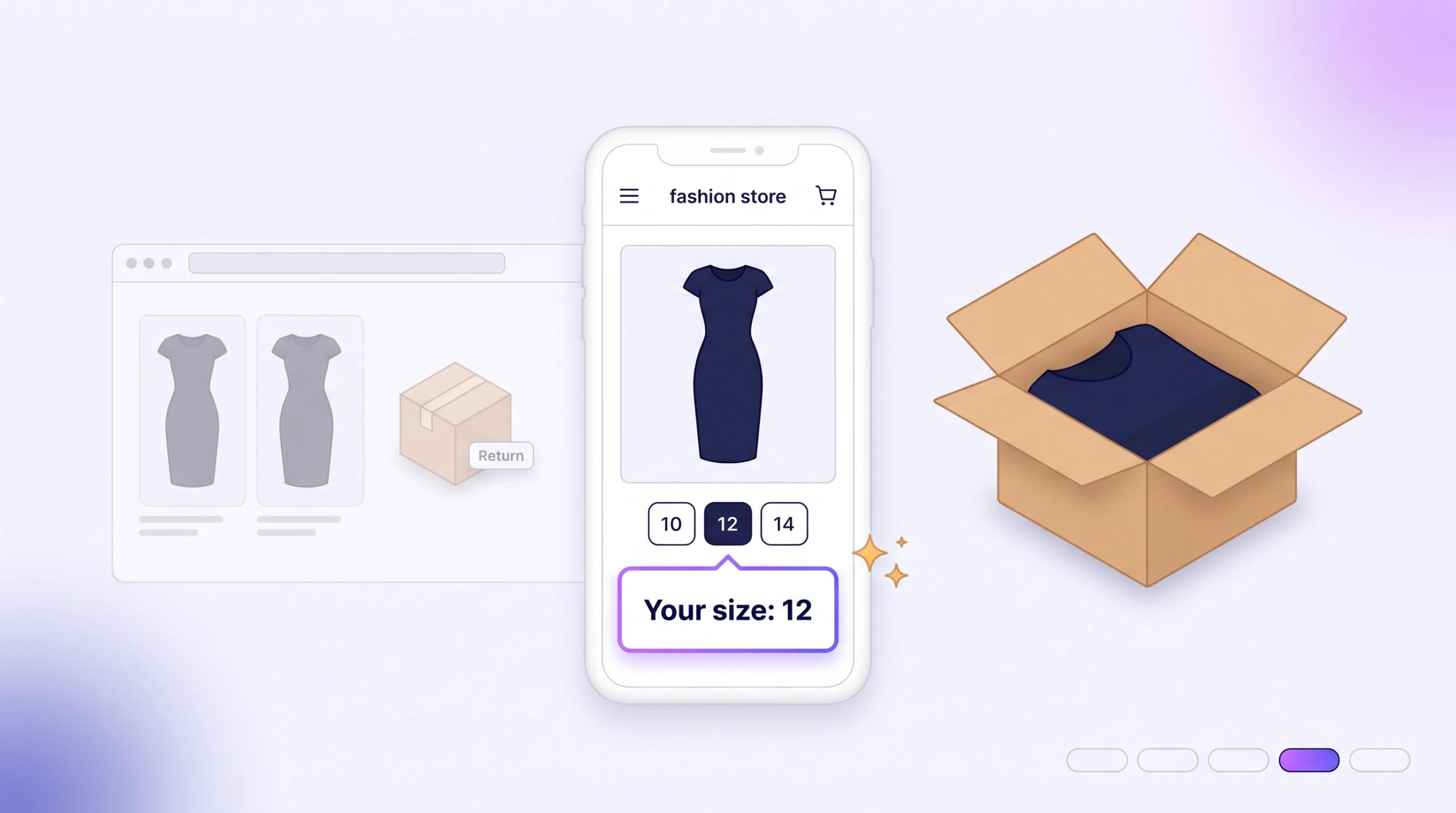
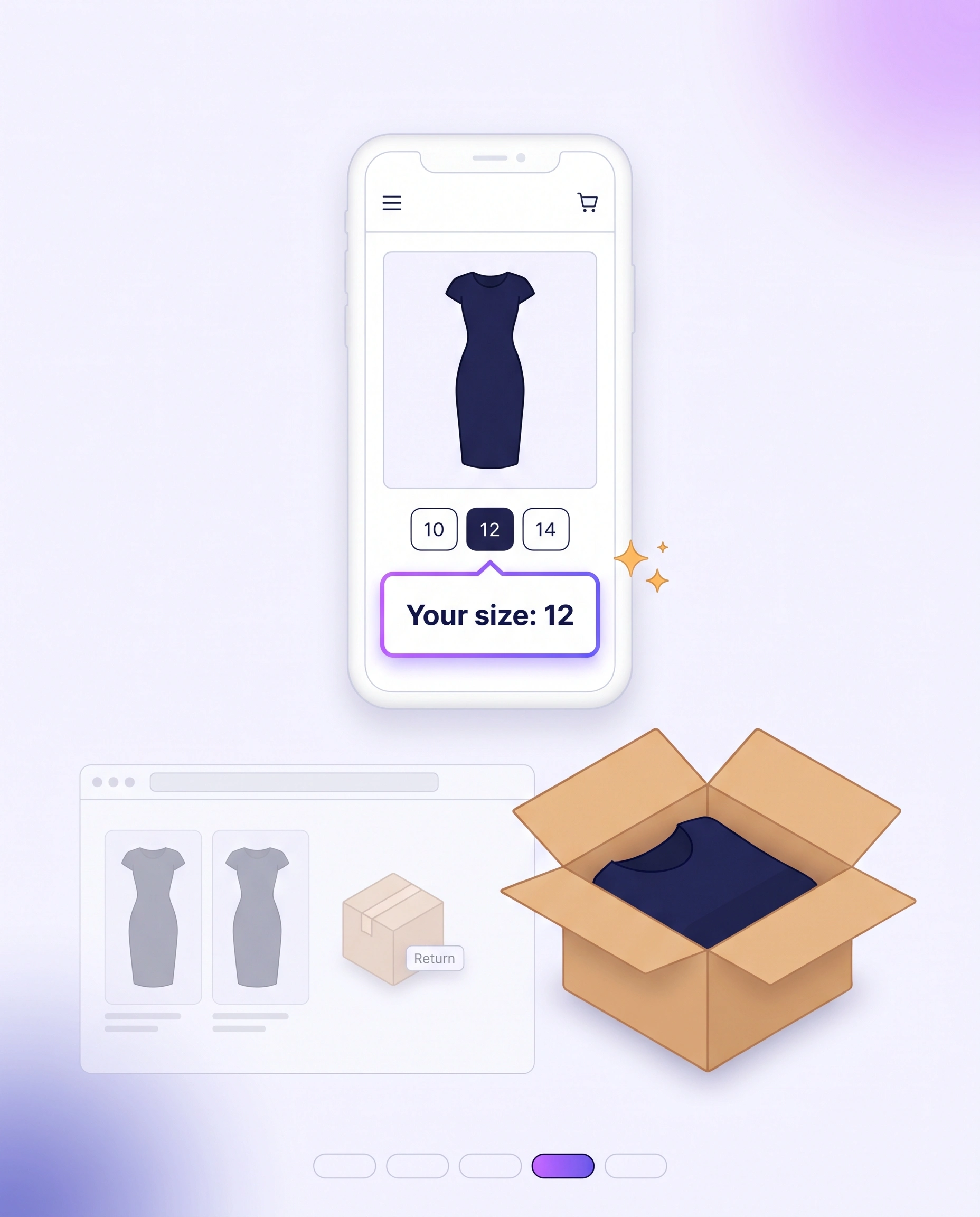
She has a wedding in three weeks and can’t tell from the size chart whether she is a 10 or a 12 in this dress. So she orders both. The 12 fits, and the 10 goes back in its bag with a printed label. You shipped two dresses to sell one, and the one that comes back has to be checked, steamed and restocked before it can sell again.
Return rate is the share of what you sell that comes back. In a fashion store most returns are decided before the order is placed: the shopper guessed her size, or bought two to be safe. It is the fifth of six stages in a Shopify fashion store, after AOV, where the order grows, and before Repeat Purchase, where she comes back to buy again.
This hub covers what to measure, what a normal number looks like, why clothes come back, and the four guides that help shoppers order the right size the first time, three of them with Shopify’s own tools.
Part of Grow Your Shopify Fashion Store with Styling: Salesperson to Stylist, our guide to the six stages of a Shopify fashion store.
In this guide
A salesperson
ships two sizes and refunds one.
A stylist
helps her choose the one size she keeps.
What is return rate for a Shopify fashion store?
Return rate is the share of what you sell that comes back: in Shopify, the units physically returned divided by the units ordered, read product by product.
One number tells you how much comes back. The reasons behind it tell you which fix to try first, and in fashion most of those reasons are about size.
| Number | What it tells you | Where to find it |
|---|---|---|
| Returned quantity rate | The share of ordered units that were physically returned | Shopify Analytics, sales reports |
| Return line item reason | Why each item came back, such as too big or too small | Shopify Analytics, sales reports |
| Sales reversals | The value taken off your sales by returns, cancellations and edits | Shopify Analytics, sales reports |
| Exchanges and refunds | How many returns you kept as another size or piece, and how many you refunded | Your orders in the Shopify admin, or your returns app |
A return costs more than the refund. You already paid to bring the shopper in and ship the order, you often pay the return postage, and the piece is off sale until it is checked and restocked.
What is a good return rate for a fashion store?
Nearly a quarter of clothing bought online in the US comes back, so a good target is a rate below your own starting point, for your own mix of products.
23.4%
is the estimated return rate for US online apparel in 2025, and nearly 70% of shoppers who returned clothing bought online gave size and fit as the reason.
Source: Coresight Research with Alvanon, 2026, Shifting the Size and Fit Paradigm
Two more benchmarks give an all-category view and a UK fashion view.
| Benchmark | Figure | Source | Year |
|---|---|---|---|
| US online apparel, return rate in 2025 | 23.4% | Coresight Research | 2026 |
| All US online sales, share returned in 2025 | 19.3% | NRF and Happy Returns | 2025 |
| UK online fashion items, share returned each year | About 30%, in a survey of 1,002 UK shoppers | fulfilmentcrowd, reported by Just Style | 2025 |
No independent benchmark covers fashion stores on Shopify alone yet. Your rate also depends on what you sell: fitted pieces, where size is hard to judge, give shoppers more reasons to send them back than scarves or jewellery do.
Read your return rate late
A return can arrive weeks after the order, so last week’s orders don’t show their returns yet. Measure orders from a period whose return window has closed, and count units as well as value, so one returned coat doesn’t hide ten returned tops.
Why do shoppers return clothes they bought online?
Most clothes come back because the shopper had to guess her size or how the piece would look on her, and the guess was wrong.
She had to guess her size
Sizes differ from brand to brand, and many size guides don’t help. In Baymard Institute’s testing, only 17% of desktop apparel sites and 13% of mobile sites gave shoppers enough size information (Baymard Institute, 2022). A generic chart for the whole store, with no note on how this piece fits, leaves her guessing.
She ordered two sizes to be safe
Bracketing means ordering several sizes or colours of one piece and returning the rest. In a 2025 survey of 1,002 UK shoppers, 62% said they had bracketed, and ordering more than one size was the most common form (fulfilmentcrowd, 2025). Bracketing is a shopper’s own fix for a size she can’t judge. Give her a size she trusts, and she has less reason to order two.
It fit the model, not her
One photo on one model in one size shows how the piece falls on that body. Without the model’s height and size, or reviews from buyers with a body like hers, she can’t translate it to her own.
The colour or style didn’t suit her
Some pieces fit and still come back: the colour looked different on her, or the style wasn’t right for her occasion. These are doubts the product page has to answer before the order, and the Conversion Rate hub covers them.
She had nothing to wear it with
A statement piece with no partner in her wardrobe can hang with its tags on until the return window is nearly closed, then go back. Showing what to wear it with, as the AOV hub explains, gives it a place in an outfit.
Some reasons are not about styling
Damaged or wrong items, late deliveries and returns abuse need operational fixes, not styling. NRF and Happy Returns found that 9% of all returns are fraudulent (2025). A clear returns policy, shown on the product page, helps with these too.
Which pattern shows up in your return reasons?
Each pattern points to a different first fix.
| What you see | What it means | Start with |
|---|---|---|
| Too big and too small lead your return reasons | Shoppers can’t judge size from your chart | A size guide for each piece |
| One product comes back far more often than others of its type | That piece fits differently from your usual sizing | Fit notes |
| Orders often hold the same piece in two sizes | Shoppers are bracketing | Model size and fit reviews or personal size and fit advice |
| Reasons such as not as expected or didn’t suit me | She couldn’t picture the piece on her own body | Model size and fit reviews |
| Colour or style reasons, not size | The doubt was about suiting her, not fitting her | The Conversion Rate hub |
| Damaged, wrong item or late | An operational problem | Your packing, picking and delivery partner |
Check your Return factors with the free Styling Score
Bots walk your store like a shopper. You get a score out of 100, a tier and a report that shows which Return factors are done.
Which fixes reduce returns?
Four guides cover this stage: give each piece its own size guide, add a fit note, show the model’s size with buyers’ fit reviews, then add personal size and fit advice for every shopper.
Each guide is one Return factor in the free Styling Score. DIY styling guides use Shopify’s own tools; the AI styling guide adds a personal AI stylist.
- RET-01How to Add a Size Guide for Each Piece on Shopify to Cut ReturnsGive each garment type its own size chart with real measurements, and show it on every product.DIY styling
- RET-02How to Write Fit Notes on Shopify Product Pages to Cut Size ReturnsAdd one line beside the size selector: runs small, true to size or runs large.DIY styling
- RET-03How to Show Model Size and Fit Reviews on Shopify to Cut ReturnsShow the model’s height and size, plus fit feedback from real buyers.DIY styling
- RET-04How to Give Personal Size and Fit Advice on Shopify to Cut ReturnsAdd a personal AI stylist that asks how she likes clothes to fit and names her size in that piece.AI styling
Which fix should I start with?
Start with a size guide and fit notes on your most-returned pieces: they cost nothing, and every other fix builds on the facts they hold.
| Fix | Best when your shopper | Effort | Main tools |
|---|---|---|---|
| Size guide for each piece | Is between sizes or new to your brand | Medium: one chart per garment type, assigned to every product | Metafields, Sidekick or Claude |
| Fit notes | Wants to know if a piece runs small or large | Low: one line per product, approved in a table | Sidekick or Claude, metafields |
| Model size and fit reviews | Has a body unlike your model’s | Medium: model details for each product, one fit question in reviews | Metafields, a reviews app |
| Personal size and fit advice | Needs her size in this piece, for her body and how she likes clothes to fit | Low: install, then test privately on best sellers | A personal AI stylist app |
Is a returns app enough to cut returns?
No: a returns app makes each return faster and can turn a refund into an exchange, but it acts after the order, when the wrong size has already shipped.
| Approach | When it acts | Good at | What it can’t do |
|---|---|---|---|
| Returns management app | After she asks to return | Labels, exchanges, refunds and store credit | Stop the wrong size from shipping |
| One size chart for the whole store | Before the order | Basic measurements at no cost | Say how this piece fits |
| Size guide for each piece, fit notes and model sizes | Before the order | Facts shoppers trust, product by product | Answer for her body and how she likes clothes to fit |
| Size recommendation widget | Before the order | A size from her height, weight or past orders | Advise on colour, style or what to wear it with |
| Personal AI stylist | Before the order | Her size, fit and style, in conversation | Process the return once she asks |
Use both. Prevention cuts how many returns happen; a returns app makes the rest cheaper to handle, and an exchange keeps the sale.
What does a personal AI stylist add before checkout?
iWAND is our product.
iWAND is an AI stylist for independent fashion brands on Shopify. Its styling agents give every shopper personal outfit, fit and styling advice from the brand’s own catalogue. It is free to install, and brands pay 5% only on sales iWAND makes.
Before checkout, five agents help a shopper order the piece she keeps:
- Size asks her height, usual size and how she likes clothes to fit, then names her size in that piece.
- Consult answers whether the colour works with her colouring and whether the piece suits her occasion, and suggests a better piece from your catalogue when the honest answer is no.
- Refine swaps the colourway or one detail, such as a longer hem, and keeps the rest of the look.
- Try-On shows the outfit on a model matched to what she described, so she can judge the look before she buys.
- Pair lets her upload a photo of a piece she already owns, then builds a complete outfit around it, so the new piece has something to be worn with.
A return is a styling decision that happened in the customer’s bedroom instead of on your product page.
Bagher Ahmadi, co-founder and CEO of iWAND, 2026
Judge it on your own catalogue, not on a demo: size advice is only as good as the measurements and fit facts in your product data, which is why the DIY guides above help it too.
How do I measure return rate in Shopify?
Record your returned quantity rate and return reasons for orders whose return window has closed, fix your most-returned products first, then compare a later period the same way.
- Set your baselineIn Shopify, open
Analytics › Reportsand find returned quantity rate and return line item reason in the sales reports. Pick a month of orders older than your return window, so all its returns have arrived. - Rank your productsBreak returned quantity rate down by product. Fix the pieces that sell often and come back often first.
- Read the reasonsSince January 2026, Shopify suggests return reasons that fit the product, such as too big and too small for apparel. Count how many returns on each top product are about size.
- Change one thingAdd one fix to your ten most-returned products first, so the change is big enough to show in the numbers.
- Compare once the window closesCompare orders placed after the fix with your baseline, once their return window has closed. Count exchanges separately: a return turned into an exchange still keeps the sale.
Small changes in return rate move real money. A store that ships 1,000 pieces a month at $60 each and gets 25% back returns $15,000 of goods a month; at 20% it returns $12,000, so $3,000 a month stays sold, before return postage and handling. This is arithmetic, not a measured result.
Where do returns fit in the six stages?
Return is the fifth of six stages: it decides whether the order that AOV grew stays kept, and a shopper whose order fit is the one who comes back for Repeat Purchase.
- AI TrafficVisits from AI assistants · 5 guides
- EngagementShoppers exploring looks · 6 guides
- Conversion RateShare of visits that buy · 5 guides
- AOVAverage order value · 3 guides
- ReturnReturn rate · 4 guides
- Repeat PurchaseRepeat purchases · guides coming
What else do founders ask about returns?
Founders most often ask these six questions.
What is a normal return rate for an online clothing store?
Coresight Research estimates that US online apparel had a 23.4% return rate in 2025, against 19.3% for all US online sales (NRF and Happy Returns, 2025). A 2025 survey of UK shoppers put the share of fashion items returned at about 30%. Your product mix matters, so track your own rate against your starting point.
Why do people return clothes they bought online?
Mostly size and fit: nearly 70% of shoppers who returned clothing bought online gave it as the reason (Coresight Research, 2026). Other common reasons are a colour or style that didn’t suit them, a piece they had nothing to wear with, and damaged, wrong or late orders.
What is bracketing, and how do I reduce it?
Bracketing is ordering several sizes or colours of one piece and returning the rest. In a 2025 survey of 1,002 UK shoppers, 62% said they had done it (fulfilmentcrowd). It falls when one size feels safe to order: a size guide for each piece, a fit note, the model’s size with fit reviews, or personal size advice.
Does virtual try-on reduce returns?
It can help when the doubt is how a piece or outfit looks on her. No independent benchmark yet shows how much it cuts returns for fashion stores, so measure it on your own store: compare returned quantity rate on the same products before and after, once the return window has closed.
Do I still need a returns app if I prevent returns?
Yes, most stores need both. A returns app handles labels, refunds and exchanges after a shopper asks to return, and can keep the sale as an exchange. Prevention acts before the order, so fewer returns reach the app at all.
How do I find out why my return rate is high?
In Shopify Analytics, break returned quantity rate down by product and read the return reasons for your most-returned pieces. Too big and too small point to size guides and fit notes; reasons about how it looked point to model sizes and fit reviews; damaged or wrong items point to packing and picking.
Sources
- Coresight Research with Alvanon. Shifting the Size and Fit Paradigm: A Three-Pillar Framework To Reduce Returns and Future-Proof for Agentic Commerce. May 19, 2026. coresight.com
- FashionUnited. Sizing intelligence is strategic priority as brands prepare for AI-driven commerce. June 30, 2026. fashionunited.com
- NRF and Happy Returns. 2025 Retail Returns Landscape. October 15, 2025. nrf.com
- Just Style. UK online fashion returns hit 30% with poor fit as top reason (fulfilmentcrowd survey of 1,002 UK shoppers). January 27, 2025. just-style.com
- Baymard Institute. Apparel size information research. July 6, 2022. baymard.com
- Shopify Help Center. Sales reports: returned quantity rate, return line item reason and sales reversals. Checked Oct 28, 2026. help.shopify.com
- Shopify Changelog. Enhanced return reasons. January 16, 2026. changelog.shopify.com
Free Styling Score
See which Return factors your store is missing
The free Styling Score walks your store like a shopper and shows which styling factors are Done, Halfway or Not yet, stage by stage.
Next read
See all six stages in one place
Returns are one of six stages. The six-stage guide shows where a Shopify fashion store loses the most, and which stage to fix first.