

At a glance
Give personal size and fit advice before checkout by adding a personal AI stylist to your Shopify product pages. It asks each shopper her height, usual size and how she likes clothes to fit, then names her size in that one piece. Test it privately first. Shoppers order one right size, so fewer orders come back.
Time: about 1 hour to install and test
Cost: free to install
Developer: not needed
A shopper is on your product page with her thumb over the size selector. She is 5’3″, usually a 10, and wider at the hip than the waist. The size chart gives her numbers, but it cannot tell her which size of this dress will sit right on her.
Personal size and fit advice is an answer to “which size, and will it fit me?” given for one shopper and one piece, based on her body, her usual sizes and how she likes clothes to fit. It is the fourth Return factor in the Styling Score, and it cuts the return rate: every order that fits the first time is a sale that stays sold.
This guide is about the moment a shopper chooses her size. To answer whether a piece suits her style, read how to answer “will this suit me?” on Shopify product pages. To build a whole outfit around one product for one shopper, read how to build a personal outfit around every product.
Part of Grow Your Shopify Fashion Store with Styling: Salesperson to Stylist, our guide to turning a Shopify fashion store from a salesperson into a stylist.
A salesperson
points to the size chart and leaves the shopper to guess between two sizes.
A stylist
asks how she likes clothes to fit, then names her size in this piece and says why.
Why does personal size and fit advice cut returns?
Personal size and fit advice cuts returns because size and fit is the top reason clothes bought online come back, and a personal answer replaces the shopper’s guess.
A size chart gives measurements, not judgement. A shopper between sizes still has to decide alone, so she often orders two sizes and plans to send one back. That habit is called bracketing, and every bracketed order is a return before the parcel even ships.
Personal advice works on the cause. When the store asks about her body and her fit preference and then names one size with a reason, she has less reason to bracket. Fewer returns means fewer refunds, less return shipping and less stock stuck in transit.
53%
More than half of the US apparel brands and retailers surveyed named size and fit as the top reason online clothing orders are returned, far ahead of colour and damage.
Source: Coresight Research, 2023, The True Cost of Apparel Returns
19.3%
US retailers expected nearly one in five online sales to be returned in 2025, a higher share than across all their sales combined.
Source: NRF and Happy Returns, 2025, 2025 Retail Returns Landscape
Fit help can win sales as well as keep them. In the same Coresight survey, 80% of the retailers that already used a size-recommendation tool said it raised their conversion rate (Coresight Research, 2023).
What does good personal size and fit advice look like?
Good personal size and fit advice is available on every product page, asks the shopper about herself, and answers for that one piece with a size and a reason.
- On every product page. The shopper can ask without leaving the page, at any hour.
- About her, not an average. It asks for her height, her usual size and how she likes a fit, such as fitted or relaxed.
- About this piece. The answer names one size in this cut and explains it, for example “runs slim through the hip, so take the 12”.
- Honest. When no size of this piece will fit the way she wants, it says so and suggests another piece.
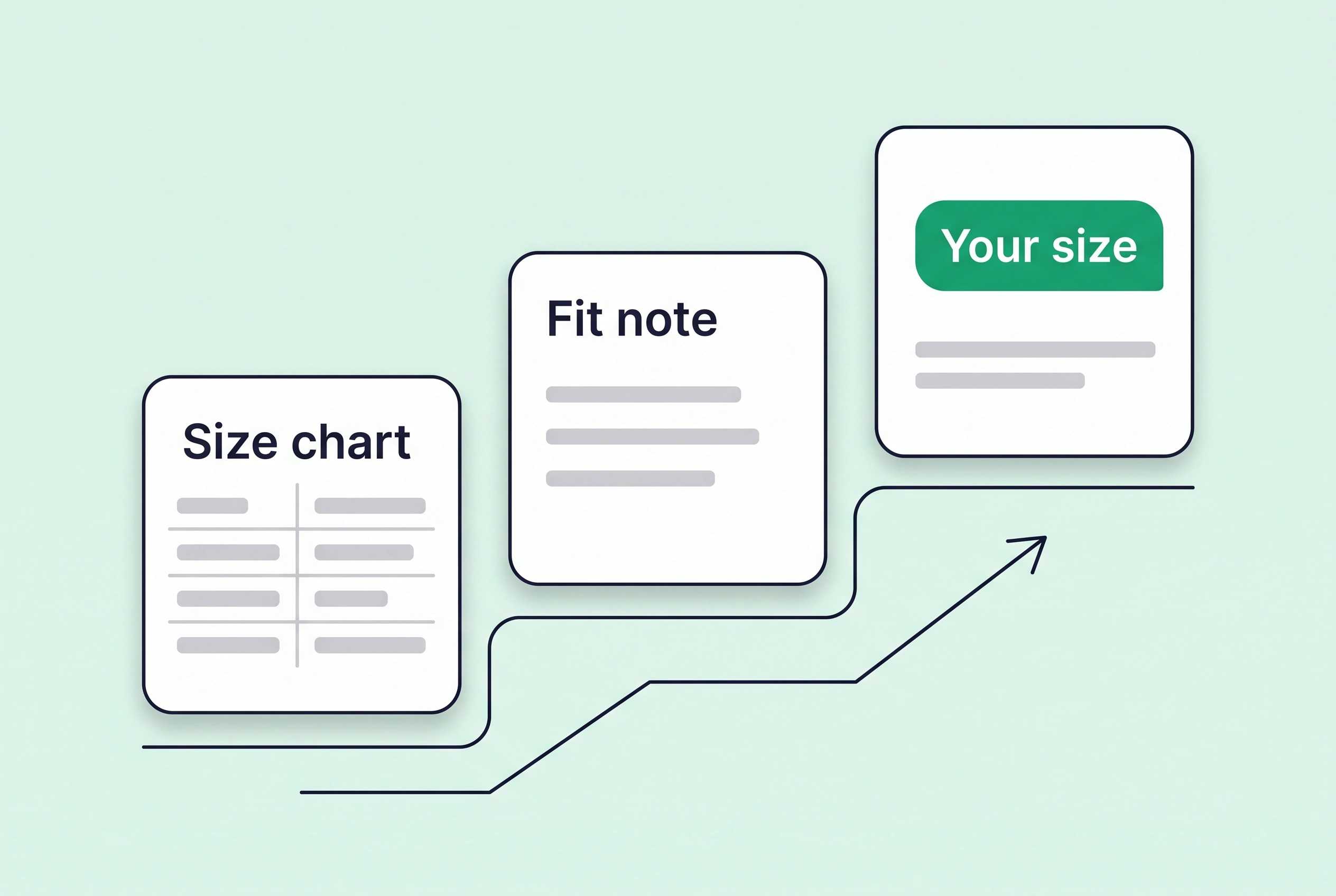
A size chart, fit notes and model sizes are the facts underneath this advice. They help every shopper the same way; personal advice turns those facts into one answer for one shopper.
Not worth it if
Stores that sell mostly one-size or forgiving pieces, such as scarves, bags, jewellery or oversized knits, rarely see size returns. A clear size chart is enough for them.
How do I check my store in two minutes?
Open your best-selling fitted piece on your phone and try to get a size answer for a shopper who is between sizes.
- Pick a fitted best sellerA dress, trousers or jeans: the pieces most often bracketed.
- Play a real shopperSay to yourself: “I’m 5’4″, usually a 10, curvy at the hip, and I like room at the waist. Which size?”
- Look for an answer, not just dataA size chart, a fit note and the model’s size help. Count them, then ask whether anything on the page answers for you.
- Try it at 10 p.m.If the only personal answer is a chat staffed in office hours, most shoppers will not get one.
If the page gives facts but never asks about the shopper, the store helps everyone the same way. That is a good base, not yet personal advice.
Check this on your store with the free Styling Score
Bots walk your store like a shopper. You get a score out of 100, a tier and a report.
What would a stylist do when a shopper asks “does it suit me”?
A stylist asks four or five quick questions about the shopper’s body and taste, then names one size in this piece and explains the choice.
In a boutique, the stylist does not hand over two sizes and walk away. She asks:
- What size do you usually wear, and in which brands?
- How tall are you?
- Where do clothes usually feel tight or loose on you?
- Do you like this kind of piece fitted or relaxed?
- What are you wearing it for?
Then she answers for this shopper and this cut: “Take the 12. This dress runs slim through the hip, and at your height it falls just below the knee. If you want it closer at the waist, add a belt.” Sometimes the honest answer is a different piece: “This cut will pull across your shoulders in any size. The wrap dress will do what you want.”
Online, most stores stop at the size chart. The questions never get asked, so the shopper answers them herself by ordering two sizes.
What are my options, from by hand to AI?
You can give personal fit advice by hand, with a size app, or with a personal AI stylist, and they differ most in how personal the answer is and when it is available.
- By hand. A team member answers fit questions on live chat, by email or in booked video fittings. The answers are personal and often excellent, but only during staffed hours and only as many as your team can handle.
- With apps. Size-recommendation apps ask for height, weight or body shape and suggest a size from your chart. Fit quizzes and fit-review apps add more data. They work at any hour, but they answer with a size number, not a conversation about how the piece will look and feel.
- With a personal AI stylist. An AI stylist on your product pages talks with the shopper the way your best stylist would. It asks about her body, her usual sizes and the occasion, answers for this one piece from your own catalogue, and can suggest a better piece when this one will not work.
| Option | Personal to the shopper? | Built on your catalogue? | Available at 2 a.m.? | Cost | Set-up time |
|---|---|---|---|---|---|
| Team member on chat or video | Yes | Yes, through your team | No | Staff time | A day to train the team |
| Size-recommendation app | Partly: a size from body data | Yes, from your size charts | Yes | Monthly fee on most listings | A few hours, plus size-chart work |
| Personal AI stylist | Yes, in conversation | Yes | Yes | Varies; iWAND is free to install and charges 5% only on the sales it makes | About 1 hour |
What does personal size and fit advice look like with iWAND?
iWAND is our product.
iWAND is an AI stylist for independent fashion brands on Shopify. It gives every shopper a personal stylist, with outfits, styling advice, try-on and size help built on the brand’s own catalogue.
On a product page, iWAND’s Consult agent answers a shopper’s doubts about that one piece, including size. She tells it her height, her usual size and how she likes clothes to fit, and it answers with a size and a reason, or says honestly that another piece would suit her better. Try-On then shows the piece on a model matched to her, so she can see the fit before she buys. Free to install; iWAND charges 5% only on the sales it makes.
Here is the same flow in words. A shopper opens a fitted midi dress on the demo store and asks: “I’m 5’4″, usually a 10, curvy at the hip, and I like room at the waist. Which size?” iWAND asks one follow-up question, then answers with one size and the reason in plain words. When she asks to see it, Try-On shows the dress on a model with a similar shape.
How do I set up personal size and fit advice on Shopify?
Setting up a personal AI stylist for size and fit advice takes about an hour in the Shopify admin, with no code: install, sync the catalogue, place it on product pages and test it as a shopper.
Give any stylist good size facts
A size chart for each piece, a fit note and the model’s size make every answer more accurate, whether a person or an AI gives it. If they are missing, start with a size guide for each piece on Shopify.
- Install the appInstall iWAND from the Shopify App Store and approve the access it asks for.
- Let it sync your catalogueiWAND reads your products, variants and images by itself. There is no CSV to upload.
- Place it on your product pagesFollow the app’s set-up screen. Apps appear either as an app embed (
Online Store › Themes › Edit theme › App embeds) or as an app block (Add block › Appson the product template). - Test it as five different shoppersIn preview mode, ask about your five best sellers as a petite shopper, a tall one, one between sizes, one curvy at the hip and one who likes a relaxed fit.
- Check every answer against what you knowIf an answer is wrong, fix the size facts on that product page, then ask again before you go live.
Preview on a duplicate theme first
Duplicate your live theme (Online Store › Themes › … › Duplicate) and place the app there first. Publish only after the product page looks right on a phone. If you later switch themes, turn the app on again in the new theme.
See iWAND style your own catalogue: free private preview
Ask it size questions about your own best sellers in a private preview, before any shopper sees it.
How do I measure whether personal fit advice cuts returns?
Compare the return rate of orders from shoppers who asked the stylist with orders from shoppers who did not, over a full buying cycle plus your return window.
- Return rate by group. Orders from shoppers who used the stylist against orders from shoppers who did not. Wait for the return window to close before you judge.
- Size reasons. Shopify now suggests “Too big” and “Too small” as return reasons for apparel (Shopify Changelog, 2026). Watch the share of returns with those two reasons.
- Bracketed orders. Count orders that hold the same piece in two sizes. That number should fall.
- Sales as well. Track conversion rate for the same two groups, because fit help can also turn a hesitant shopper into a buyer.
How much time and money does personal fit advice take?
Personal fit advice costs staff time by hand, a monthly fee with most size apps, and about an hour of set-up with a personal AI stylist.
| Way | Time | Cost | Skills needed |
|---|---|---|---|
| By hand (chat, email, video fittings) | Ongoing, for every question | Staff time | A team member who knows every cut |
| With a size-recommendation app | A few hours to set up, plus size charts | Monthly fee on most listings | No developer |
| With a personal AI stylist | About 1 hour to install and test | iWAND: free to install, 5% only on the sales it makes | No developer |
How do I know personal size and fit advice is working?
Personal size and fit advice is working when any shopper, on any product page and at any hour, can ask which size suits her and get an answer for her.
Run the Styling Score again once the stylist is live, and this factor moves toward Done. Then watch the return rate and the share of “Too big” and “Too small” returns in Shopify for at least 60 days: a 30-day return window needs a full month of orders behind it.
Where does this fit in Return?
Return has four factors: three give every shopper the same size facts, and this one turns them into a personal answer.
- RET-01Size guide for this pieceA size chart for each garment type, not one for the whole store.
- RET-02Fit notesOne line on how the piece fits: small, true or large.
- RET-03Fit from real peopleModel height and size worn, plus buyers’ fit reports.
- RET-04Does it suit me?Size and fit advice for one shopper, before she buys.You are here
Part of Grow Your Shopify Fashion Store with Styling: Salesperson to Stylist. Personal styling also helps at three other moments: outfit recommendations while she explores, styling advice on one piece and a personal outfit around a product.
What else do founders ask about personal size and fit advice?
Founders most often ask these six questions.
Is a size chart enough to cut size returns on Shopify?
A size chart is the base, but it is rarely enough on its own. It gives every shopper the same measurements and leaves her to judge her size between two options. Fit notes and model sizes help more. Personal advice goes furthest, because it asks about her body and fit preference and names one size in that piece.
What is bracketing, and how does personal fit advice reduce it?
Bracketing is ordering the same piece in two or more sizes and sending back the ones that do not fit. Shoppers bracket when they are unsure of their size. Personal fit advice reduces that doubt: when the store names one size for her and explains why, she has less reason to order a backup size.
Do I need a developer to add personal size advice to Shopify?
No. A personal AI stylist installs from the Shopify App Store and goes on your product pages as an app embed or app block in the theme editor. Set-up takes about an hour with no code. Test it on a duplicate theme first, and check its answers on your five best sellers before going live.
Can AI give each shopper personal size and fit advice?
Yes. A personal AI stylist asks each shopper about her height, usual size and fit preference, then answers for one piece from the brand’s own catalogue, at any hour. iWAND is one such stylist for Shopify fashion brands. It is free to install and charges 5% only on the sales it makes.
How long before I see fewer returns?
Allow at least 60 days. Returns arrive weeks after the order, so a store with a 30-day return window needs a full month of orders plus that window before the numbers settle. Compare shoppers who used the stylist with those who did not, and watch the Too big and Too small return reasons.
What if my sizing is not consistent across products?
Fix the facts first, because any stylist, human or AI, can only be as accurate as your size information. Give each garment type its own size chart, add a fit note that says when a piece runs small or large, and show the model’s height and size. Then personal advice has true facts to work from.
Sources
- Coresight Research. The True Cost of Apparel Returns: Alarming Return Rates Require Loss-Minimization Solutions. Apr 4, 2023. coresight.com
- National Retail Federation and Happy Returns. Consumers Expected to Return Nearly $850 Billion in Merchandise in 2025. Oct 15, 2025. nrf.com
- Shopify Changelog. Better insights with category-specific return reasons. Jan 16, 2026. changelog.shopify.com
- Shopify Help Center. Extend your theme with apps. Checked Oct 20, 2026. help.shopify.com
- Shopify App Store. iWAND: AI Stylist & Try-On. Checked Oct 20, 2026. apps.shopify.com
Free private preview
See iWAND style your own catalogue
Ask iWAND the size questions your shoppers ask, on your own products, in a free private preview.
Return
Check every Return factor on your store
The free Styling Score walks all four Return factors and shows which are Done, Halfway or Not yet.