

At a glance
Add a personal outfit built around the exact product a shopper is viewing, powered by an AI stylist that reads that one product and your whole catalogue. A static “Complete the look” block shows the same set to everyone; a personal AI stylist builds a different outfit for every shopper and every product.
Time: about 1 hour to install and configure
Cost: free to install
Developer: not needed
A shopper lands on one product — a floral midi dress — and has to imagine the rest of the outfit herself: which shoes, which jacket, which bag. Most Shopify product pages leave her to work that out alone.
A personalized outfit is a full look built around the one product a shopper is looking at right now, chosen for that product and that shopper rather than shown the same way to everyone. It is the AOV factor that turns a single product view into a full-look purchase, growing average order value without any extra traffic.
This guide is about the outfit built for one shopper around one product. For the same-outfit-for-everyone version of this idea, read How to Add Complete the Look on Shopify to Raise Average Order Value (AOV-01). For the version built so shoppers can buy a whole styled look, read Shop the Look on Shopify (AOV-02).
Part of Grow Your Shopify Fashion Store with Styling: Salesperson to Stylist, our guide to turning a Shopify fashion store from a salesperson into a stylist.
A salesperson
shows the same “Complete the look” bundle to every visitor.
A stylist
builds a different outfit for every shopper, around the exact piece in their hands.
Why does a personalized outfit grow average order value?
A personalized outfit built around one product grows average order value because it turns a single-item visit into a full-look purchase, chosen for that shopper rather than shown to everyone the same way.
A static “complete the look” bundle is the same handful of items whether the shopper is petite or tall, dressing for a wedding or for work, and it never changes as the catalogue does. When the outfit responds to the actual product and to what the shopper says about herself, more of the recommended pieces are ones she will actually buy, so order size grows without any extra traffic.
10–15%
Effective personalization most often lifts a company’s revenue by 10 to 15 percent, with the best performers reaching up to 25 percent.
Source: McKinsey & Company, 2021, The value of getting personalization right—or wrong—is multiplying
10%
An independent Forrester Consulting study of AI-powered outfit and bundling technology found it raised average order value by 10 percent and ecommerce conversion rates by 15 percent for a composite retailer.
Source: Forrester Consulting, 2023 (via Business Wire), Total Economic Impact study
What does good look like for a personalized outfit?
A personalized outfit is closer to Done the more it rebuilds itself for every shopper and every product; it stays closer to Halfway when the same “complete the look” set shows for everyone, because the full fix needs an AI stylist working across your whole catalogue, one shopper at a time.
Not worth it if
Your catalogue is one narrow category — socks only, say — with nothing to build a look around. A single-category store gets more from styling advice on fit and fabric than from an outfit builder.
How do I check my store in two minutes?
Open one of your own product pages on your phone, the way a shopper would, and look for anything that completes the look.
- Open two product pages in different categories — a dress and a jacket, say — and see whether the “complete the look” suggestions actually change.
- Check whether the same handful of items appears no matter which product you’re viewing.
- Ask whether anything on the page knows what you came in for — the occasion, your size, your style — or whether it’s the same for every visitor.
What would a stylist do with this one product?
A stylist builds the rest of the outfit around the one piece in a shopper’s hand, and around her, not around a fixed list.
In a boutique, a stylist glances at the dress in your hand and asks what it’s for — a wedding, work, a first date. She pulls a jacket, a pair of heels, and a clutch that match that dress and that occasion, then asks about your height or whether you run warm, and adjusts what she’s holding. None of that happens because a sign on the wall says “goes well with.” It happens because she’s looking at the one piece in your hand and asking about you.
Online, that moment usually doesn’t happen at all. The product page shows the same “frequently bought together” row to a shopper buying for a wedding and one hunting for a work blazer.
What are my options, from by hand to AI?
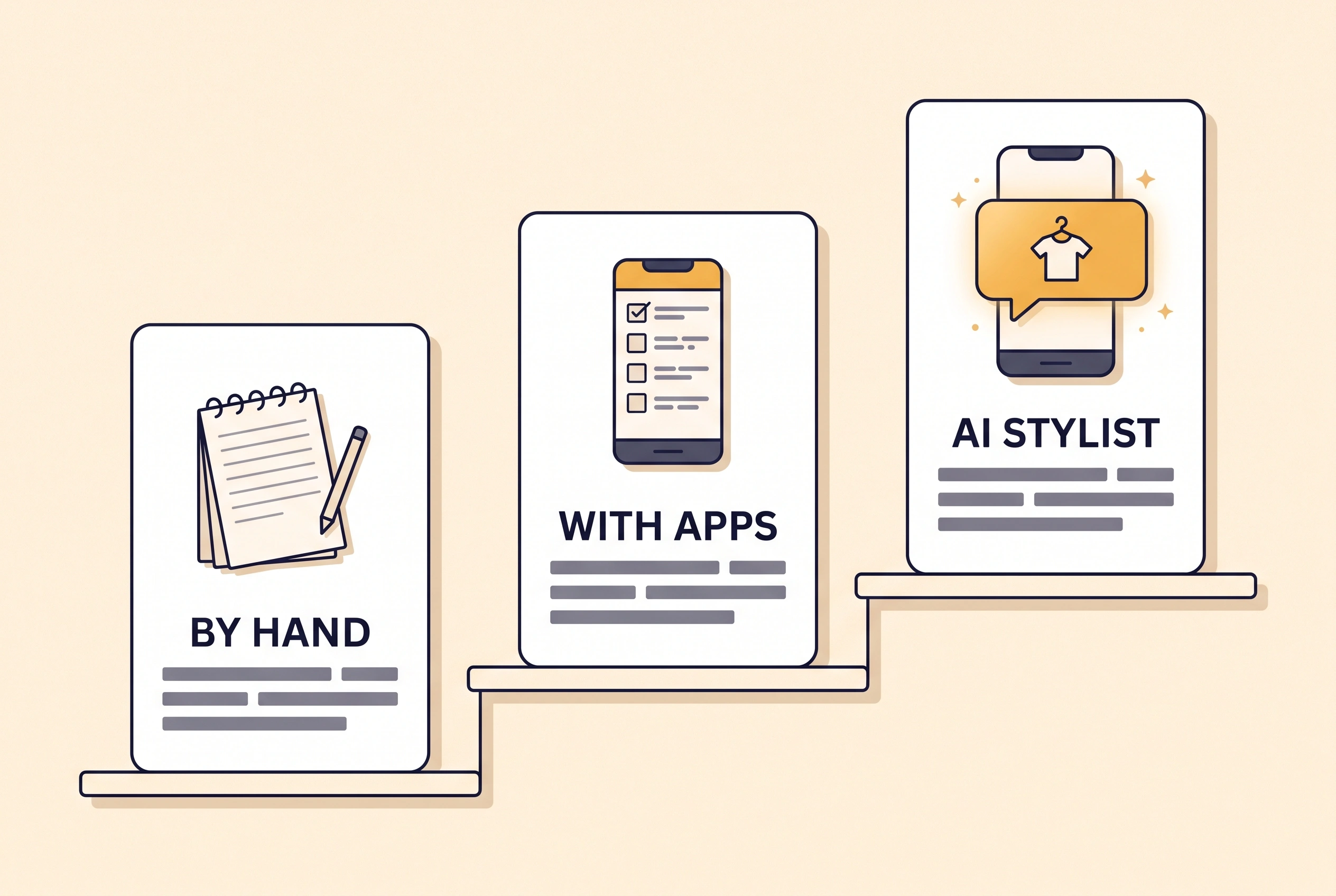
By hand, with apps, or with a personal AI stylist are the three ways to build an outfit around a product, and they differ mainly in how personal the result is to the shopper looking at it.
- By hand. A team member answers on live chat, books a styling call, or works a styling-request inbox. Personal, but slow and limited to your staffed hours.
- With apps. A style quiz, a rules-based “frequently bought together” app, or a size/fit app. Built on your catalogue and always available, but usually the same answer for everyone who takes the same quiz.
- With a personal AI stylist. Reads the one product a shopper is viewing and what she tells it, then builds a different outfit from your own catalogue every time.
| Personal to the shopper? | Built on your catalogue? | Available at 2 a.m.? | Cost | Set-up time | |
|---|---|---|---|---|---|
| Team member on chat | Yes, but slow | Depends on training | No | Staff time | None |
| Static “complete the look” | No | Yes | Yes | Free–low | A few hours |
| Quiz-based style finder app | Only at sign-up | Yes | Yes | $20–$100+/month | A few hours |
| Personal AI stylist | Yes, every visit | Yes | Yes | Free to install; 5% of the sales it makes | About 1 hour |
What does this look like with iWAND?
iWAND is our product.
iWAND is an AI stylist for independent fashion brands on Shopify. It gives every shopper a personal stylist, with outfits, styling advice, try-on and size help built on the brand’s own catalogue.
On a product page, iWAND’s Complete agent looks at the exact piece a shopper is viewing and builds a full outfit around it from your own catalogue — different shoes, outerwear and accessories depending on the product, the shopper’s stated size, and the occasion she mentions. Free to install; iWAND charges 5% only on the sales it makes.
[VIDEO: YouTube link — walkthrough of iWAND building an outfit on the demo store]
A shopper on a product page for a floral midi dress tells iWAND she needs it for a garden wedding. iWAND answers with a jacket, sandals and a bag from the same store, sized to what she already told it, and lets her add the whole look to her bag in one tap.
How do I set this up on Shopify?
Setting up a personal AI stylist on a product page takes about an hour, with no developer and no theme rebuild.
- Install iWAND from the Shopify App Store and approve the access it asks for.
- Let it read your catalogue. iWAND connects to your products, variants and images automatically — no CSV export needed.
- Choose where the outfit shows. Pick the product-page placement in iWAND’s settings — below the price, in a tab, or in a slide-out panel.
- Test it as a shopper. Open five different product pages yourself and check the outfit it builds for each one before you tell anyone it’s live.
Clean your product data first
An AI stylist can only recommend across products it understands — check that colours, categories and images are filled in before connecting it, rather than assuming it will work around messy data.
See iWAND style your own catalogue: free private preview
Try a private preview on your own catalogue before you install anything.
How do I measure it?
Measure a personalized outfit by comparing the average order value of shoppers who used it against those who didn’t, over one full buying cycle, not just the first week.
Compare average order value and units per order between sessions where a shopper opened the outfit panel and sessions where she didn’t, over 30 to 60 days. Watch the return rate on those larger orders too — a well-matched outfit should lower returns, not raise them, because the shopper sees fewer dead ends.
| Way | Time | Cost | Skills needed |
|---|---|---|---|
| By hand (styling inbox or booked calls) | Ongoing, per request | Staff time | A trained team member |
| With apps (quiz or rules-based) | A few hours to set up | $20–$100+/month | No developer |
| With a personal AI stylist | About 1 hour to install | Free to install; 5% of the sales it makes | No developer |
How do I know it’s fixed?
This factor moves toward Done once the outfit shown on a product page changes with the product and the shopper, not just once per catalogue.
Watch average order value and units per order for product-page sessions where the outfit was opened, against sessions where it wasn’t. Give it a full buying cycle — at least 30 days — before judging the change. Run your Styling Score again once it’s live to see the factor move.
Where does this fit in AOV?
AOV has three factors, and this guide covers the one built around a single product for one shopper.
- AOV-01Complete the lookThe same bundle for every shopper on a given product.
- AOV-02Shoppable looks: buy the lookA styled look every piece of which a shopper can buy.
- AOV-03Personalized outfitAn outfit that changes with the product and the shopper.You are here
Part of Grow Your Shopify Fashion Store with Styling: Salesperson to Stylist, our guide to turning a Shopify fashion store from a salesperson into a stylist.
What else do founders ask about personalized outfits?
Founders most often ask these seven questions.
What’s the difference between complete the look and a personalized outfit?
Complete the look (AOV-01) shows one fixed bundle to every shopper for a given product. A personalized outfit changes with each shopper — her size, the occasion she mentions, and what else she’s viewed — so two shoppers looking at the same dress can see two different outfits.
Do I need a developer to set this up?
No. Installing a personal AI stylist from the Shopify App Store takes about an hour, with no code and no theme edits beyond choosing where the outfit panel shows on the product page.
Will this work if my store only sells one category, like dresses only?
It works best with at least two or three categories that naturally form an outfit — dresses with shoes, bags or jackets. A single-category store can still offer styling advice, but there’s less to build a full look from.
Can AI do this for each shopper?
Yes. A personal AI stylist reads one product and a shopper’s own answers, then builds a different outfit for her from your catalogue. iWAND is one such stylist — free to install, with a 5% commission only on the sales it makes.
How long before I see a change in average order value?
Give it a full buying cycle, generally 30 to 60 days, since fashion shoppers often browse across more than one session before buying a full outfit.
Does a personalized outfit increase returns?
Not when the outfit is sized and occasioned correctly — a well-matched outfit should lower returns, because the shopper sees fewer dead ends. The personal-fit guide for the Return stage covers this in more detail.
Sources
- McKinsey & Company. The value of getting personalization right—or wrong—is multiplying. Nov 12, 2021. https://www.mckinsey.com/capabilities/growth-marketing-and-sales/our-insights/the-value-of-getting-personalization-right-or-wrong-is-multiplying
- Forrester Consulting (via Business Wire). Total Economic Impact Study Found That AI-Powered Stylitics Drove ROI of 563% Over Three-Year Period. Sept 28, 2023. https://www.businesswire.com/news/home/20230928073082/en/Total-Economic-Impact-Study-Found-That-AI-Powered-Stylitics-Drove-ROI-of-563-Over-Three-Year-Period
Free private preview
See iWAND style your own catalogue
Try a free private preview of iWAND styling outfits around your own products, before you install anything.
AOV
Check every AOV factor on your store
The free Styling Score walks all three AOV factors and shows which are Done, Halfway or Not yet.