

At a glance
Agentic commerce is shopping in which an AI agent such as ChatGPT, Microsoft Copilot or Google’s AI Mode finds, compares and helps buy products in a chat. Shopify lists eligible products there by default, so being found no longer sets a fashion brand apart. The sale is won on your product page.
AI channels: ChatGPT, Copilot, AI Mode, Gemini
Checkout: US buyers only for now
Set-up: built into Shopify, no app needed
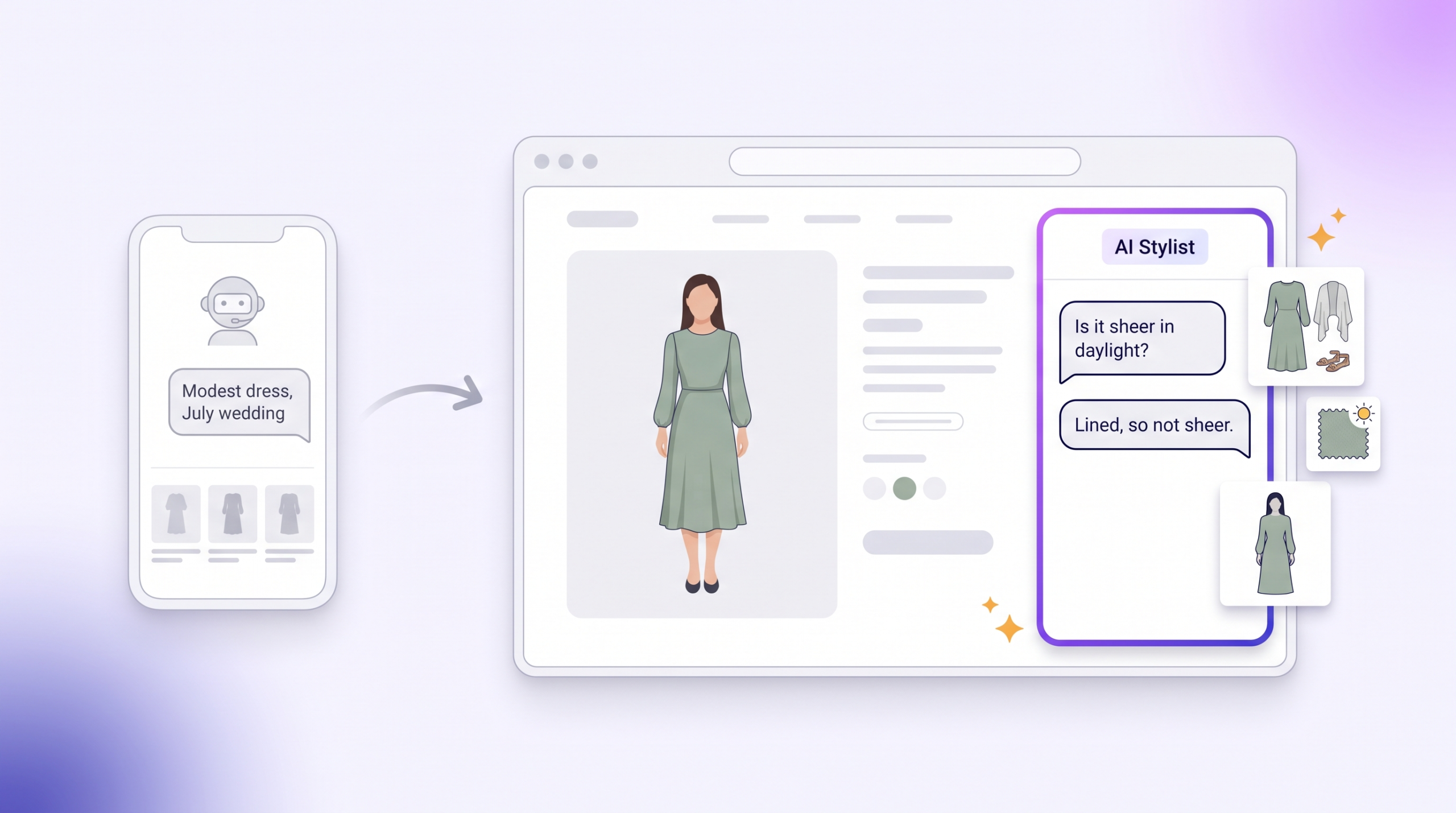
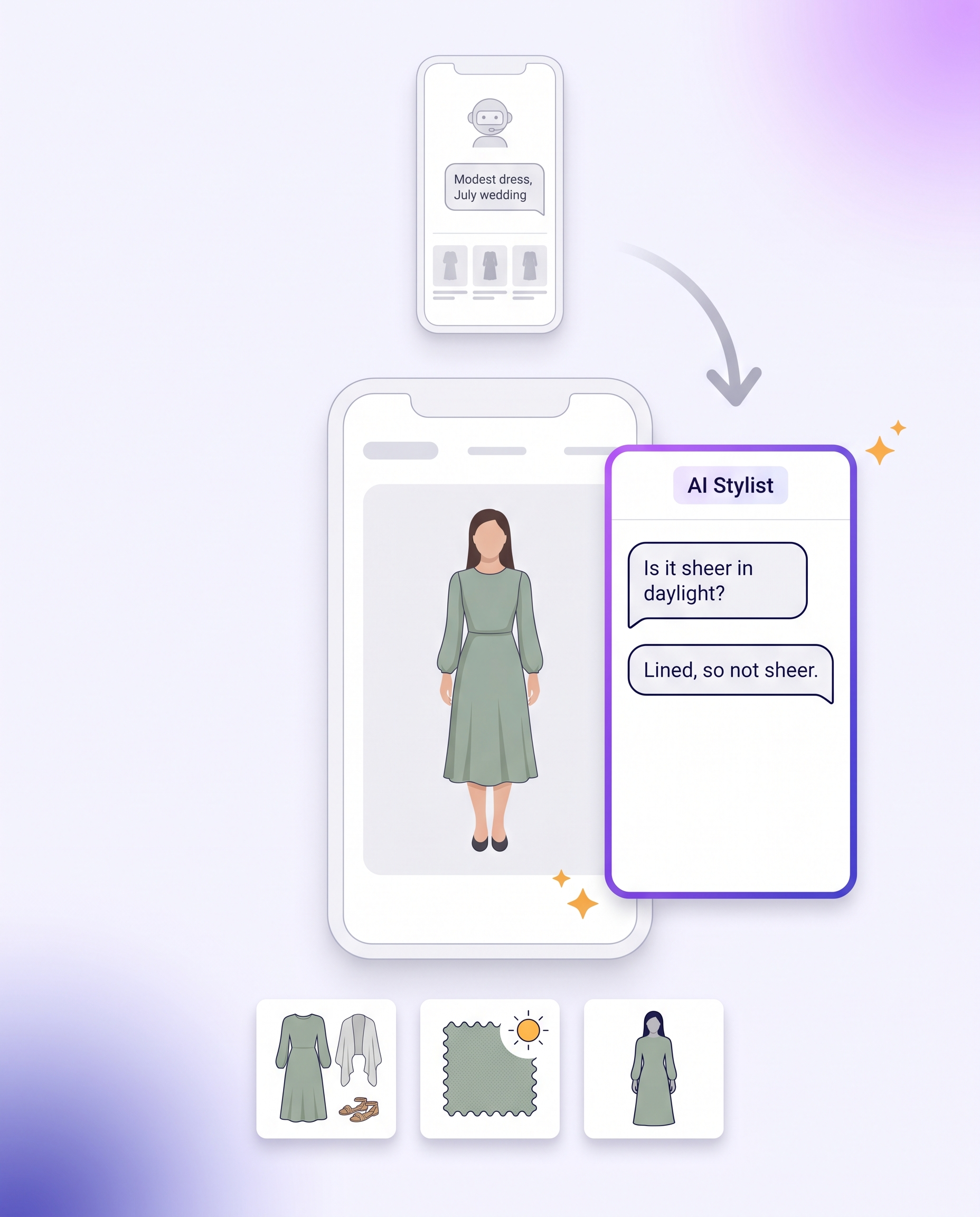
A shopper asks an AI assistant for “a modest dress for a July wedding, with sleeves that cover my arms without being hot.” The assistant returns a short list, and she taps yours. She lands on one product page with the question the assistant could not settle: is the fabric sheer in daylight, and which size should she order?
Agentic commerce is shopping in which AI agents find, compare and help buy products inside a conversation. This guide explains how it works on Shopify, which AI channels a fashion store can sell through, what a brand gives up when the sale happens inside a chat, and how to win the shopper once she arrives.
For the stylist side of the story, read the complete guide to AI stylists for Shopify fashion stores, AI stylist vs generic AI agent, AI stylist or support chatbot and who owns your Shopify customer’s style data.
Part of Grow Your Shopify Fashion Store with Styling: Salesperson to Stylist, our guide to turning a Shopify fashion store from a salesperson into a stylist.
In this guide
A salesperson
lists the product and leaves the shopper an AI agent just sent over to work out fabric, fit and what to wear with it alone.
A stylist
answers the doubt she arrived with: whether the fabric is sheer, which size to order and what completes the look.
What is agentic commerce for a Shopify fashion store?
Agentic commerce is shopping in which AI agents such as ChatGPT, Microsoft Copilot and Google’s AI Mode find, compare and help buy products inside a conversation, and for Shopify fashion stores it is already a live sales channel.
The old model had a shopper browse a store, type a search and check out alone. Now she describes what she needs to an assistant, and the agent does the finding. New buyers order through AI channels at nearly twice the rate of other channels (Shopify, June 2026).
8×
AI-driven traffic to Shopify stores in Q1 2026, compared with a year earlier. Orders from AI-powered searches rose nearly 13 times.
Source: Shopify, 2026, Agentic Commerce on Shopify: How It Works
The growth continued into the second quarter. On Shopify’s Q2 2026 earnings call, president Harley Finkelstein said AI-driven traffic and orders to Shopify stores had each tripled year over year, and that 75% of AI-attributed purchases came from outside Shopify’s top 100 product categories (Retail TouchPoints, August 2026). Specialised products gain most, and that describes most independent fashion brands: a modest occasion dress, a petite-cut trouser, a swimsuit built for a particular body.
Across US retail the picture is the same. Adobe found that traffic from AI sources to US retail sites grew 393% year over year in the first quarter of 2026, and that AI-referred visitors stayed 48% longer and viewed 13% more pages (Adobe, April 2026).
42%
In March 2026, traffic from AI sources converted 42% better than non-AI traffic on US retail sites. A year earlier it converted 38% worse.
Source: Adobe, 2026, U.S. retailers see surge in AI traffic
AI is quickly becoming the primary interface between consumers and their favorite brands.
Vivek Pandya, director of Adobe Digital Insights, Adobe, April 2026
A fashion request shows why the channel works. A shopper asks an assistant for “a modest dress for a July wedding, with sleeves that cover my arms without being hot.” A search bar cannot match that sentence, because no product is tagged “covers arms.” An AI agent can interpret it, read structured product data from many stores, and return a shortlist, including yours if your product data describes sleeves, fabric weight and occasion clearly.
How did fashion ecommerce get here?
Fashion ecommerce got here by treating the store as a grid of images, where the shopper does all the searching, filtering and deciding alone.
For nearly thirty years, fashion ecommerce ran on a silent contract: the merchant supplied the images, and the shopper did the work. The desktop era, roughly 1995 to 2010, digitised the catalogue into a keyword, a thumbnail and a form. The mobile era, roughly 2010 to 2024, made browsing visual and fast, with feeds and one-tap checkout. Neither changed who did the work.
The result was a store that displays everything and answers nothing. When a shopper wonders whether a cut will work on a petite frame, or what to wear with a skirt to a winter wedding, the page has nothing to say. The average Shopify store converts about 1.4% of sessions (Littledata, 2023).
53%
of visitors left a site after viewing a single page, in a benchmark of 90 billion sessions.
Source: Contentsquare, 2025, Digital Experience Benchmarks
Those shoppers were not rejecting the store. Nobody engaged them.
Agentic commerce arrived in 2026 as infrastructure rather than a trend. AI agents now read structured product catalogues directly and reason about occasion, weather, formality and layering before a shopper ever opens a store tab. Shoppers who have grown used to describing what they want in plain language do not go back to a filter panel willingly. A store that cannot talk back now feels broken rather than plain.
How does agentic commerce work on Shopify?
Agentic commerce on Shopify runs on three pieces of infrastructure plus Shopify’s own checkout: Shopify Catalog makes products readable to AI agents, the Universal Commerce Protocol defines how agents transact, and Agentic Storefronts connects a store to each AI platform from Shopify admin.
None of it requires a merchant to install an app or write code.
What is Shopify Catalog?
Shopify Catalog is the structured data layer that makes products readable to AI agents. It standardises products into a universal taxonomy, checks pricing and inventory in real time, and sends that data to every connected AI platform. Eligible products are listed by default, and changes made in Shopify admin carry across to AI channels automatically. Catalog also infers extra attributes from transaction signals: in Shopify’s own example, a candle listed under “home decor” can surface as a Mother’s Day gift because of how it sells.
What is the Universal Commerce Protocol (UCP)?
The Universal Commerce Protocol is an open standard, co-developed by Shopify and Google, that defines how AI agents handle cart creation, checkout, payment and post-purchase with a merchant. Shopify lists Amazon, American Express, Etsy, Mastercard, Meta, Microsoft, Salesforce, Stripe, Target, Walmart and Visa as backers. UCP lets a merchant’s checkout rules, discounts and terms behave the same whichever agent starts the purchase, and when a new AI platform adopts it, Shopify merchants can sell there without a new integration.
What are Agentic Storefronts?
Agentic Storefronts is the sales channel in Shopify admin that connects a merchant’s products to AI shopping platforms and holds the settings for each one. It is switched on automatically for eligible merchants, has no apps to install, and charges no fees beyond standard payment processing. Shopify launched it in its Winter ’26 Edition in December 2025.
We’re making every Shopify store agent-ready by default.
Tobi Lütke, Shopify CEO, quoted by PYMNTS, December 2025
What happens at checkout?
Shopify Checkout completes the purchase and handles payment, tax, fraud checks and fulfilment. Depending on the platform, the buyer pays on the merchant’s own store in an in-app browser (ChatGPT) or in an embedded checkout inside the AI interface (Copilot, AI Mode). Either way the order lands in Shopify admin with the AI channel attributed, and the merchant remains merchant of record. Distribution is now solved for the merchant, by the platform, by default. Differentiation is not.
Which AI channels can a Shopify fashion store sell through today?
As of Shopify’s June 2026 guide, Shopify merchants can sell through ChatGPT, Microsoft Copilot, AI Mode in Google Search and the Gemini app.
Each channel handles checkout differently and has its own eligibility rule.
| AI channel | Where the shopper checks out | Who is eligible | What the merchant controls |
|---|---|---|---|
| ChatGPT | On the merchant’s own online store, in an in-app browser | Merchants in Shopify Catalog who sell to US buyers, wherever the store is based | Whether order data is shared with ChatGPT |
| Microsoft Copilot | Inside Copilot through Copilot Checkout, for eligible merchants | Merchants in Shopify Catalog who sell to US buyers | Direct checkout on or off |
| AI Mode in Google Search and the Gemini app | Native checkout inside the AI interface | Select US-based shops selling to US buyers, with wider rollout underway | Direct checkout on or off |
Purchasing is US-only for now
Shopify states that purchasing across all of these channels is currently available to US buyers only. For brands that sell mainly in the Gulf, Europe or Asia, the channels are a smaller share of the opportunity until AI partners open checkout in more regions, so their own storefront carries more of the load. Shopify says merchants will be ready by default when the partners expand.
How do I manage Agentic Storefronts in Shopify admin?
You manage every AI channel from one place in Shopify admin, and most eligible stores have nothing to switch on.
The real work is choosing which platforms receive your data, deciding where checkout happens, and checking that AI agents can read your product pages.
- Confirm eligibilityYour products must be eligible for Shopify Catalog, and purchases through AI channels currently require selling to US buyers.
- Open the channelGo to
Settings › Sales Channels › Agentic Storefronts. Eligible stores are activated automatically. - Choose your AI partnersPick which platforms receive your product data through Shopify Catalog, or let Shopify distribute to current and future AI channels automatically.
- Decide where checkout happensFor Copilot, AI Mode and the Gemini app, turn direct checkout on to let buyers pay inside the AI interface, or off to send them to your store. ChatGPT always checks out on your own store.
- Audit your product pagesRun Shopify’s free agentic-readiness audit on your best-selling product URLs. It reports on the structured data and robots.txt access AI shopping assistants need.
- Map custom dataIf fit, fabric or occasion details live in metafields, use Catalog Mapping to control how those fields reach AI agents.
- Track the ordersAI-channel orders arrive in admin with channel attribution, so you can compare them with your other channels from the first week.
Where the built-in tools stop
Agentic Storefronts handles discovery and checkout inside AI platforms. Nothing in it answers a fit, fabric or styling question once the shopper reaches your own product page, and that is where half of these sessions land.
How should a fashion brand prepare product data for AI channels?
Write down in text every detail a shopper would otherwise read from a photo, because AI agents read structured text, not images.
66%
Retail product pages scored 66% on Adobe’s AI Content Visibility Checker, against 75% for homepages. About a third of product-page content could not be read by large language models.
Source: Adobe, 2026, U.S. retailers see surge in AI traffic
Fashion is hit hardest, because the attributes that decide a clothing purchase, such as how sheer a fabric is or where a hem falls, usually live in the photography. Shopify Catalog cleans and structures what you give it, but it cannot describe a drape it was never told about.
| Attribute | The shopper question it answers | Where to add it in Shopify |
|---|---|---|
| Fabric and composition, including weight and sheerness | “Is it too hot or see-through for a summer wedding?” | Product description and a fabric metafield |
| Fit and cut (slim, regular, relaxed, oversized) | “Will it cling?” | Metafield or variant option |
| Length, rise and sleeve length | “Does it cover my arms? Is it midi or maxi?” | Metafields |
| Occasion and dress code | “Can I wear this to a black-tie event?” | Tags or an occasion metafield |
| Exact colour name and colour family | “Is this sage or olive?” | Variant option plus a colour-family metafield |
| Size guide written as text | “I’m usually a 10, what should I order?” | Product page text, not an image of a chart |
| Model height and size worn | “How will this length look on someone my height?” | Product description |
| Care instructions | “Can I machine-wash it?” | Product description |
The same work pays twice. Richer product records help AI agents recommend you, and they answer the shopper who then lands on your product page.
What happens when an AI agent sends a shopper to my store?
The shopper usually skips your homepage and collections and lands on one product page, already partly decided.
50%
of AI-referred sessions land directly on a product page, about 2.5 times the rate of traditional search, according to Shopify president Harley Finkelstein.
Source: Retail TouchPoints, 2026, Shopify Credits AI for 34% Revenue Growth in Q2 2026
That page now has to do the job your homepage, lookbook and navigation used to share.
These are valuable visitors. Finkelstein said searches powered by Shopify Catalog convert about twice as well as those using scraped data, and about 80% better than traditional organic search. Shopify’s Q1 2026 data show AI-referred sessions converting at nearly 50% higher rates than organic search, with average order values 14% higher (Shopify, May 2026). An AI-referred shopper has already stated her need in full sentences.
Fashion is where this handover is weakest. In Adobe’s 2025 category data, apparel was one of the categories where AI-referred visitors were still less likely to order than other traffic, while consumer electronics and jewellery improved (Adobe, May 2025). Categories that sell on specification close the gap quickly, because a specification survives being turned into text. Fashion sells on fit, drape and colour against skin.
So the shopper arrives with questions the assistant did not settle. The one who asked for a modest wedding dress still wants to know whether the fabric is sheer in daylight, which size to order, and what shoes go with it. Typical questions at this stage sound like these (illustrative examples, not quotations from customer logs): “Is this dress sheer in daylight?”, “I’m between a 38 and a 40 in this brand, which should I order?” and “What shoes and wrap would suit it for a daytime wedding?” If the product page cannot answer, a qualified visitor leaves like any other.
See how your store answers AI-referred shoppers with the free Styling Score
Bots walk your store like a shopper. You get a score out of 100, a tier and a report.
What does a fashion brand lose when the sale happens inside an AI chat?
A fashion brand keeps the order but can lose three things: control of its demand, the presentation that justifies its prices, and the relationship that produces the next order.
Shopify states that the merchant remains merchant of record on every AI channel and receives each order in admin with attribution. What does not come back is everything around the order.
Is selling through AI channels a repeat of the Amazon marketplace problem?
Not exactly, but the core risk is the same. On marketplaces, fashion brands grew sales through a platform they did not control, gave up direct access to their customers, and in some cases watched the platform launch competing private labels. Shopify’s AI channels are designed differently: the merchant stays merchant of record and keeps the order data. The risk that survives is dependence. A brand whose discovery happens entirely inside someone else’s interface has rented its demand, and a channel that tripled in a year can be reweighted just as fast by a party that is not the brand.
Why do fashion brands look the same inside AI answers?
A text-first AI answer reduces a garment to a row of specifications, so a heritage label and a fast-fashion copy can read almost the same. A hand-finished 100% mulberry silk slip dress and a polyester satin one become two similar strings: a name, a price, a fabric, a shipping estimate.
Brand hierarchy in fashion is carried by sensory cues: lighting, styling, pacing, whitespace, the way a page scrolls. A shopper can tell a heritage house from a fast-fashion marketplace within a second of looking, and none of that second involves reading a specification. That visual and editorial layer turns a garment into an identity purchase, and it lets a brand charge a premium. When the comparison becomes specification against specification, the cheaper row tends to win, because nothing in the interface argues for the more expensive one.
Personalisation is the other casualty. McKinsey found that 71% of consumers expect personalised interactions, 76% get frustrated when they do not get them, and personalisation drives a 10 to 15% revenue lift (McKinsey, 2021). A third-party agent does personalise, but it does so on behalf of the platform, using preference data the platform keeps.
What happens to repeat purchases when an AI completes the sale?
Zero-click commerce is the pattern in which an AI agent answers the shopper’s question so completely that she never opens the brand’s website. The order still arrives. The lookbook, the founder’s story, the newsletter sign-up and the reason to come back do not. The store becomes a fulfilment endpoint for an interface someone else owns.
13%
of visitors return to a site within 30 days of their first visit.
Source: Contentsquare, 2026, Digital Experience Benchmark
Fashion depends on the next order. Bain research reported in Harvard Business Review found that a 5% rise in retention can raise profits by 25% to 95%, while acquiring a new customer costs five to 25 times more than keeping one (HBR, 2014). Retention is built on knowing a customer’s size, taste and history. If that record sits inside a third-party agent, so does the retention upside.
Who owns shopper data when a Shopify store sells through AI agents?
You own the order data on every Shopify AI channel; who owns the styling conversation depends on where it happens.
When a shopper explains the occasion, a fit worry and the options she rejected to an external assistant, that context stays with the assistant, and your admin shows a conversion without the reason. For ChatGPT, merchants can also choose whether order data is shared back with the platform.
Take one sentence a shopper might type: “I love this dress, but I’m worried the silk is too sheer for an outdoor daytime wedding.” It holds an occasion, a physical objection and the reason she has not bought yet. Said to an external assistant, it stays with that assistant. Said on your own product page, it can become a clearer fabric note, a merchandising signal and a reason to stock a lined version.
Owning your shoppers’ style data means being able to act on the reasons a customer buys, not only the record that they bought. That is only possible when the conversation runs on the merchant’s own storefront.
| Where the conversation happens | What the merchant learns | Who holds the shopper’s stated needs |
|---|---|---|
| Inside an AI platform (ChatGPT, Copilot, AI Mode) | The order, items, payment and fulfilment details | The AI platform |
| A marketplace listing | Order and product data, with limited contact details | The marketplace |
| A support chatbot on your store | Shipping, returns and order-status questions | The merchant, with little style intent |
| A recommendation widget on your store | Clicks and co-purchase patterns, with no stated reason | The merchant, behavioural data only |
| A styling agent on your store | Occasion, fit, taste, rejected options and wardrobe gaps | The merchant |
Hosting the conversation on your own store also changes your privacy position: the merchant becomes the data controller and the app vendor a processor under a data processing agreement, so retention and deletion requests can be handled in one place. That is a precondition for compliance with rules such as GDPR and CCPA, not compliance on its own. Our guide to who owns your Shopify customer’s style data covers the details and a data-ownership checklist.
Why do McKinsey and BCG tell retailers to own their AI agent?
Both firms expect agentic commerce to be very large, and both advise retailers to build agents of their own rather than rely only on third-party AI for discovery.
$1T
in orchestrated revenue from agentic commerce could flow through US B2C retail alone by 2030, McKinsey projects, and $3 trillion to $5 trillion globally.
Source: McKinsey, 2025, The agentic commerce opportunity
McKinsey adds that “smart organizations are already beginning to create new, agent-ready sites that provide both strong agentic and consumer experiences.”
BCG names the cost of skipping that second step: retailers “will become increasingly dependent on third-party AI ecosystems to drive visibility and conversion, while losing access to first-party data that powers personalization, loyalty, and monetization.” Its answer is the brand agent, which uses “deep domain expertise, proprietary data, and customized interactions to provide a higher level of personalization that third-party agents cannot replicate” (BCG, October 2025). In fashion, deep domain expertise means styling knowledge, and proprietary data means the fit and taste a shopper shares on your own store.
Does a Shopify fashion store need an on-site AI stylist?
An on-site AI stylist, sometimes called an agentic layer, is conversational AI on your own storefront that reads your live catalogue, answers shopper intent in natural language and assembles complete outfits, without changing your theme or your catalogue.
It runs under the merchant’s brand, so the styling conversation, the customer relationship and the resulting first-party data stay with the merchant.
Picture your store as a high-end boutique with perfect lighting and no staff. Everything is there, and the customer is alone. If she cannot find her size, she leaves. If she does not know what goes with the trousers, she does not buy the blouse. An on-site stylist is the floor team you never hired.
Think of an agentic strategy in two halves. Syndication means selling to AI: Shopify Catalog makes your products readable to external agents, and it is now automatic. The second half is selling through an AI you control: an agent on your own storefront that answers in your brand’s voice. Syndication is the floor; your own agent is the differentiator.
| Approach | Where styling happens | Who keeps first-party data | Shows the outfit on the shopper? | Brand environment |
|---|---|---|---|---|
| Third-party AI storefront | On the AI platform | The platform | No | Replaced by the platform’s interface |
| Static store with filters and related items | Nowhere; the shopper serves herself | The merchant | No | Fully preserved |
| Generic support chatbot | On the store, but scripted | The merchant | No | Preserved |
| On-site AI stylist | On the store, in natural language | The merchant | Yes, with Virtual Try-On | Preserved |
Not worth it if
A small catalogue of basics bought by repeat customers who know their size may be well served by Shopify Catalog and a thorough product page. The case gets stronger as the purchase gets harder to judge from a photo: occasion wear, outfits of several pieces, fit-sensitive categories such as swimwear and tailoring, and stores whose returns are driven by size and fit.
How does Virtual Try-On change agentic commerce for fashion?
Virtual Try-On renders a recommended outfit on a body model matched to the shopper before checkout, so fit and colour can be judged visually rather than guessed from a product photo shot on a single sample size.
It is the part of agentic commerce a third-party AI agent cannot reproduce, because rendering a look needs your catalogue imagery and this shopper’s attributes in the same moment. An external agent can list your product. It cannot show it on the person deciding.
59%
of US online shoppers surveyed had been dissatisfied with an item bought online because it looked different on them than expected. 42% said they do not feel represented by images of models.
Source: Google and Ipsos, 2023, survey of 1,614 US online shoppers
That dissatisfaction carries a freight bill: Narvar found wrong size, fit or colour cited for 46% of returns at non-Amazon retailers (Narvar, 2019).
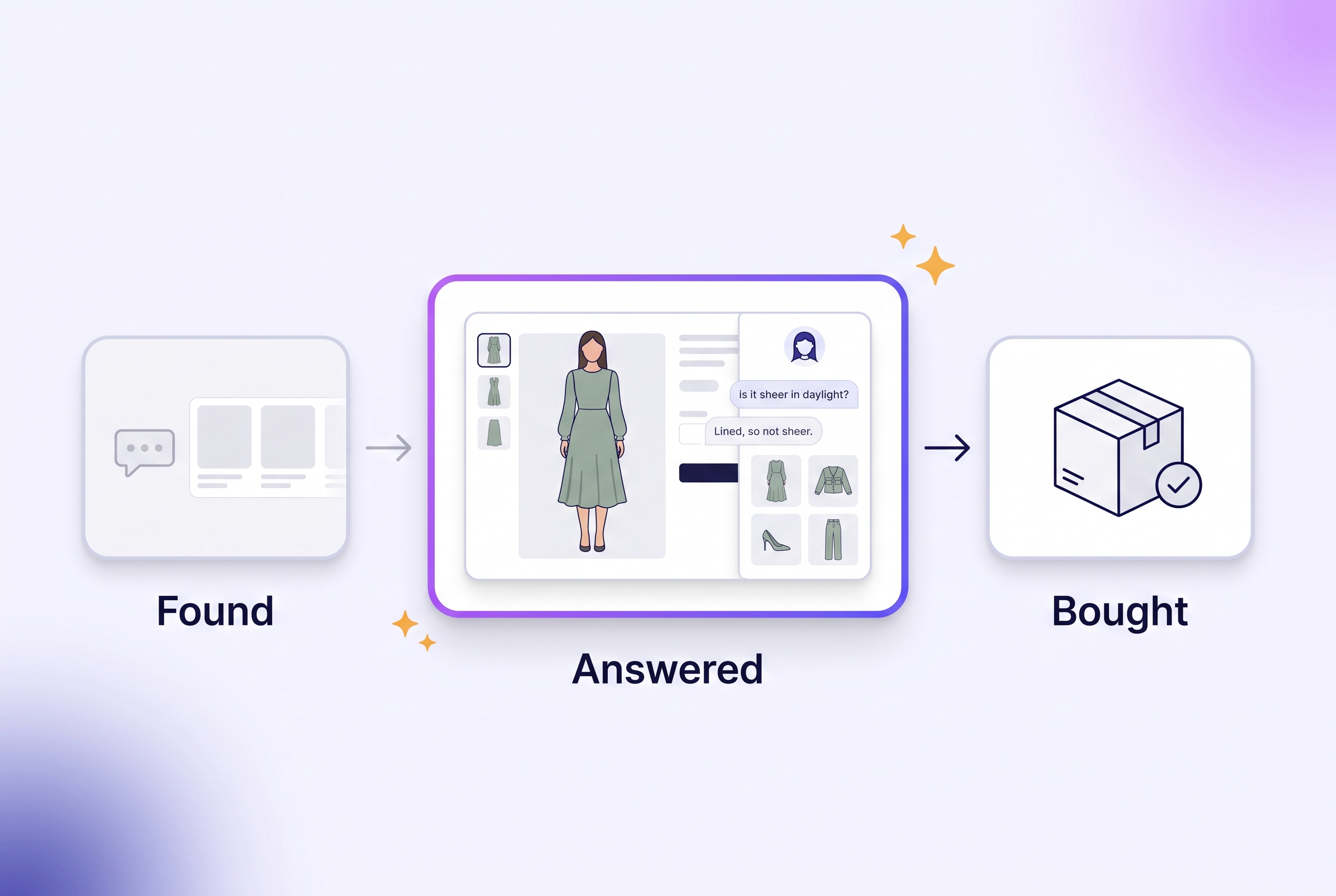
The sequence that works is short. The shopper describes an occasion, a styling agent builds the outfit from the store’s own stock, Virtual Try-On renders it on a matched model, and the shopper buys with the doubt removed instead of ordering two sizes to find out. Rendering the whole outfit, not one garment, also answers the paradox of choice: three outfits shown are a faster decision than three outfits described. A brand that can show the garment on the shopper is no longer competing on specification.
AI shopping agent, AI stylist or support chatbot: what is the difference?
An AI shopping agent finds products across many stores, an AI stylist helps a shopper decide on one store, and a support chatbot handles questions after the decision.
The three are often confused because all of them chat, but they do different jobs at different points in the purchase.
Does it retrieve answers or reason toward a goal?
A chatbot matches a shopper’s words to a pre-written answer or to rows in a database. Ask it for a “black dress” and it returns products containing those words. An agent reasons toward an outcome. Ask for a versatile outfit for a three-day work trip to Tokyo in November, and it has to work out the professional context, layering for the season and pieces that combine across three days, then assemble a coherent set from unrelated products.
The gap shows most clearly when the catalogue has no literal match. Baymard Institute found that nearly half of ecommerce sites have no effective way to recover a shopper after a zero-results search (Baymard, 2025). That is exactly the moment a reasoning agent earns its place, because it can reinterpret the request instead of returning an empty page.
| Tool | What it does | Where it runs | Who keeps the conversation | Best for |
|---|---|---|---|---|
| AI shopping agent (ChatGPT, Copilot, AI Mode) | Finds and compares products across many merchants | Inside the AI platform | The AI platform | Being discovered by new shoppers |
| AI stylist on your store | Interviews the shopper, builds outfits from your catalogue, answers fit doubts | Your own storefront | The merchant | Turning a product-page visit into a confident purchase |
| Support chatbot | Answers shipping, returns and order-status questions | Your own storefront | The merchant, with little style intent | Reducing support tickets |
| Recommendation widget | Shows items other shoppers bought together | Your product pages | No conversation | Simple cross-sell on a known product |
A clerk ends the session; a stylist extends it, and depth converts. Contentsquare found that sites which increased session depth by 10% or more saw an average 5.4% conversion boost (Contentsquare, 2025). Go deeper in AI stylist vs generic AI agent and AI stylist or support chatbot.
What can an on-site stylist change for conversion, order value and returns?
An on-site stylist works on three numbers through three different mechanisms: conversion rises when a hesitating shopper gets an answer, average order value rises when the unit of sale becomes an outfit instead of a garment, and returns fall when fit and colour are settled before checkout.
The worked example below uses public benchmarks only. Take a Shopify fashion store with 100,000 monthly sessions, converting at the 1.4% Shopify average (Littledata, 2023), with a $120 average order value and the 19.3% US online return rate for 2025 (NRF and Happy Returns, 2025). That store takes 1,400 orders and $168,000 a month, and keeps $135,576 after returns.
| Lever | Change | Extra gross revenue a month | Extra kept revenue a month (after 19.3% returns) |
|---|---|---|---|
| Conversion rate | +0.1 percentage point (1.4% to 1.5%) | $12,000 | $9,684 |
| Average order value | +$10 per order ($120 to $130) | $14,000 | $11,298 |
| Return rate | −1 percentage point (19.3% to 18.3%) | $0 | $1,680, plus the shipping and handling of 14 fewer returns |
Read the table as a sensitivity guide, not a forecast. It shows which lever matters most for your store before you spend anything: a store with high traffic and low conversion gains most from answering doubts, while a store with a high return rate gains most from settling fit before checkout. Use the public benchmarks above as a starting point, then compare assisted and unassisted shoppers in your own analytics over a full buying cycle.
Measure the three separately
Average order value can rise from price changes alone, and a conversion lift built on unresolved doubt can arrive weeks later as a return. Compare shoppers who used the stylist with those who did not, over the same period, and track returns on their orders as well as sales.
How should a Shopify fashion brand prepare for agentic commerce?
Treat it as a sequence, not a replatforming: Shopify handles syndication, so your effort goes into product data and the on-site experience AI-referred shoppers land on.
- Review your channel settingsCheck your Agentic Storefronts settings and decide, channel by channel, where checkout should happen.
- Run the readiness auditRun the agentic-readiness audit on your top 20 product pages and fix what AI agents cannot read.
- Describe every product in textAdd fabric, fit, length, occasion and colour-family details to product records as text and metafields, starting with your highest-return categories.
- Let product pages answerMake your best-selling product pages able to answer the fit and styling questions AI-referred shoppers bring with them.
- Show outfits, not only garmentsLet shoppers see complete looks, on a body like theirs, before checkout.
- Keep the shopper’s reasonsKeep stated reasons, such as occasions and fit concerns, as first-party data you can use in merchandising and email.
- Measure AI channels separatelyUse channel attribution in Shopify admin, and segment referrals from chatgpt.com, copilot.microsoft.com, gemini.google.com and perplexity.ai in your analytics.
Steps one to three make you findable and accurately described by external agents. Steps four to seven make you worth arriving at, which is the part no platform will do on your behalf.
What does an on-site stylist look like with iWAND?
iWAND is our product.
iWAND is an AI stylist for independent fashion brands on Shopify. Its styling agents give every shopper personal outfit, fit and styling advice from the brand’s own catalogue. It is free to install, and brands pay 5% only on sales iWAND makes.
It works alongside Shopify Catalog and Agentic Storefronts: they make a store findable inside AI platforms, and iWAND answers the shopper once she lands on a product page. For a shopper an AI agent has just sent over, Consult answers her doubts about that one piece, including fit and size. iWAND also suggests outfits built from the brand’s own catalogue, and Try-On shows the look on a model matched to her.
Where does this fit in AI Stylist?
This guide is the starting point for the AI Stylist posts: it covers the AI channels outside your store, and the posts below cover the stylist on it.
- Agentic commerce for Shopify fashion brandsHow the AI channels work and how to win the shopper they send.You are here
- The complete guide to AI stylists for Shopify fashion storesWhat an AI stylist does on a fashion store.
- AI stylist vs generic AI agentWhy an agent that lists products from many stores is not a stylist for yours.
- AI stylist or support chatbotWhich job each one does on a Shopify store.
- Who owns your Shopify customer’s style dataWhy the place where the styling conversation happens decides who keeps the reasons behind each order.
- How top fashion brands use AI stylistsWhat larger fashion retailers have done with conversational styling.
Part of Grow Your Shopify Fashion Store with Styling: Salesperson to Stylist.
What else do founders ask about agentic commerce?
Founders most often ask these eleven questions.
What is agentic commerce?
Agentic commerce is a model of online shopping in which AI agents discover, compare and help buy products inside a conversation, instead of a shopper browsing a store, searching and checking out alone. Shoppers describe what they need to an assistant such as ChatGPT, Microsoft Copilot or Google’s AI Mode, and the agent surfaces products and guides the purchase.
Is the ecommerce website dead now that AI assistants shop for people?
No. Adobe found that traffic from AI sources to US retail sites grew 393% year over year in the first quarter of 2026, and in March 2026 it converted 42% better than non-AI traffic. AI assistants send shoppers to stores rather than replacing them, and half of AI-referred sessions on Shopify land directly on a product page, which now has to answer the shopper’s questions.
How does agentic commerce work on Shopify?
Shopify Catalog structures product data and sends it to connected AI platforms automatically. The Universal Commerce Protocol, co-developed by Shopify and Google, defines how agents handle carts, checkout and payment. Agentic Storefronts is the sales channel in Shopify admin where merchants manage each AI platform, and the merchant remains merchant of record throughout.
Which AI channels can Shopify merchants sell through?
As of June 2026, Shopify merchants can sell through ChatGPT, Microsoft Copilot, AI Mode in Google Search and the Gemini app. ChatGPT checks out on the merchant’s own store in an in-app browser, while Copilot, AI Mode and Gemini can offer checkout inside the AI interface for eligible merchants.
Can stores outside the US sell through Shopify’s AI channels?
A store based anywhere can take part if it sells to US buyers, because Shopify says purchasing through AI channels is currently available to US buyers only. Checkout in AI Mode and the Gemini app is limited further, to select US-based shops. Shopify says merchants will be ready by default when AI partners expand to other regions.
Do I need an app to sell through Agentic Storefronts?
No. Agentic Storefronts is built into Shopify, with no apps to install and no transaction fees beyond standard payment processing. An app becomes relevant for what happens on your own storefront, such as answering fit questions, styling outfits and showing them with virtual try-on, which the AI channels do not handle.
Do merchants lose customer data when selling through ChatGPT or Copilot?
Merchants keep the order data and remain merchant of record, with orders arriving in Shopify admin with channel attribution. What stays with the AI platform is the conversation before the purchase: the occasion, the fit worries and the options the shopper rejected. For ChatGPT, merchants can also control whether order data is shared back with the platform.
What is an on-site AI stylist, and how is it different from Shopify’s AI channels?
An on-site AI stylist is an AI styling agent that runs on the merchant’s own Shopify storefront, under the merchant’s brand, so the styling conversation, the customer relationship and the resulting first-party data stay with the merchant. The AI channels bring shoppers to your store; the stylist helps them decide once they arrive.
Can virtual try-on work inside an AI chat?
Not in a way that serves the brand. Virtual try-on needs the brand’s own catalogue imagery and the shopper’s own inputs in the same session, which is why it runs on the merchant’s storefront. A general AI chat can list a product but cannot render the brand’s garment on the shopper deciding whether to buy it.
How is an AI stylist different from a support chatbot?
A support chatbot matches a shopper’s words to pre-written answers about shipping, returns and order status. An AI stylist reasons about the occasion, fit and the rest of the outfit, then builds a look from the store’s catalogue. The difference shows when a request has no literal match: a chatbot returns nothing, while a stylist reinterprets the request.
Do fashion merchants have to choose between AI channels and their own AI stylist?
No. Shopify lists eligible products in AI channels automatically, so syndication needs no decision. The remaining choice is what happens on the merchant’s own storefront after an AI agent sends a shopper there, and half of AI-referred sessions land directly on a product page.
Sources
- Shopify. Agentic Commerce on Shopify: How It Works. Jun 18, 2026. shopify.com
- Shopify. AI search insights from Q1 2026 commerce data. May 11, 2026. shopify.com
- Retail TouchPoints. Shopify Credits AI for 34% Revenue Growth in Q2 2026. Aug 5, 2026. retailtouchpoints.com
- Adobe. U.S. retailers see surge in AI traffic, but many websites are not entirely readable by machines. Apr 16, 2026. business.adobe.com
- Adobe. The explosive rise of generative AI referral traffic. May 23, 2025. business.adobe.com
- PYMNTS. Shopify brings merchant catalogs to ChatGPT, Perplexity and Copilot. Dec 11, 2025. pymnts.com
- McKinsey. The agentic commerce opportunity: how AI agents are ushering in a new era for consumers and merchants. Oct 17, 2025. mckinsey.com
- Boston Consulting Group. Agentic Commerce Is Redefining Retail: Here’s How to Respond. Oct 6, 2025. bcg.com
- McKinsey. The value of getting personalization right, or wrong, is multiplying. 2021. mckinsey.com
- Contentsquare. 2025 Digital Experience Benchmarks. 2025. contentsquare.com
- Contentsquare. 2026 Digital Experience Benchmark. 2026. contentsquare.com
- Littledata. Average website performance benchmarks. 2023. littledata.io
- Baymard Institute. No-results page research. Updated Feb 2025. baymard.com
- Google, with Ipsos. AI virtual try-on in Google Shopping. 2023. blog.google
- Narvar. State of Online Returns. 2019. narvar.com
- National Retail Federation and Happy Returns. Consumers Expected to Return Nearly $850 Billion in Merchandise in 2025. Oct 15, 2025. nrf.com
- Harvard Business Review. The Value of Keeping the Right Customers. Oct 2014. hbr.org
Free Styling Score
See how your store answers AI-referred shoppers
The free Styling Score walks your store like a shopper and shows which factors are Done, Halfway or Not yet.
Next read
What an AI stylist does on a Shopify fashion store
The complete guide to AI stylists for Shopify fashion stores, from the questions they answer to how they differ from chatbots and agents.