

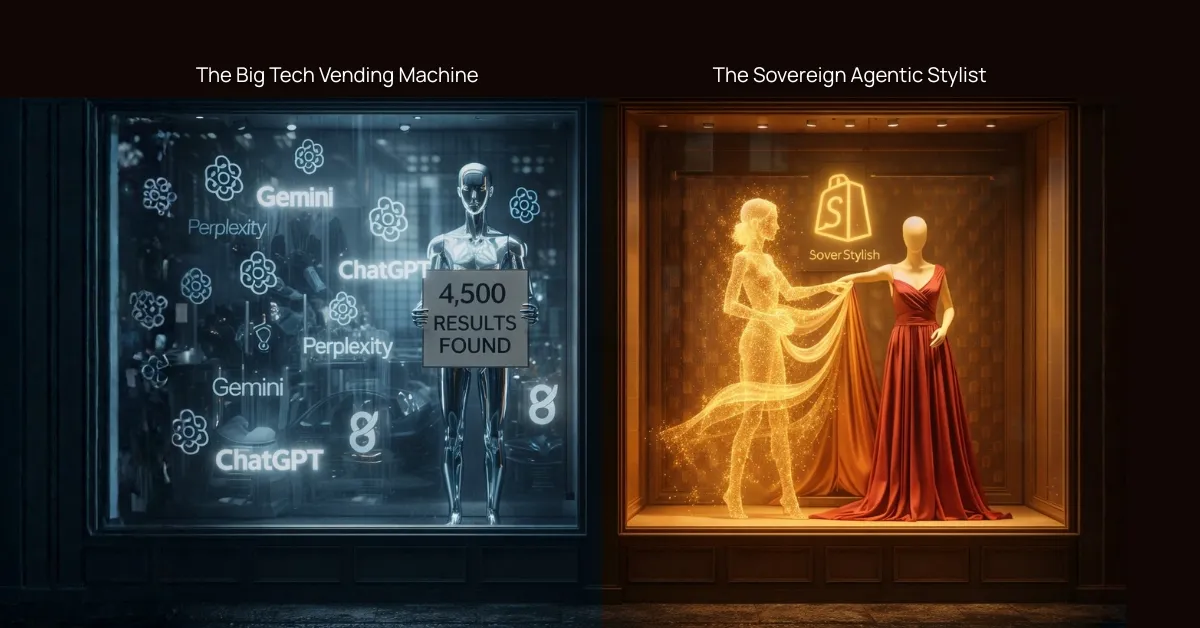
Introduction: The Shift to Sovereign Intelligence In 2026, the e-commerce landscape is undergoing a fundamental shift from Silent Commerce (passive browsing) to Agentic Commerce (proactive service). This manifesto explores the existential choice facing Shopify fashion merchants: surrender your data to the “Grey Goo” of Big Tech’s generic AI, or build a Sovereign AI Stylist storefront.
We outline why the future of fashion retail belongs to “The Agent Inside.” Learn how replacing reactive chatbots with iWAND’s autonomous styling agents can protect brand equity, secure first-party data, and transform online stores into intelligent, revenue-generating destinations.
Table of Contents
From Silent Commerce to Agentic Service: The 2026 Shift
For nearly three decades, we have collectively agreed on a silent contract for online shopping: the merchant provides the grid, and the customer provides the labor.
Think back to the Desktop Era (1995–2010). It was the age of the digital catalog. We marveled at the ability to see a photo of a dress on a screen, but the experience was clinical. You searched for a keyword, clicked a thumbnail, and filled out a form. It was a transaction of data, not an interaction of style.
Then came the Mobile Era (2010–2024). Shopping moved into our pockets, becoming “snackable” and visual. We traded keyboards for thumb-swipes and Instagram feeds. But beneath the high-resolution videos and the “Buy It Now” buttons, the fundamental problem remained: the website was still a passive, silent observer. If a customer felt a pang of doubt—“Will this look good on a petite frame?” or “What can I pair this with for a winter wedding?”—the website had no answer. The customer either spent twenty minutes hunting through filters or, more likely, they simply closed the tab.
Welcome to 2026: The Agentic Commerce Era.
We are witnessing the most dramatic shift in consumer behavior since the invention of the shopping cart. With the rapid acceleration of Agentic Commerce on Shopify, the industry has sent a clear signal: the “Self-Serve” model of e-commerce is dying.
The Agentic Era is defined by a move from Search to Service. In this new world, your storefront is no longer a static gallery of images; it is a “living” entity capable of thought, reasoning, and proactive engagement.
Shopify’s vision for agentic commerce invites a future where software doesn’t just display your inventory, it actively sells it. We are moving toward a reality where “browsing” is replaced by “consulting.” Customers are no longer wandering through digital aisles alone; they are being met by AI agents, intelligent and goal-oriented software, that can understand intent, negotiate style, and handle complex requests that a search bar never could.
For fashion merchants, the stakes are existential. Fashion is not a utility; it is an emotional, high-context category. When you sell a $300 blazer, you aren’t selling fabric. You’re selling a silhouette, a lifestyle, and a boost of confidence.
As shoppers grow accustomed to the conversational ease of tools like ChatGPT and Perplexity, they will begin to view the traditional “grid-and-filter” website as a relic. A store that cannot talk back, that cannot offer advice, and that cannot “see” the customer’s needs will feel broken.
We stand at a fork in the road. Shopify has opened the door to a world where AI agents lead the way. The question for you is this: who will own the agent that speaks for your brand? Will you let your products be sold by a generic, third-party bot on a different platform, or will you give your own store a brain?
Defining Agentic Commerce: The Transition from Bots to Agents
To understand why the fashion industry is vibrating with talk of “agents,” we first have to strip away the science-fiction gloss. At its core, Shopify’s vision for Agentic Commerce is about a fundamental upgrade to the internet’s “plumbing.”
For years, your Shopify store has been a destination—a beautiful, walled garden that customers had to visit. In the Agentic Era, your store becomes a Data Asset that can travel. Shopify is essentially turning your product catalog into a high-octane fuel that powers a new generation of autonomous software.
From Reactive Bots to Proactive Agents
The biggest point of confusion for many merchants is the difference between the “Chatbots” of the last decade and the “Agents” of today.
Traditional chatbots are reactive. They are digital filing cabinets. They wait for a specific keyword like “shipping” or “return” and then hand the user a pre-written document. They don’t think; they match patterns. If a user asks a question the bot hasn’t been explicitly trained on, the bot fails.
AI Agents, by contrast, are goal-oriented. They possess reasoning capabilities. If a customer says, “I need a versatile outfit for a three-day work trip to Tokyo in November,” an agent doesn’t just look for “travel clothes.” It plans.
- It checks the weather in Tokyo for November.
- It considers the professional context of a “work trip.”
- It scans your entire inventory for pieces that can be layered (versatility).
- It constructs a cohesive wardrobe from disparate SKUs.
Shopify is building the infrastructure—specifically the Shopify Catalog API and the Agentic Commerce Protocol (ACP)—to ensure that when a customer asks a question like this to any AI, your products are the ones that provide the answer.
Shopify’s vision is clear: they want to make every merchant “agentic-ready” by default. They are providing the tools to make your inventory discoverable in the conversations of the future.
However, being “discoverable” is not the same as being “desired.” While Shopify is building the plumbing to send your data out to the world, the experience of your brand is still in your hands—and if you leave that experience to third-party agents alone, you may find your brand fading into the background.
Strategic Choice: Syndication (Selling TO AI) vs. Sovereignty (Selling THROUGH AI)
As the infrastructure for Agentic Commerce snaps into place, every Shopify fashion merchant faces a defining strategic crossroads. You can choose to be found by the world’s AI agents, or you can choose to own the AI agent that defines your world.
This is not a technical choice; it is a battle for the ownership of your future profits. To understand the gravity of this moment, we must look at the ghosts of e-commerce past.
The Amazon Parallel: A Warning from History
A decade ago, the promise of the Amazon Marketplace was irresistible. It offered “infinite distribution.” Brands were told: List your products here, and we will bring the customers to you.
For many, it felt like a dream until it became a trap. Brands soon realized that while they were getting sales, they weren’t getting customers. Amazon owned the data, Amazon owned the “Buy Box,” and eventually, Amazon used that data to launch private labels that competed directly against the very brands that built the marketplace. The brands became “blind fulfillment centers,” shipping boxes for a platform that held all the cards.
Today, the “Agentic Storefronts” of ChatGPT, Perplexity, and Google Gemini are the new Amazon. They are the 21st-century Department Stores. If you rely 100% on them for your discovery, you aren’t a brand; you are a supplier.
The New Gatekeepers: Selling “To” AI vs. Selling “Through” AI
We are entering a period where the “Buy” button is moving away from your website and into the chat interface of Big Tech. This creates a critical distinction in your strategy:
Path A: The Syndication Route (Selling TO AI) In this path, you treat Agentic Commerce purely as a distribution channel. You optimize your metadata and wait for external agents to send you orders.
- The Asset: You build a “First-Party Data Vault.” Every question asked, every style preference revealed, and every fit concern addressed becomes part of your brand’s intelligence.
- The Advantage: You maintain “Brand Theater.” You aren’t a line of grey text; you are an immersive experience where the AI understands your specific aesthetic and inventory.
The fork in the road is simple: Do you want to rent your customers from a new set of AI gatekeepers, or do you want to own the brain that guides them?
The “Grey Goo” Effect: How LLMs Dilute Brand Aesthetics
Fashion is a visual language. It is a sensory experience built on the curve of a lapel, the grain of a cinematic hero video, and the deliberate whitespace of a luxury layout. You have likely spent years (and a fortune) perfecting this “Brand Theater.” You chose your typography, your color palette, and your editorial photography for a single reason: to create an emotional justification for your price point.
When a customer visits your Shopify store, they aren’t just looking at a garment; they are stepping into your world. But as we rush toward third-party agentic commerce, we are facing a dangerous paradox. We are trading that world for a text box.
This is the “Grey Goo” of branding.
The Great Flattening: When Luxury Meets 12-Point Font
Inside a Large Language Model (LLM) like ChatGPT or Perplexity, the hierarchy of fashion collapses. These platforms are built for “Task Completion,” not “Brand Immersion.” They strip your product of its visual context and convert it into pure, structured data.
In this text-based interface, a high-end, sustainable designer brand looks nearly identical to a fast-fashion giant.
- Brand A (High End): “Black Silk Slip Dress. 100% Mulberry Silk. Hand-stitched.”
- Brand B (Fast Fashion): “Black Satin Slip Dress. Polyester Blend. Soft finish.”
If a user asks an AI agent for a “black cocktail dress,” the agent retrieves options from a database and presents them as text. In that moment, your carefully curated aesthetic—the “signal” of your quality—is lost in the noise of grey text. The customer cannot feel the difference.
When you are reduced to a list of specs (fabric weight, price, shipping time), you are forced into a commodity market. Without the emotional layer of your visual brand, the customer has no reason to choose the more expensive, higher-quality option. The “Grey Goo” doesn’t just make you look boring; it makes you look cheap.
The “Zero-Click” Ghost Kitchen
Analysts are already warning about the rise of “zero-click” commerce. If an AI agent can answer every question a user has and complete the purchase via a simple text interface, the user never needs to visit your website.
This creates a “Ghost Kitchen” effect for fashion.
- They don’t see your new Lookbook.
- They don’t read your “About Us” page or connect with your founder’s story.
- They don’t sign up for your newsletter.
Your Shopify store risks becoming a hidden warehouse that fulfills orders for an AI interface that owns the entire emotional relationship. You get the sale today, but you lose the brand equity that ensures a sale tomorrow.
To survive, fashion brands must ensure that the “Agent” doesn’t replace the store, but rather inhabits it. You need an agent that operates as a layer over your existing world, one that uses the power of conversation to point back to your visuals, your videos, and your unique brand voice.
The Data Black Hole: The Risks of Outsourcing Intelligence
In the digital age, data is the “eyes” of your business. For twenty years, Shopify merchants have relied on pixel-tracking and clickstream data to understand their customers. You know which pages they visited, which buttons they clicked, and where they dropped off. This data allowed you to optimize your funnel and retarget with precision.
But as commerce becomes “Agentic,” we are entering a Data Black Hole.
When a customer interacts with a third-party AI, like ChatGPT or Perplexity, to find a product in your store, a massive wall of silence goes up between you and the buyer.
The Death of the “Why”
Traditional analytics tell you what happened (a user left the cart), but they never tell you why. Agentic commerce has the potential to solve this by capturing natural language.
Imagine a customer typing: “I love this dress, but I’m worried the silk is too sheer for an outdoor daytime wedding.”
That sentence is the most valuable piece of data in fashion. It reveals a specific hesitation, a use case (outdoor wedding), and a physical preference (modesty/opacity).
- If the conversation happens on ChatGPT: OpenAI learns that this user is looking for modest wedding guest attire. OpenAI uses that data to refine their own models. You, the merchant, see nothing. You just see a “bounce” in your Shopify analytics.
- The Black Hole Effect: You are essentially paying for the privilege of letting Big Tech train their AI on your customers’ most intimate style preferences, while you stay in the dark.
The Trap of Unstructured Data
90% of the information created in a styling session is unstructured data, the nuances of conversation, the specific way someone describes their body type, or the “vibe” they are trying to achieve.
When you syndicate your products to external agents, you are effectively outsourcing your brain. You become a “blind fulfillment center.” You get the transaction (maybe), but you lose the Customer IQ. Without this IQ, you cannot:
- Predict Trends: You won’t know that 30% of your visitors are asking for “breathable fabrics for tropical travel” until it’s too late to adjust your inventory.
- Personalize Retargeting: You can’t send an email saying, “We found a non-sheer version of that dress you liked,” because you never knew they were worried about transparency in the first place.
- Build Loyalty: Loyalty is built when a customer feels understood. If the “understanding” happens inside someone else’s app, that’s where the loyalty goes.
Choosing a Sovereign AI Agent, one that lives on your domain, isn’t just about a better user experience; it’s about data ownership. By hosting the “Stylist” inside your own storefront, every word the customer speaks becomes First-Party Data. You own the transcripts. You own the intent signals. You own the feedback loops.
The Solution: Building an Independent Agentic Layer via MCP
To survive the shift toward agentic commerce, merchants must look beyond simple chat bubbles. The solution is the Independent Agentic Layer.
This is not just another plugin or a basic FAQ bot. Instead, it is a sophisticated “reasoning engine” that sits over your entire Shopify store like a digital brain.
Autonomy Over Reactivity
The defining feature of this layer is Autonomy. In the old world of e-commerce, software was reactive. It waited for a customer to click a filter or type a search term. If the customer did nothing, the website did nothing.
An Independent Agentic Layer is proactive. It functions as a virtual employee that understands the goal of your business: to help the customer find the perfect outfit and complete the sale. It doesn’t just wait for a question; it observes the customer’s journey. If a shopper is hovering over a silk blouse but hesitates because they aren’t sure if it’s machine-washable, the agent provides that specific context before the customer even has to ask.
Sovereignty on Your Own Domain
By hosting this agentic layer on your own domain, you maintain Sovereignty. You are using the power of the most advanced AI models, but you are wrapping them in your own brand’s rules, tone, and logic.
This creates a “Best of Both Worlds” scenario. Your customers get the seamless, conversational ease of a modern AI assistant, but they stay inside your brand’s visual universe. You keep the data, you keep the relationship, and you keep the “Brand Theater” that makes your fashion label unique. This is the only way to build an AI strategy that is an asset you own, rather than a service you rent.
UX Comparison: The Reactive Clerk vs. The Proactive AI Stylist
As we transition to this new era, the biggest mistake a merchant can make is treating AI as a digital clerk. There is a fundamental difference between an AI that “retrieves data” and an AI that “understands style.” To win in fashion, you don’t need a clerk; you need a Stylist.
The AI Clerk: Searching for Keywords
Most AI assistants on the market today are Clerks. They are built for task completion and keyword matching. If you ask a Clerk for a “black dress,” it will search your database for the words “black” and “dress” and present a list of links.
The Clerk is useful for logistics. It can tell a customer when their package will arrive or help them find a specific SKU in a size Large. But in the world of fashion, the Clerk is a conversion killer. It lacks the nuance to understand the emotional context behind a purchase. It cannot tell a customer if a dress is “appropriate for a black-tie wedding in Italy” or if a certain pair of trousers will “flatter a pear-shaped silhouette.”
The AI Stylist: Understanding Intent
The AI Stylist represents a total revolution in user experience. Instead of matching keywords, it understands Intent.
When a shopper says, “I need something for a winter wedding in the mountains,” the Stylist doesn’t just look for “dresses.” It reasons through the context. It considers the weather, the level of formality, and the need for layering. It then suggests a complete look—including a coat, jewelry, and shoes—that fits the specific occasion.
The Stylist acts like an expert sales associate in a high-end boutique. It asks about the customer’s preferences, their body shape, and their existing wardrobe.
In 2026, personalization is no longer about putting a customer’s name in an email. It is about Psychological Alignment. The AI Stylist is the first technology capable of meeting a customer at their specific point of need and guiding them through the complex, emotional journey of a fashion purchase.
The Economic ROI: Increasing Conversion and AOV
In the competitive landscape of 2026, AI is no longer a luxury “experiment” for fashion brands; it is a fundamental driver of the bottom line. For the Shopify merchant, the shift from a passive storefront to an Agentic Stylist isn’t just a UX upgrade, it is a transformation of the store’s unit economics.
While traditional “Support Bots” were measured by how many tickets they closed, the Independent Agentic Stylist is measured by how much revenue it generates.
The Conversion Catalyst: Engaging the Silent Browser
In fashion e-commerce, the “bounce” is your biggest competitor. 97% of visitors typically leave a store without buying, often due to “Choice Paralysis” or a simple lack of confidence.
The Agentic Stylist acts as a proactive sales associate that interrupts this silence. By asking a simple question: “Are you shopping for a specific occasion or just browsing for inspiration?”. It bridges the gap between interest and intent.
- The Metric: Personalized, conversational discovery tools have been shown to lift conversion rates by 15% to 30%, with some high-performing brands seeing uplifts as high as 135% after integrating agentic flows.
The AOV Engine: From Items to Outfits
The traditional “People Also Bought” carousel is a relic. It suggests products based on historical statistics, often failing to consider the customer’s current aesthetic goal. An Agentic Stylist, however, understands the Logic of the Look.
By suggesting complete, tailored outfits rather than isolated items, the agent naturally drives Average Order Value (AOV). Instead of a single $80 shirt, the stylist builds a $240 ensemble by adding the perfect trousers and accessories that match the customer’s stated “vibe.”
- The Metric: Brands deploying AI-powered styling and bundling are seeing AOV increases ranging from 10% to 35%.
The Return Rate Remedy: Solving the Fit Crisis
Returns are the silent killer of fashion margins. In 2025, online return rates for apparel still hover around 20% to 30%, with roughly 70% of those returns caused by poor fit or mismatched expectations.
The Product Agent on your product detail pages (PDPs) acts as a preventative measure. By answering hyper-specific questions about fabric drape, transparency, and size comparisons to other brands, it resolves the uncertainty that usually leads to a “bracketing” purchase (buying two sizes with the intent to return one).
- The Metric: AI discovery and sizing agents are currently reducing return rates by up to 30%, directly reclaiming lost margins and reducing the environmental and logistical cost of reverse logistics.
The Lifetime Value Loop: Retention through Understanding
A customer who feels “seen” and “understood” by your brand develops a different kind of loyalty. If your agent remembers their preference for sustainable materials or their body shape from a previous session, you move from being a “vending machine” to a “personal advisor.”
This intelligence drives Customer Lifetime Value (CLV). Customers who use agentic styling features return to the store directly, bypassing the expensive “Ad Tax” of Google or Instagram for their next purchase.
Implementing the Vision, iWAND and the “Agent Inside” Strategy
The challenge of 2026 is not finding AI, it is finding the right AI. While Shopify provides the “Agentic Storefront” infrastructure to send your data to the world, iWAND provides the “Sovereign Intelligence” that keeps your brand alive on your own site.
iWAND is the Agentic Stylist. It represents a hybrid strategy: a Stylist by trade (what it does) and an Agent by power (how it functions). Unlike external bots that view your products as simple line items, iWAND acts as a proactive virtual employee that lives inside your store to close the sale.
The Three Pillars of iWAND Autonomy
iWAND replaces the static, silent website with three specialized agentic layers, each designed to remove a specific point of friction in the fashion funnel:
- The Stylist Agent (The Discovery Engine): This is your virtual personal shopper. It doesn’t wait for a search query; it approaches the customer. By asking about appearance, preferences, and the occasion, it constructs complete outfits from your inventory. It solves the “I have nothing to wear” dilemma by offering expert, empathetic guidance, converting “browsers” into “believers.”
- The Product Agents (The Confidence Builders): Located on every Product Detail Page (PDP), these agents are garment experts. They answer questions and resolve shoppers’ concerns that standard descriptions miss: for example, ‘Will this make me look taller?’, ‘Will it match my makeup?’, or practical queries about fabric sensitivity, brand sustainability, care instructions, and precise size comparisons. Acting as the final nudge before a shopper clicks ‘Add to Cart,’ they remove hesitation and help lower bounce rates.
- The Wardrobe & Visual Agent (The Connection): This agent bridges the gap between the customer’s existing closet and your new collection. Users can upload a photo of a jacket they already own, and the agent identifies the items in the image and recommends matching pieces from your store. It turns inspiration into a transaction in seconds using visual recognition.
Why “The Agent Inside” Wins
The distinction is vital: Shopify’s agentic commerce often focuses on external agents (like ChatGPT) finding products; iWAND places an expert agent inside your store.
By using iWAND, you aren’t just a “supplier” to Big Tech. You are a Destination. Because iWAND is built on the Model Context Protocol (MCP), it integrates seamlessly with your Shopify data while ensuring that the conversation remains your property. You keep the branding, you keep the data, and most importantly, you keep the customer relationship.
Future Outlook: The Era of the Brain-Powered Brand
We are at the end of the “Silent Era” of e-commerce. The choice for fashion merchants in 2026 is no longer about whether to adopt AI, but how to position it.
The industry is splitting into two distinct camps:
- The Ghost Kitchens: Brands that simply syndicate their data to third-party AI apps. They will get sales, but they will lose their identity, their data, and their margins to the “Grey Goo” of generic interfaces.
- The Flagship Destinations: Brands that give their storefront a brain. They use agentic technology to elevate their brand theater, protect their customer IQ, and provide a level of service that was once reserved for high-end physical boutiques.
The First-Mover Advantage
The “Agentic Shift” is not a slow evolution; it is a platform displacement. As shoppers become used to the ease of talking to their favorite stores, the old “search-and-filter” experience will begin to feel like an ancient chore. They will expect to be guided, styled, and understood.
By deploying an Independent Agentic Stylist today, you are doing more than just increasing your conversion rate. You are future-proofing your brand. You are ensuring that in a world of autonomous software, your products are not just “found”, they are styled, explained, and desired.
Don’t let your brand become a line of text in someone else’s database. Empower your products, respect your customers’ needs, and take control of your agentic future.
The future of fashion isn’t just “online”, it’s intelligent. It’s time to put the Agent Inside with iWAND.
Ready to Hire your Sovereign Agentic Stylist
AI Agentic stylist for Shopify fashion stores that turns browsers into loyal buyers.
Free, no code, no setup stress
What is the difference between Silent Commerce and Agentic Commerce?
Silent Commerce refers to the traditional “self-serve” model where customers browse static grids and rely on filters to find products. Agentic Commerce transforms the store into a “living” entity where proactive AI agents act as consultants, understanding customer intent and guiding them to purchase, much like a human sales associate.
What is the “Grey Goo” threat in fashion e-commerce?
The “Grey Goo” describes the phenomenon where generic Large Language Models (LLMs) strip fashion products of their visual context and branding, presenting them as commoditized text. In this environment, a high-end luxury item looks identical to a fast-fashion alternative, causing brands to lose their “Brand Theater” and pricing power.
Why should Shopify merchants choose Sovereign AI over third-party platforms?
Choosing Sovereign AI (like iWAND) allows merchants to keep the “Agent” inside their own store. This ensures they retain ownership of First-Party Data, protect their customer relationships from being rented back to them by Big Tech, and maintain control over the visual and emotional presentation of their brand.
How does an AI Stylist differ from a standard Chatbot?
A standard chatbot is a “Clerk” that reacts to keywords and retrieves static information (tracking, returns). An AI Stylist (like iWAND) is proactive; it understands fashion nuances, creates complete outfits based on occasions, and helps overcome purchase hesitation by offering expert styling advice.
How does an agentic AI stylist boost ROI for fashion ecommerce brands?
An agentic stylist improves ROI by directly impacting the three core revenue levers: conversion rate, Average Order Value (AOV), and returns. It increases conversion by engaging hesitant shoppers with proactive, conversational guidance that builds confidence. It raises AOV by shifting purchases from single items to complete, personalized outfits. It also reduces costly returns by resolving fit, fabric, and expectation issues before checkout. Together, these gains compound into higher margins, stronger customer lifetime value, and more efficient unit economics.