

Updated September 30, 2026: corrected the agent count to eight.
The New Era of Agentic Commerce is here. When a generic AI sells your product, it keeps the context and you get the shipping label. Here is why you need to bring the “brain” back to your own store.
This article is part of our Agentic Commerce guide, on moving from third-party LLM syndication to a sovereign inside-agent model that protects brand equity, first-party data and conversion.
At a Glance:
- The Problem — Traffic from generative AI sources to US retail sites grew 12-fold between July 2024 and February 2025 (Adobe Analytics). Each of those shoppers described their body, occasion and doubts to someone else’s model before reaching the store.
- The Concept — Data sovereignty in ecommerce is a merchant’s ability to own the reasons a customer buys, not only the record that they bought, because the conversation that produced the sale happened on the merchant’s own storefront.
- The Solution — iWAND runs the styling conversation and the Virtual Try-On render inside the Shopify store itself, so fit notes, occasions, rejected options and try-on history accumulate in the merchant’s own customer profile.
Who Owns Your Shopify Customer’s Style Data When an AI Makes the Sale?
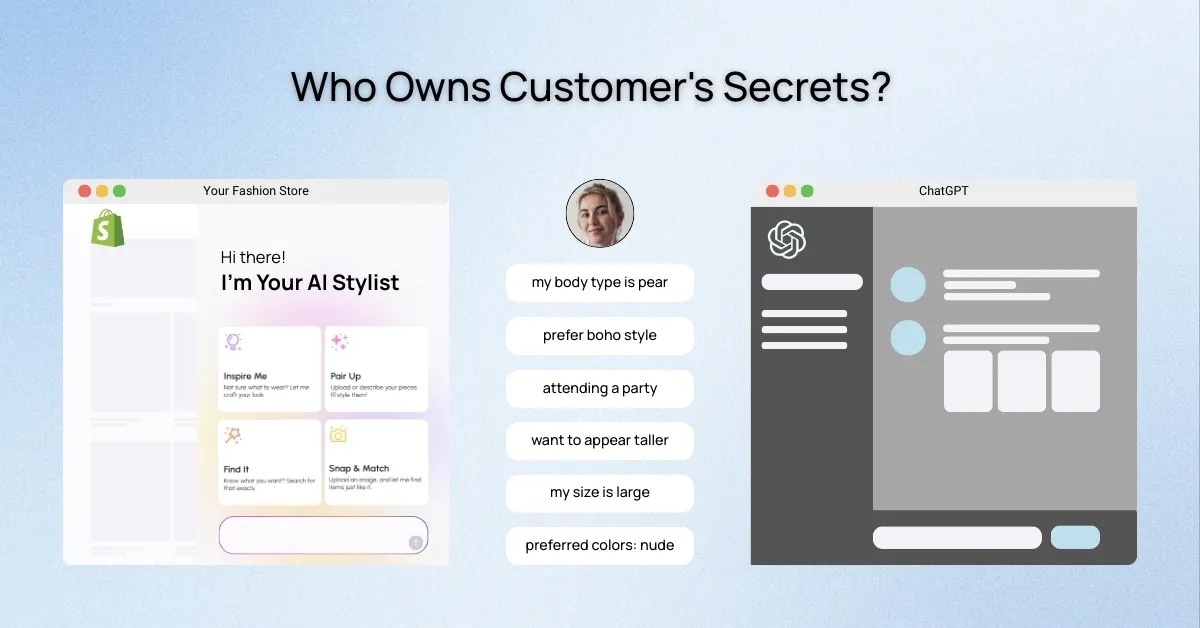
Data sovereignty in ecommerce is a merchant’s ability to own, store and act on the reasons a customer buys, not only the record that they bought, because the conversation that produced the sale happened on the merchant’s own storefront. A Shopify fashion brand holds that ownership when the styling conversation runs on its own domain, and loses it when the conversation runs inside someone else’s assistant.
The shift is already measurable. Traffic from generative AI sources to US retail websites grew 12-fold between July 2024 and February 2025, according to Adobe Analytics (2025). Every one of those sessions started somewhere else, with a shopper describing what she needed to a model that was not yours.
iWAND is an AI stylist and virtual try-on app for Shopify fashion stores, built on Shopify’s Shop Minis, that talks to shoppers, builds complete outfits from the store’s own catalogue, and shows them on a matched model. Because both the conversation and the Virtual Try-On render happen on the merchant’s storefront, the fit notes, the occasion and the rejected options stay with the merchant.
The “Data Black Hole”: What a Third-Party AI Agent Sends You, and What It Keeps
A third-party AI agent sends the merchant the order and keeps the conversation. Under the Agentic Commerce Protocol that OpenAI and Stripe launched alongside Instant Checkout in ChatGPT on 29 September 2025, the merchant stays the merchant of record and receives the order, the payment and the fulfilment details. What the merchant does not receive is the reasoning that produced the order.
Picture the sale you are probably already making. A shopper opens a chat assistant and types something she would never type into a search bar: a modest dress for a July wedding, sleeves that cover her arms without adding heat. The assistant reads the web, finds your brand, recommends your floral maxi. She buys. Your Shopify dashboard shows a conversion. It does not show the wedding, the July heat, or the self-consciousness about her arms.
That gap is the data black hole. OpenAI states that sellers keep “full control of their payments, systems, and customer relationships,” and for the transaction itself that is accurate. The pre-purchase conversation is a separate asset, and it never crosses the protocol. Our companion piece on the agentic commerce trap for Shopify fashion stores examines what that dependency costs over a full year of selling.
Why the “Why” Is Worth More Than the Order in Fashion
In fashion, purchase context is worth more than purchase history, because two customers who buy the same dress may have bought it for opposite reasons. Customer IQ is the structured knowledge a store accumulates about why each shopper buys: their body and fit, the occasions they dress for, the styles they reject, and what they already own.
The commercial case for holding that knowledge is documented. BCG research found that data-driven marketing can double revenue and increase cost savings by 1.6 times, yet only about 30% of companies create a single customer view across channels and just 1% to 2% use data to deliver a full cross-channel experience (BCG, 2021). The scarce asset is not data volume. It is connected, intent-level data about individual people.
Fashion makes that scarcity visible. Google and Ipsos found that 42% of online shoppers do not feel represented by images of models, and that 59% have been dissatisfied with an item bought online because it looked different on them than expected (Google/Ipsos, 2023). A store that never hears why a shopper hesitated cannot fix either number.
Where the Styling Conversation Happens: Five Ways to Sell with AI
Data sovereignty comes down to one question: whose servers host the conversation that leads to the sale. Third-party assistants, marketplaces, support chatbots, recommendation engines and on-site agentic layers all move clothes. Each leaves the merchant with a different amount of knowledge about the shopper once the box has shipped.
| Approach | Where the styling conversation happens | What the merchant learns | Who holds the shopper profile |
|---|---|---|---|
| Third-party AI assistant with agentic checkout | Inside the AI platform | Order, items, fulfilment and payment details | The AI platform |
| Marketplace listing | Inside the marketplace | Order and SKU data, limited or no contact details | The marketplace |
| Generic support chatbot on your store | On your store | Ticket topics, policy questions, little style intent | The merchant, but thin |
| Static recommendation engine | No conversation | Clicks and co-purchase patterns, no stated reasons | The merchant, behavioural only |
| iWAND agentic layer on your store | On your store | Body and fit, occasion, taste, wardrobe gaps, try-on history | The merchant |
None of the first four rows is worthless. A marketplace buys reach, a support chatbot deflects tickets, a recommendation engine lifts basket size. The distinction is narrower than it looks: only one of these five approaches produces a record of what the shopper said about herself, in her own words, on infrastructure the brand controls.
How iWAND Keeps the Styling Conversation Inside Your Shopify Store
iWAND installs as an independent conversational layer on the Shopify storefront and runs eight named agents against the store’s live catalogue. The Style Agent interviews the shopper on body type, skin tone, occasion and mood. The Find Agent replaces keyword filters with conversation. The Consult Agent answers product doubts, the Size Agent handles fit, and the Complete Agent attaches the rest of the look.
Every one of those exchanges is unstructured data a search bar never captures: a fabric sensitivity, a body-image concern, a wedding in July, a jacket already hanging in a wardrobe that the Pair Agent is asked to build around. The store receives it as a profile rather than an order line.
This is the architecture we describe in detail in our guide to building an agentic layer on a Shopify fashion store. The design principle is simple to state and hard to retrofit: whoever hosts the conversation accumulates the intelligence. Bagher Ahmadi, CEO of iWAND, puts it this way: “The brands that still own their customers in five years will be the ones that decided, this year, where the conversation happens.”
Virtual Try-On: First-Party Data a Product Photo Cannot Produce
Virtual Try-On is a feature that renders a recommended outfit on a body model matched to the shopper, before checkout, so fit and colour can be judged visually rather than guessed from a product photo shot on a single sample size. On a Shopify store running iWAND, every render is also a data event the merchant keeps.
Try-on history is visual preference data. It records which silhouettes a shopper asked to see on a body like hers, which ones she rendered twice, and which ones she abandoned after looking. No third-party AI agent can generate that signal, because generating it requires the brand’s catalogue images and the shopper’s own body parameters in the same session. A shopper can try the styling and render flow on the live demo before a single line of code touches the theme.
For a category where 59% of shoppers have been disappointed because an item looked different on them than expected (Google/Ipsos, 2023), the render is also the point at which doubt is resolved. The merchant gets the sale and the reason for it in the same interaction.
Does Hosting Your Own AI Agent Help with GDPR and CCPA?
Hosting the AI agent on your own storefront changes where the data sits and who controls it, which is a precondition for compliance rather than compliance itself. When the conversation runs on the merchant’s store, the merchant is the data controller and the app vendor is a processor bound by a data processing agreement. When it runs inside a third-party assistant, the merchant is neither.
That distinction matters practically. Under an on-site model, the merchant decides retention periods, honours deletion requests across the styling record, and knows exactly which fields were collected. Under a third-party model, the shopper’s disclosures sit in a system the merchant cannot query or purge.
None of this is legal advice, and no app makes a store compliant on its own. Consent notices, retention policy and the DPA still need review with counsel. What an on-site agent changes is that the review is possible at all, because the data is inside the perimeter the merchant already governs.
What First-Party Style Data Compounds Into: Repeat Purchases
First-party style data pays back through retention, not through the first order. Only 13% of visitors return to a site within 30 days of their first visit (Contentsquare, 2026), and a brand that knows nothing about why the other 87% bought has nothing specific to bring them back with.
The arithmetic on the other side is well established. Bain research reports that a 5% rise in retention can raise profits by 25% to 95%, and that acquiring a new customer is five to 25 times more expensive than retaining one (via Harvard Business Review, 2014). McKinsey finds that 71% of consumers expect personalised interactions, 76% get frustrated when they do not get them, and personalisation drives a 10 to 15% revenue lift (McKinsey, 2021).
Stored style context is what makes the second email specific. A customer who told the Style Agent she was dressing for an October trip to Paris can be sent an autumn layering edit built from her own size and palette, rather than a generic newsletter. Merchants running iWAND report up to 20% improved customer retention and up to 18% higher average order value (iWAND platform data). Our guide to the agentic fashion funnel traces how that context moves through every stage from first visit to reorder.
You Can Sell Through Third-Party AI Agents and Still Own the Customer
Data sovereignty does not require refusing third-party AI channels. It requires that the brand’s own storefront remains the place where the deepest conversation happens, so that syndicated traffic lands somewhere with memory. Appearing in ChatGPT, Perplexity and AI Overviews is distribution. Owning the on-site conversation is equity.
BCG frames the risk of skipping the second half: retailers become “increasingly dependent on third-party AI ecosystems to drive visibility and conversion, while losing access to first-party data that powers personalization, loyalty, and monetization” (BCG, October 2025). McKinsey reaches the same conclusion from the build side: “Smart organizations are already beginning to create new, agent-ready sites that provide both strong agentic and consumer experiences” (McKinsey, October 2025).
The failure mode is not invisibility. It is sameness — a catalogue described by a model that describes every catalogue, which we examine in our piece on brand dilution and AI grey goo. A store with its own agent answers in its own voice, using its own merchandising logic, and keeps what the shopper said.
A Data Sovereignty Checklist for Shopify Fashion Brands
Auditing data sovereignty takes an afternoon. The question in each step is the same: after this channel produces a sale, what does the store know about the person that it did not know before? Any channel that answers “an email address and a SKU” is a distribution channel, not a relationship.
- List every route a shopper can take to a purchase, including third-party assistants, marketplaces, social checkout and the store itself.
- For each route, write down which fields land in your Shopify customer record and which stay with the intermediary.
- Check whether your store captures any stated reason for a purchase at all, beyond behavioural clicks.
- Install an on-site conversational layer so that the intent behind a purchase is recorded where you can query it.
- Connect that record to email, SMS and merchandising, so stored context changes what each customer is shown next.
- Review retention periods, consent language and your data processing agreement with counsel before scaling the capture.
The agentic era will not stop selling your clothes. It will decide, quietly, whether your store is a brand with customers or a warehouse with order numbers. That decision is made by where the conversation lives.
Ready to reclaim your Customer IQ?
iWAND runs the styling conversation and Virtual Try-On inside your own Shopify store, so body, fit, occasion and taste stay in your customer record. No code, no theme changes.
Install on Shopify for Free →What is data sovereignty in ecommerce?
Data sovereignty in ecommerce is a merchant’s ability to own, store and act on the reasons a customer buys, not only the record that they bought, because the conversation that produced the sale happened on the merchant’s own storefront. It covers stated intent — body and fit, occasion, taste, rejected options — rather than transaction records alone.
Do brands lose customer data when they sell through ChatGPT Instant Checkout?
Not the order data. Under the Agentic Commerce Protocol launched by OpenAI and Stripe in September 2025, the merchant remains the merchant of record and receives order, payment and fulfilment details on its existing stack. What stays on the AI platform is the pre-purchase conversation: the occasion, the fit anxieties and the options the shopper rejected.
What is first-party data in fashion ecommerce?
First-party data is information a brand collects directly from its own customers with consent, on its own properties. In fashion it includes size and fit history, body-shape preferences, occasions shopped for, colours avoided and outfits viewed. BCG research found that data-driven marketing can double revenue, yet only about 30% of companies build a single customer view across channels.
How does iWAND keep the styling conversation on a Shopify store?
iWAND installs as an independent conversational layer on the Shopify storefront and runs its agents against the store’s live catalogue. Because the Style Agent, Find Agent, Consult Agent and Size Agent all operate on the merchant’s own domain, the shopper’s stated body type, occasion and fit preferences are recorded in the merchant’s customer profile rather than a third party’s.
What data does Virtual Try-On create that a product photo does not?
Virtual Try-On renders a recommended outfit on a body model matched to the shopper, before checkout, so fit and colour can be judged visually rather than guessed from a photo shot on a single sample size. Each render also produces visual preference data: which silhouettes a shopper asked to see on a body like hers, and which she abandoned.
Does hosting your own AI shopping agent help with GDPR or CCPA compliance?
It changes where the data sits and who controls it, which is a precondition for compliance rather than compliance itself. On-site hosting makes the merchant the data controller and the app vendor a processor under a data processing agreement, so retention and deletion are enforceable. Consent notices and contracts still need review with legal counsel.
What is the difference between an AI stylist and a support chatbot?
A support chatbot answers policy and order questions and produces ticket data. An AI stylist conducts a styling conversation — body, occasion, wardrobe, taste — and produces intent data tied to specific products. The first reduces support load. The second generates the customer knowledge that drives repeat purchases and personalised merchandising.
Can a Shopify store sell through third-party AI agents and still own its customer data?
Yes, if the store also hosts its own conversation. Third-party agents are a distribution channel; an on-site agentic layer such as iWAND is where the shopper explains what she needs and sees it rendered on a matched model. Brands that run both gain AI-sourced traffic without ceding the intent data that powers retention.