

At a glance
To grow a Shopify fashion store, stop acting like a salesperson that only shows products and start acting like a stylist that answers shoppers. Growth comes from six stages: AI traffic, engagement, conversion rate, average order value, returns and repeat purchases. Find your weakest stage, add the styling that fixes it, then move to the next.
Stages: 6, from AI traffic to repeat purchase
Guides: 23, most of them DIY
Diagnosis: free Styling Score
Change log: Oct 25, 2026. Rebuilt around six stages, with a guide count and a sourced figure for each stage. Next review: January 2027.
It is 10 p.m. and a shopper is on your product page for a green satin midi dress. An AI assistant sent her there. She wants to know whether it works for a winter wedding, which size to order and what to wear over it. The page shows six photos and a size chart. Nothing on it answers her.
Growing a Shopify fashion store with styling means answering those questions at every step of the purchase, the way a good stylist does in a boutique, instead of only displaying products the way a salesperson points at a rail. Styling is the work of helping each shopper choose, fit and combine pieces. A stylist store is a Shopify store that answers each shopper’s fit, fabric and occasion questions at every step instead of only displaying products.
This guide sets out the six stages where a fashion store wins or loses shoppers, how to find your weakest one, and where the step-by-step guides for each stage live. For the AI side of shopping, read agentic commerce for Shopify fashion brands. For what an AI stylist does on a store, read the complete guide to AI stylists for Shopify fashion stores.
In this guide
A salesperson
shows every product and leaves each shopper to search, size and style alone, so most leave after one page.
A stylist
asks what she is dressing for, answers the doubt that stops the order and suggests what completes the look.
Why does a Shopify fashion store need a stylist, not a salesperson?
A fashion store needs a stylist because shoppers buy clothes on fit, occasion and how a piece works with the rest of an outfit, and a store that only displays products leaves every one of those questions unanswered.
In a good boutique, the person on the floor asks what you are dressing for, pulls three pieces and tells you honestly which one suits you. Most Shopify fashion stores do the opposite: a grid, a set of filters and a size chart. They behave like a salesperson who points at the rail and waits.
1.4%
The average Shopify store turns about 1.4% of its sessions into orders, so roughly 98 of every 100 visits end without a sale.
Source: Littledata, 2023, Average website performance benchmarks
53%
of visitors left a site after viewing a single page, in a benchmark of 90 billion sessions.
Source: Contentsquare, 2025, Digital Experience Benchmarks
Those shoppers were not rejecting the clothes. Nothing answered them. A stylist store closes that gap at each step: it helps the shopper find a look for her occasion, settles her size and fabric doubts, shows what completes the outfit and gives her a reason to come back.
| Moment | Salesperson store | Stylist store |
|---|---|---|
| First visit | Shows the whole catalogue in a grid | Starts from what she is dressing for |
| Product page | Photos and a size chart | Answers fit, fabric and occasion doubts |
| Basket | One item plus related products | A complete look built around the piece |
| After the order | A generic discount email | The next piece that completes what she bought |
Most fashion stores don’t have a traffic problem. They have a silence problem. Thousands of visitors ask the questions a boutique associate would answer in ten seconds, and the store says nothing.
Bagher Ahmadi, co-founder and CEO of iWAND, 2026
What are the six stages of a Shopify fashion store?
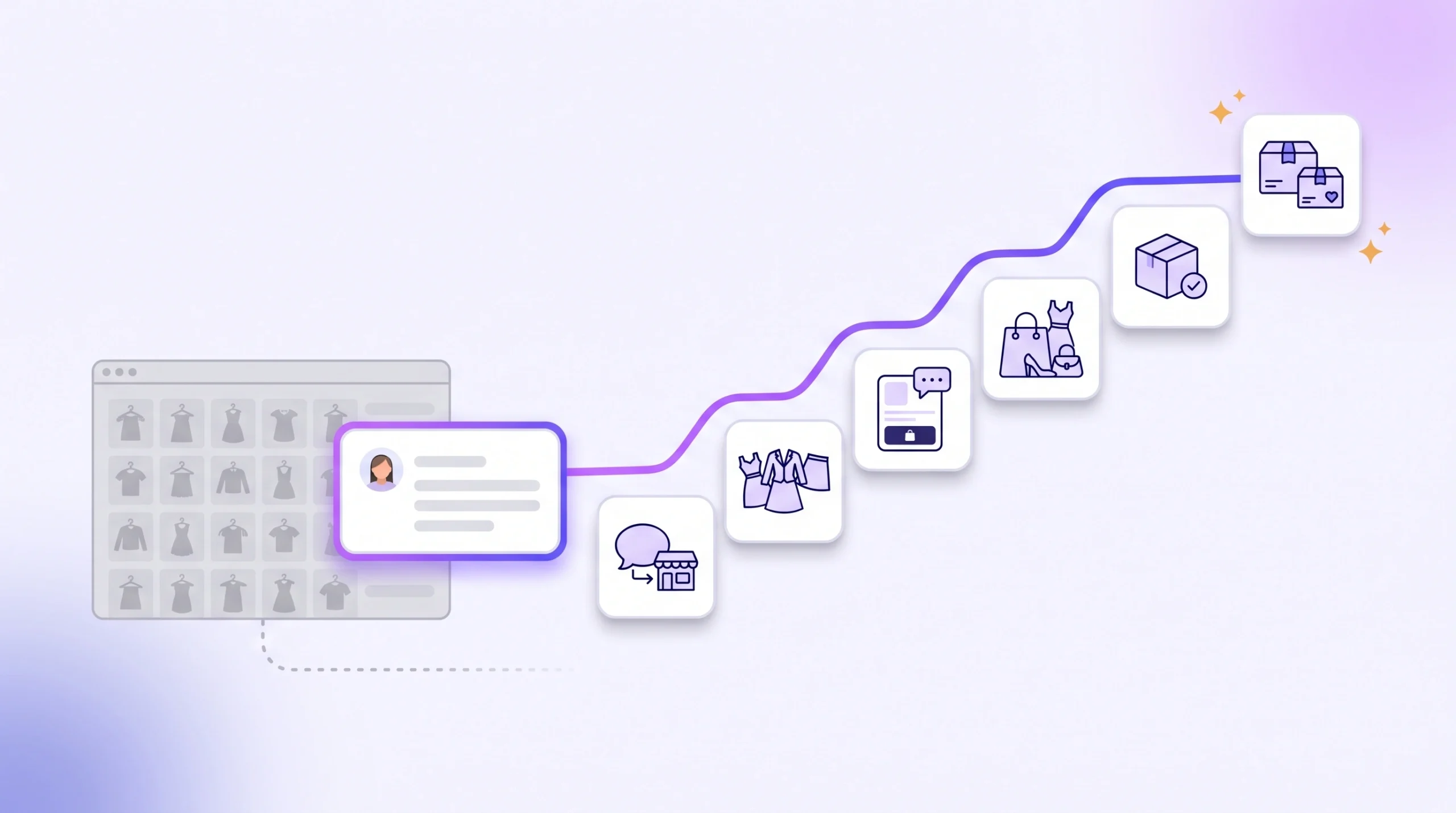
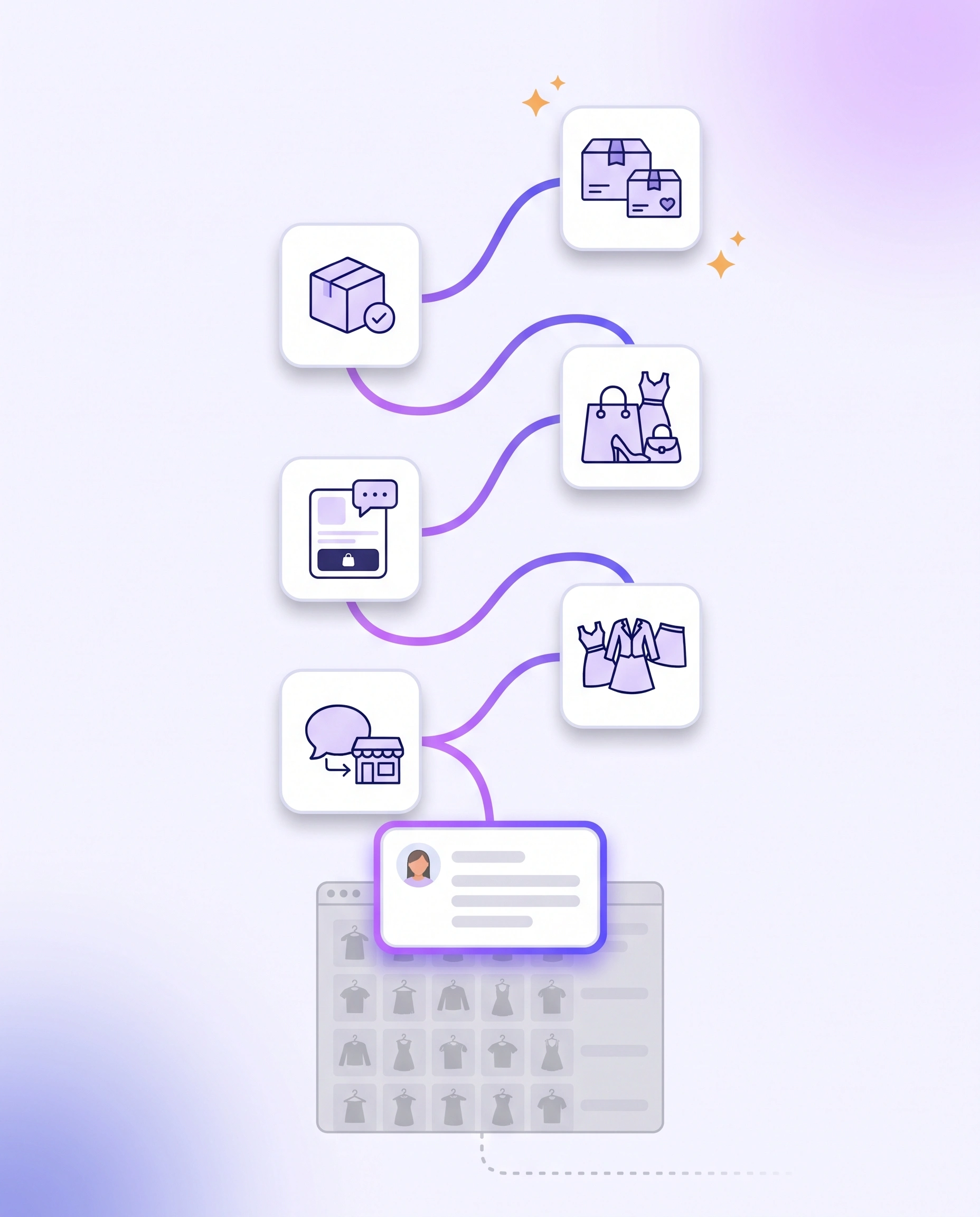
A Shopify fashion store grows through six stages, in the order a shopper meets them: AI Traffic, Engagement, Conversion Rate, AOV, Return and Repeat Purchase.
Each stage is a number you can measure, a point where shoppers leave, and a place where styling keeps them. The table gives the short version; the sections below take one stage at a time.
| Stage | What it measures | Salesperson store | Stylist store | Guides |
|---|---|---|---|---|
| AI Traffic | Visits from AI assistants | Product details live only in photos | Fabric, fit and occasion written in text AI can read | 5 |
| Engagement | Shoppers exploring looks | A grid of everything | Looks for the occasion she has in mind | 6 |
| Conversion Rate | Share of visits that buy | Photos and a size chart | An answer to the doubt that stops the order | 5 |
| AOV | Average order value | Related products from sales data | A complete outfit around the piece | 3 |
| Return | Return rate | She orders two sizes and returns one | One confident size before checkout | 4 |
| Repeat Purchase | Customers who order again | A generic discount | The next piece for the look she bought | Coming soon |
AI Traffic: do shoppers sent by AI assistants find their answer?
AI traffic is the visits that reach your store from AI assistants such as ChatGPT, Microsoft Copilot and Google’s AI Mode. AI-driven traffic to Shopify stores grew eight times in the first quarter of 2026 compared with a year earlier (Shopify, 2026), and about half of AI-referred sessions land directly on a product page (Retail TouchPoints, 2026).
A salesperson store leaves the details that matter in its photos, where an assistant cannot read them. A stylist store writes fabric, fit and occasion in plain text, so assistants recommend it, and answers the question the shopper still has when she lands. See the 5 AI Traffic guides.
Engagement: do shoppers explore past the first page?
Engagement is how far shoppers explore beyond the page they land on: opening products, looks and collections instead of leaving. In Contentsquare’s benchmark of 90 billion sessions, 53% of visitors left after a single page (Contentsquare, 2025).
A salesperson store shows a grid of everything and leaves the shopper to search. A stylist store starts from what she is dressing for and shows a few complete looks that fit the answer, through shop-by-occasion menus, style edits and outfit ideas. Read the Engagement hub or see the 6 Engagement guides.
Conversion Rate: do visitors who are interested actually buy?
Conversion rate is the share of sessions that end in an order. The average Shopify store converts about 1.4% of sessions (Littledata, 2023), and the average documented online cart abandonment rate is 70.22%, across 50 studies (Baymard Institute, 2025).
Fashion shoppers stall on doubts a photo cannot settle: will it fit, is the fabric sheer, can I wear it to this event. A salesperson store offers a size chart. A stylist store answers that doubt on the product page with fabric and fit details, styling tips, photos on more than one body and, where it helps, personal advice. Read the Conversion Rate hub or see the 5 Conversion Rate guides.
AOV: does each order hold a complete look?
Average order value (AOV) is revenue divided by the number of orders. In fashion it grows when the unit of sale changes from one garment to a complete outfit. Fashion AOV depends so much on price point that an industry average says little about your store, so compare your AOV with your own past months.
A salesperson store shows related products picked from sales data. A stylist store builds the outfit around the piece she is viewing, for the occasion she has in mind, while she is still deciding: complete-the-look pairings, buyable looks and personal outfits. Read the AOV hub or see the 3 AOV guides.
Return: do shoppers keep what they buy?
Return rate is the share of what you sell that comes back. US retailers expected 19.3% of online sales to be returned in 2025 (NRF and Happy Returns, 2025), and 53% of US apparel brands and retailers surveyed named size and fit as the top reason clothes come back (Coresight Research, 2023).
A salesperson store leaves her to order two sizes and send one back. A stylist store settles size and fit before checkout, with a size guide for each piece, fit notes, model sizes and personal fit advice, so the first order is the one she keeps. Read the Return hub or see the 4 Return guides.
Repeat Purchase: do buyers come back for the next piece?
Repeat purchase is the share of customers who order again. Only 13% of visitors return to a site within 30 days of their first visit (Contentsquare, 2026), and Bain research found that a 5% rise in customer retention can raise profits by 25% to 95% (Harvard Business Review, 2014).
A salesperson store sends the same discount to everyone. A stylist store gives each buyer a reason to come back: a next piece that completes the look she already bought, and ideas for wearing it in new ways. Read the Repeat Purchase hub; step-by-step guides for this stage are on the way.
Why do small gains at each stage add up?
Small gains add up because each stage feeds the next, so improvements multiply instead of adding: more shoppers reach a product page, more of them buy, each order is larger and more of it is kept.
Take a store that gets 10% better at four stages: the share of shoppers who reach a product page, the share of those who order, the average order value and the revenue kept after returns. The result is 1.10 × 1.10 × 1.10 × 1.10 = 1.46, about 46% more net revenue from the same traffic and the same ad spend. A store that improves only one stage by 10% gets 10%.
Read this as arithmetic, not a forecast
The 10% figures are an illustration. Use them to see why fixing several stages beats fixing one, then measure your own stages before and after each change.
How do I find my weakest stage?
Measure each stage in Shopify, compare it with a benchmark or your own past results, and start with the stage where the gap costs you the most.
- Pull 90 days of numbersNote one number per stage from the measurement table below.
- Compare each oneSet each number beside a benchmark from our benchmarks page, or beside the same 90 days last year.
- Put a price on each gapEstimate how many extra orders, or how much extra kept revenue, closing the gap would bring. The biggest amount is your weakest stage.
- Fix one stage at a timeOpen that stage’s guides and start with a DIY styling change on your best sellers.
- Measure againCompare the next 30 days with the 30 days before. For returns, wait until your return window has closed.
Find your weakest stage with the free Styling Score
Bots walk your store like a shopper. You get a score out of 100, a tier and a report, stage by stage.
How do I measure each stage in Shopify?
Each stage has one main number, and five of the six are in Shopify’s own Analytics reports.
| Stage | Main number | Where to find it |
|---|---|---|
| AI Traffic | Sessions and orders from AI assistants | Shopify Analytics sessions by referrer (chatgpt.com, copilot.microsoft.com, gemini.google.com, perplexity.ai), then the orders from those sessions |
| Engagement | Share of sessions that go beyond the first page | Your web analytics engagement or bounce rate, beside Shopify’s sessions by landing page |
| Conversion Rate | Orders divided by sessions | Shopify Analytics conversion rate, with its added-to-cart and reached-checkout steps |
| AOV | Revenue divided by orders | Shopify Analytics average order value |
| Return | Returned sales as a share of sales | Shopify Analytics returns reports, plus the reason recorded on each return |
| Repeat Purchase | Customers who order again | Shopify Analytics returning customer rate |
Where can I compare my numbers with benchmarks?
Our Shopify fashion benchmarks page lists a figure for each stage with its source and year, so you can see which of your numbers sits furthest from the norm.
Treat any benchmark as a starting line, not a target. Averages mix stores of every size, price point and region, so your own numbers from last year are often the fairest comparison.
Do I need an app to style my shoppers?
No: 19 of our 23 stage guides are DIY styling changes made with Shopify’s own tools, and the other 4 use an AI stylist for the moments that need a conversation with one shopper.
DIY styling gives every shopper the same, better information: products named so AI and Google can find them, shop by occasion menus, fit notes beside the size selector and complete the look pairings. Most take a few hours with Sidekick, Claude, metafields or the free Search and Discovery app.
AI styling answers one shopper at a time: personalized outfit recommendations, an answer to will this suit me?, a personal outfit around every product and personal size and fit advice. These need an AI stylist on your product pages.
When DIY styling is enough
A small catalogue of basics, bought by repeat customers who know their size, may need nothing more than the DIY guides. Personal styling pays off as purchases get harder to judge from a photo: occasion wear, outfits of several pieces and fit-sensitive categories such as tailoring and swimwear.
What does a stylist store look like with iWAND?
iWAND is our product.
iWAND is an AI stylist for independent fashion brands on Shopify. Its styling agents give every shopper personal outfit, fit and styling advice from the brand’s own catalogue. It is free to install, and brands pay 5% only on sales iWAND makes.
It covers the stages that need a conversation. For Engagement, it builds outfits for the shopper’s occasion and finds pieces from a description or a photo. For Conversion Rate and Return, Consult answers her doubts about one piece, including size, and Try-On shows the look on a model. For AOV, it suggests a complete outfit around the piece she is viewing and swaps items when she asks.
Where are the guides for each stage?
Every stage has its own hub and guides; start with the stage furthest from its benchmark and work along.
- AI TrafficVisits from AI assistants · 5 guides
- EngagementShoppers exploring looks · 6 guides
- Conversion RateShare of visits that buy · 5 guides
- AOVAverage order value · 3 guides
- ReturnReturn rate · 4 guides
- Repeat PurchaseRepeat purchases · guides coming
What else do founders ask about growing a fashion store?
Founders most often ask these nine questions.
How do I grow a Shopify fashion store without spending more on ads?
Grow from the visitors you already have. The average Shopify store converts about 1.4% of sessions (Littledata, 2023), so most visits end without a sale. Work through six stages, AI traffic, engagement, conversion rate, average order value, returns and repeat purchases, find the weakest one and add the styling that fixes it before buying more traffic.
What are the stages of a fashion ecommerce funnel?
A Shopify fashion store has six stages in the order a shopper meets them: AI traffic (visits from AI assistants), engagement (exploring beyond the first page), conversion rate (visits that buy), average order value, returns and repeat purchases. Each stage is a number you can measure and a point where shoppers leave.
What is a good conversion rate for a Shopify fashion store?
The average Shopify store converts about 1.4% of sessions, according to Littledata (2023). Fashion rates vary with price point and traffic source, so compare your rate with your own past months as well as the average, and look at each step, from product page to cart to checkout, to see where shoppers stop.
What is the difference between a salesperson store and a stylist store?
A salesperson store displays products and leaves the shopper to search, size and style alone. A stylist store answers her questions at each step: it starts from what she is dressing for, settles fit and fabric doubts on the product page, suggests what completes the outfit and gives her a reason to come back.
Which stage should I fix first?
Fix the stage where the gap costs you most. Measure each stage in Shopify over 90 days, compare it with a benchmark or with the same period last year, and estimate the extra orders or kept revenue that closing each gap would bring. The free Styling Score also shows which styling factors your store is missing, stage by stage.
How does AI traffic change a fashion store’s funnel?
AI-driven traffic to Shopify stores grew eight times in the first quarter of 2026 compared with a year earlier (Shopify, 2026), and about half of AI-referred sessions land directly on a product page (Retail TouchPoints, 2026). That makes the product page do the work a homepage used to do: it has to answer fit, fabric and occasion questions on its own.
How long before styling changes show results?
Compare 30 days after a change with the 30 days before for engagement, conversion rate and average order value. Returns take longer: wait until your return window has closed on a full month of orders. Repeat purchase takes longest, because customers need time to come back, so judge it over several months.
What is a stylist store?
A stylist store is a Shopify store that answers each shopper’s fit, fabric and occasion questions at every step instead of only displaying products. It starts from what she is dressing for, settles her size doubts on the product page, suggests what completes the outfit and gives her a reason to come back.
Is styling the same as personalization?
No. Personalization changes what a shopper sees based on her past behavior, such as recommended products. Styling answers what she is trying to wear and why: occasion, fit, fabric and what completes the look. A store can use both, but only styling settles the doubt that stops an order.
Sources
- Littledata. Average website performance benchmarks. 2023. littledata.io
- Contentsquare. 2025 Digital Experience Benchmarks. 2025. contentsquare.com
- Contentsquare. 2026 Digital Experience Benchmark. 2026. contentsquare.com
- Shopify. Agentic Commerce on Shopify: How It Works. Jun 18, 2026. shopify.com
- Retail TouchPoints. Shopify Credits AI for 34% Revenue Growth in Q2 2026. Aug 5, 2026. retailtouchpoints.com
- Baymard Institute. Cart Abandonment Rate Statistics. Updated Sep 22, 2025. baymard.com
- National Retail Federation and Happy Returns. Consumers Expected to Return Nearly $850 Billion in Merchandise in 2025. Oct 15, 2025. nrf.com
- Coresight Research. The True Cost of Apparel Returns: Alarming Return Rates Require Loss-Minimization Solutions. Apr 4, 2023. coresight.com
- Harvard Business Review. The Value of Keeping the Right Customers. Oct 2014. hbr.org
Free Styling Score
Find your weakest stage
The free Styling Score walks your store like a shopper and shows which styling factors are Done, Halfway or Not yet, stage by stage.
Next read
Start with the stage guides
Step-by-step guides for every stage, most of them DIY with Shopify’s own tools.