

At a glance
To increase repeat purchases on a Shopify fashion store, make the first order a keeper and give the shopper a reason to come back: the right size the first time, styling that shows what goes with what she bought, and new pieces that complete her wardrobe, not just a discount. Apparel retailers keep about 31.7% of customers (Bluecore, 2025).
Measures: customers who order again
Benchmark: apparel retention 31.7%
Guides: coming soon
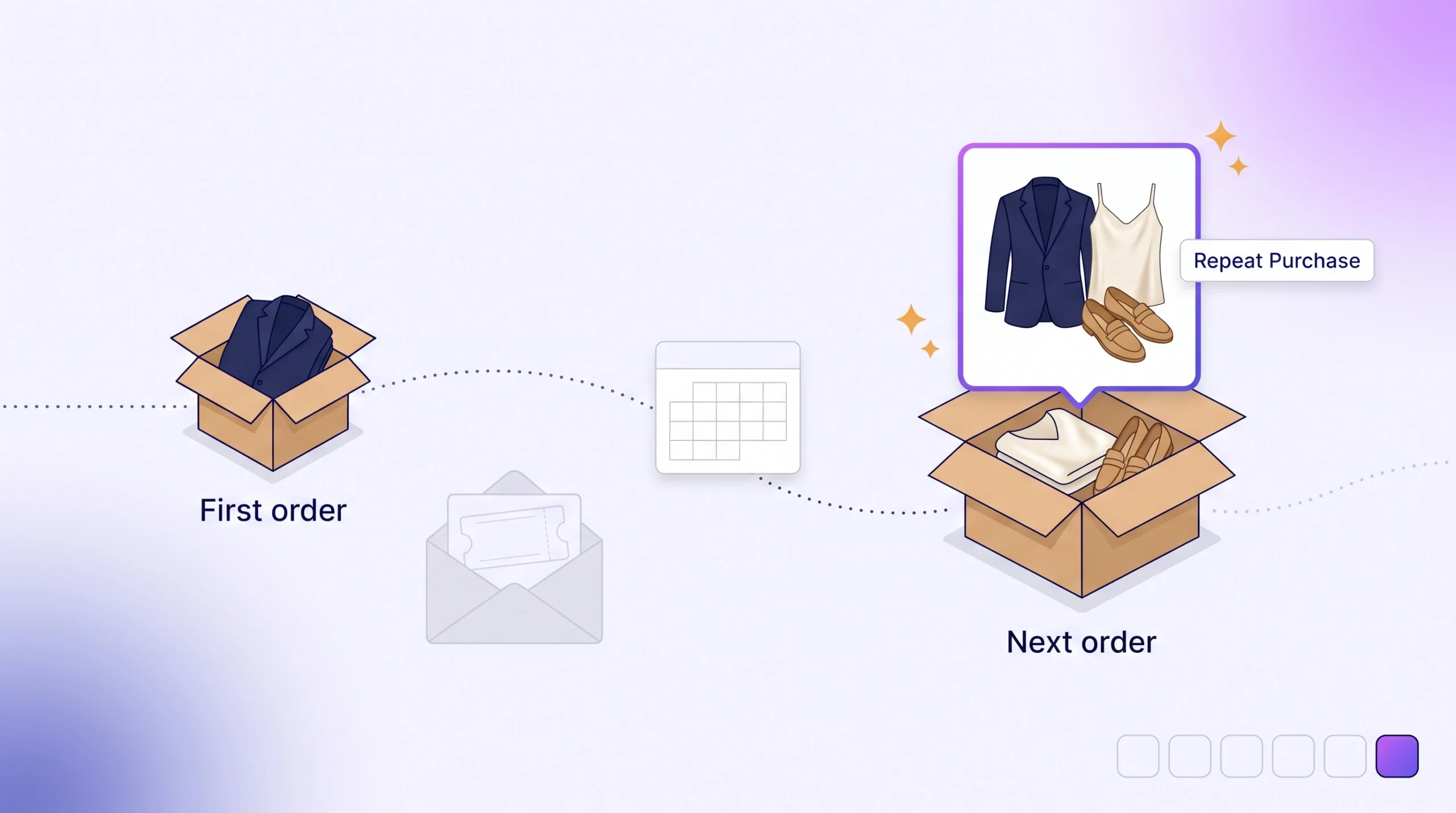
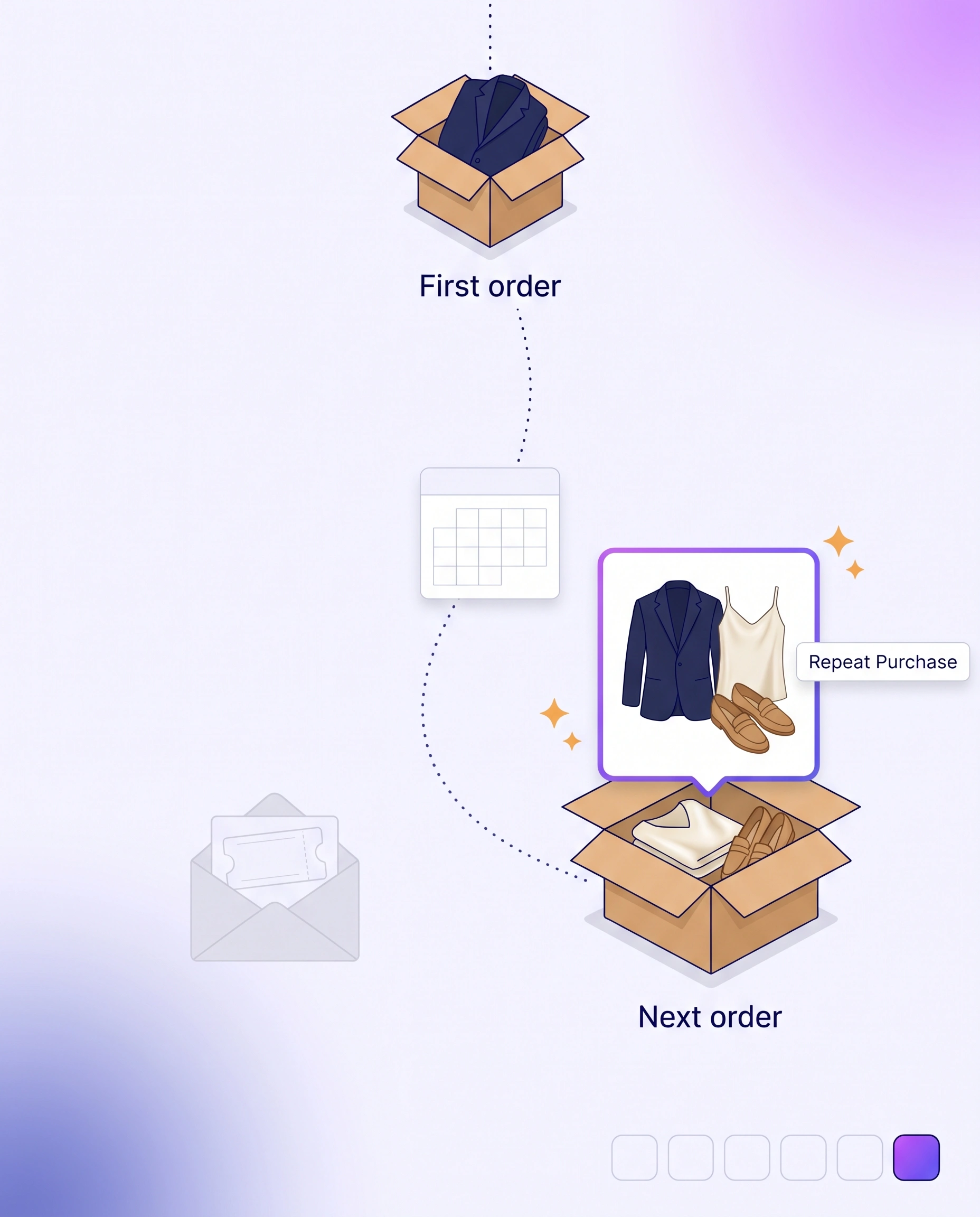
She bought a navy blazer from you in March and kept it. In June an email arrives: 10% off everything. She taps through to a grid of new arrivals, and nothing on it goes with the blazer. She closes the tab. You paid to win her once, and the second order never happens.
Repeat purchase rate is the share of customers who come back and order again. In a fashion store the second order usually depends on two things: the first order worked, and the shopper can see what to buy next to go with it. It is the last of six stages in a Shopify fashion store, after Return, where the first order has to stay kept, and it feeds back into the first stage, AI Traffic, as loyal customers recommend you.
This hub covers what to measure, what a normal number looks like, why first-time buyers don’t come back, and five fixes that give them a reason to, most of them with Shopify’s own tools.
Part of Grow Your Shopify Fashion Store with Styling: Salesperson to Stylist, our guide to the six stages of a Shopify fashion store.
In this guide
A salesperson
sends a discount code and hopes she comes back.
A stylist
shows her what goes with what she already bought.
What is repeat purchase rate for a Shopify fashion store?
Repeat purchase rate is the share of your customers who have placed two or more orders, measured over a set period or for a group of customers who first bought at the same time.
Shopify gives you four reports that describe it from different angles. Pick one as your main number and keep the others as checks.
| Report | What it tells you | Where to find it |
|---|---|---|
| Customer cohort analysis | How many customers who first bought in a given month came back later, with customer retention rate as one of its metrics | Shopify Analytics, customers reports |
| Returning customers | Every customer whose order history holds two or more orders | Shopify Analytics, customers reports |
| One-time customers | Customers who have ordered once and not again | Shopify Analytics, customers reports |
| RFM customer analysis | Groups customers by how recently, how often and how much they buy | Shopify Analytics, customers reports |
The cohort view is the most useful for a fashion store. It shows not just how many customers come back, but how long after the first order they usually do, which tells you when to give them a reason.
What is a good repeat purchase rate for a fashion store?
Apparel retailers keep about one customer in three, so a good target is a rate above your own starting point, measured the same way each time.
31.7%
is the average customer retention rate of apparel retailers, against 27.4% across seven retail sectors. Once a shopper buys twice, her chance of buying a third time rises by 95%.
Source: Bluecore, 2025, Customer Growth Benchmarks Report, 2024 data, as reported by Shopify
The same research shows how other sectors compare, and how many customers never come back at all.
| Benchmark | Figure | Source | Year |
|---|---|---|---|
| Apparel retailers, customer retention rate | 31.7% | Bluecore | 2025 |
| Seven retail sectors combined, customer retention rate | 27.4% | Bluecore | 2025 |
| Footwear, and jewellery and accessories, customer retention rate | 22.2%, and 19.1% | Bluecore | 2025 |
| Share of a retailer’s customers who buy only once | Nearly three-quarters | Bluecore | 2025 |
No independent benchmark covers repeat purchases for fashion stores on Shopify alone yet. That makes your own cohort report the number to beat.
Retention and repeat rate are not the same number
A retention rate compares the customers you had at the start of a period with those still buying at the end. Shopify’s Returning customers report counts everyone with two or more orders, and the cohort report follows customers from their first order. Each gives a different number, so pick one and compare it with itself over time.
Why don’t first-time fashion buyers come back?
First-time buyers don’t come back when the first order didn’t work for them, or when nothing about the next visit gives them a reason to buy the next piece.
The first order didn’t fit
A shopper whose first order went back in the post has learned that your sizes are a gamble. Getting the first order right is the cheapest repeat-purchase fix there is, and the Return hub covers it.
She had nothing to wear it with
A single piece that doesn’t fit into her wardrobe stays in the cupboard, and so does your brand. When the first order is an outfit, or the start of one, she has a reason to come back for the rest. The AOV hub shows how to sell the look, not the piece.
The next visit looks like the first
An email brings her back to a grid of new arrivals. Nothing on it connects to the blazer she bought, so the visit asks her to start from scratch. A returning customer needs a shorter path than a stranger, not the same one.
Every message is a discount
A code gives her a lower price, not a reason. When every email after the first order is an offer, she learns to wait for the next one, and the orders you do win come with less margin.
Some reasons are not about styling
Poor quality, slow delivery and a hard return lose customers whatever you send them next. Read your reviews and support tickets for these first, then fix the styling.
Which pattern shows up in your reports?
Each pattern points to a different first fix.
| What you see | What it means | Start with |
|---|---|---|
| Many first orders come back | The first order didn’t fit, so there is no second | The Return hub |
| Most first orders hold a single piece | She bought a piece, not an outfit | The AOV hub |
| Customers open your emails but don’t order | The page they land on doesn’t connect to what they bought | New-arrival edits built around your best sellers |
| Repeat orders cluster around sales | Customers wait for a discount | A styling email after delivery instead of a code |
| Second orders arrive after your emails have stopped | Your messages end before her usual time to buy again | A second-order message timed from your cohort report |
Check your styling factors with the free Styling Score
Bots walk your store like a shopper. You get a score out of 100, a tier and a report that shows which styling factors are done, stage by stage.
Which fixes raise repeat purchases?
Five fixes raise repeat purchases: make the first order fit, send styling after delivery, build new arrivals around what customers already own, time a second-order message, and add personal outfit advice.
Step-by-step guides for this stage are on the way. Until then, the table shows what each fix is and which Shopify tools it uses.
| Fix | What it is | Main tools | Guide |
|---|---|---|---|
| Make the first order fit | A size guide for each piece, fit notes and model sizes, so the first order is kept | Metafields, a reviews app | 4 guides in Return |
| Send styling after delivery | An email a few days after delivery: how to wear the piece, and two pieces that go with it | Shopify’s marketing automations or Shopify Flow | Coming soon |
| Build new arrivals around best sellers | Small edits that show new pieces with the best sellers customers already own | Shopify collections, Sidekick | Coming soon |
| Time a second-order message | A message to one-time customers at the point your cohort report shows most second orders arrive | Customer segments, Shopify’s marketing automations | Coming soon |
| Add personal outfit advice | A personal AI stylist that builds outfits around a piece she already owns | A personal AI stylist app | Coming soon |
Which fix should I start with?
Start with the first order: if many first orders come back, no message will win the second. Then send styling after delivery, because it reaches every new customer at the moment she is deciding whether your brand fits her wardrobe.
Do discounts and loyalty points bring fashion shoppers back?
They can bring a shopper back, but they don’t give her a reason to buy the next piece, so they work best alongside styling, not instead of it.
| Approach | What brings her back | What it costs | What she learns |
|---|---|---|---|
| Discount code | A lower price | Margin on every order that uses it | To wait for the next code |
| Loyalty points | A reward for spending | Margin when points are redeemed, plus the app | That spending earns rewards |
| Email or SMS reminder | A message at the right time | Time to write and set up | Whatever the message teaches her |
| Styling content | A look that uses what she already bought | Time to style and photograph | That your store helps her dress |
| Personal AI stylist | An outfit built around a piece she owns | The app’s fee | That she can ask your store for advice |
Email decides whether she comes back; the page she lands on decides whether she buys. Use your messages to bring her back with a look, not a code, and save discounts for the moments when price is the real reason she hasn’t ordered.
Is repeat purchase rate the same as customer lifetime value?
No: repeat purchase rate counts how many customers order again, while customer lifetime value is how much a customer spends with you over time, so a higher repeat rate is the main way a fashion store grows lifetime value.
Customer lifetime value (LTV) is average order value times the number of orders a customer places over a period. Multiply by your gross margin to see what she is worth in profit. Order value is covered in the AOV stage; the number of orders is this stage.
Take 1,000 first-time customers at $113 each, the median fashion order on Shopify (Littledata, 2026). If 20% order once more, the group spends $135,600. If 30% do, it spends $146,900: $11,300 more from customers you have already paid to win. This is arithmetic, not a measured result.
What does a personal AI stylist add to the second order?
iWAND is our product.
iWAND is an AI stylist for independent fashion brands on Shopify. Its styling agents give every shopper personal outfit, fit and styling advice from the brand’s own catalogue. It is free to install, and brands pay 5% only on sales iWAND makes.
When a customer comes back, five agents help her find the next piece that works with what she has:
- Pair lets her upload a photo of a piece she already owns, such as the blazer she bought from you, then builds a complete outfit around it from your catalogue.
- Complete builds the rest of the look around the piece she is viewing.
- Style asks where she is going and builds the outfit for that occasion.
- Try-On shows the outfit on a model matched to what she described, so she can judge the look before she buys.
- Size asks her height, usual size and how she likes clothes to fit, then names her size in that piece, so the second order is kept too.
iWAND doesn’t keep a profile between visits; each visit starts from what she tells it or shows it. Bringing her back is still the job of your emails and messages. Judge it on your own catalogue, not on a demo: a stylist can only build outfits from what you stock.
How do I measure repeat purchases in Shopify?
Use the customer cohort analysis to see how many customers order again and when, change one thing, then compare a later cohort at the same age.
- Set your baselineIn Shopify, open
Analytics › Reportsand the customer cohort analysis. Note the share of customers from each of the last six months of first orders who have ordered again. - Find your repeat windowIn the same report, see in which month after the first order most second orders arrive. That is when a second-order message should land.
- Size your one-time customersOpen the One-time customers report, or build a customer segment of customers with exactly one order. This is the group every fix in this stage is for.
- Change one thingAdd one fix, such as a styling email after delivery, for every new customer from a set date.
- Compare cohorts at the same ageCompare customers who first bought after the change with an earlier cohort, at the same point after their first order, such as 90 days.
Where does Repeat Purchase fit in the six stages?
Repeat Purchase is the last of six stages: it turns a kept first order into a second one, and every stage before it decides whether she has a reason to come back.
- AI TrafficVisits from AI assistants · 5 guides
- EngagementShoppers exploring looks · 6 guides
- Conversion RateShare of visits that buy · 5 guides
- AOVAverage order value · 3 guides
- ReturnReturn rate · 4 guides
- Repeat PurchaseRepeat purchases · guides coming
What else do founders ask about repeat purchases?
Founders most often ask these six questions.
What is a good repeat purchase rate for a clothing store?
Apparel retailers had an average customer retention rate of 31.7%, against 27.4% across seven retail sectors (Bluecore, 2025, using 2024 data). No independent benchmark covers fashion stores on Shopify alone yet, so measure your own rate in Shopify’s customer cohort analysis and aim to beat it.
When should I email a customer after her first order?
Send a styling email a few days after delivery, showing how to wear the piece and what goes with it, rather than a discount. Then time a second-order message from your own customer cohort analysis, at the point after the first order when most of your second orders arrive.
Do loyalty programs work for fashion stores?
They reward spending, which can tip a customer who is already close to ordering again. They cost margin when points are redeemed and don’t tell her what to buy next, so pair them with styling content that shows new pieces with what she already owns.
What is the difference between repeat purchase rate and customer lifetime value?
Repeat purchase rate is the share of customers who order more than once. Customer lifetime value is average order value times the number of orders a customer places over a period. Raising the repeat rate is the main way a fashion store raises lifetime value.
Why do most first-time buyers never come back?
Bluecore found that nearly three-quarters of a retailer’s customers buy only once (2025). In fashion, common reasons are a first order that didn’t fit, a piece with nothing to wear it with, a next visit that ignores what she bought, and messages that only offer discounts.
Can an AI stylist bring customers back?
Not on its own: your emails and messages bring her back. Once she is on your store, a personal AI stylist can build an outfit around a piece she already owns, from a photo she uploads, which gives her a reason to buy the next piece.
Sources
- Bluecore. 2025 Customer Growth Benchmarks Report, more than 100 retailers across seven sectors, 2024 calendar-year data. 2025. bluecore.com
- Shopify. Average customer retention rate by industry (Bluecore data). September 4, 2026. shopify.com
- Littledata. Fashion & Apparel benchmarks, 76 Shopify stores. Data July 27 to October 24, 2026. Checked Oct 28, 2026. littledata.io
- Shopify Help Center. Customers reports: customer cohort analysis, returning customers, one-time customers and RFM customer analysis. Checked Oct 28, 2026. help.shopify.com
Free Styling Score
See which styling factors your store is missing
The free Styling Score walks your store like a shopper and shows which styling factors are Done, Halfway or Not yet, stage by stage.
Next read
See all six stages in one place
Repeat purchases close the loop. The six-stage guide shows where a Shopify fashion store loses the most, and which stage to fix first.