

This article is part of our Master Guide to Shopify Agentic Commerce in 2026, focused on moving from third-party LLM syndication to a Sovereign Inside Agent model that protects brand equity, first-party data, and boosts conversions.
The fashion website, as we know it, is in trouble.
For the last 15 years, the experience has been exactly the same. A grid of photos. A sidebar of filters. A search bar that only understands keywords. It is essentially a paper catalog digitized.
Critics are now saying that the website is dead. They argue that in the era of Agentic Commerce, shoppers will stop visiting stores entirely and will just ask ChatGPT to “buy me a shirt.”
But they are missing the point. The website isn’t dead. The static website is dead.
The solution isn’t to abandon your beautiful Shopify fashion store and become a supplier for a faceless AI bot. The solution is to wake your website up.
You need an Agentic Layer.
The Expert Consensus: Don’t Rent Your Brain, Own It
Major strategy firms are already sounding the alarm. They are warning brands that if they rely solely on third-party agents (like Google or OpenAI) for discovery, they will lose their competitive edge.
McKinsey notes that the smartest organizations are not waiting for ChatGPT to sell their products. Instead, they are creating “agent-ready sites” that provide both strong agentic and consumer experiences.
BCG is even more specific. They stress that retailers must launch “proprietary agents that showcase their brand’s unique edge.”
Why? Because if you outsource the intelligence, you outsource the relationship.
For Shopify fashion stores, this is the strategic imperative of the decade. You cannot afford to let a generalist AI control how your products are described, styled, or recommended. You need a “Proprietary Agent” that lives on your turf, speaks your language, and pushes your inventory.
What is the “Agentic Layer”?
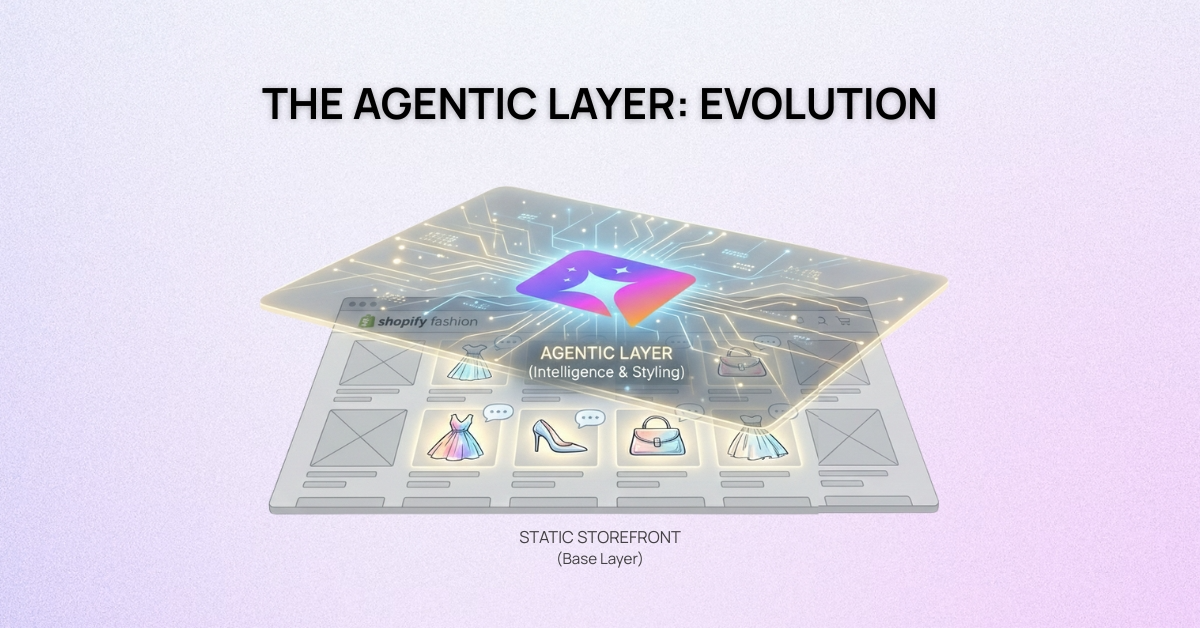
Imagine your current Shopify store as a beautiful, high-end boutique… but with no staff. The clothes are there, the lighting is perfect, but the customer is alone. If they can’t find their size, they leave. If they don’t know what matches the pants, they don’t buy the top.
The Agentic Layer is the digital equivalent of hiring a team of expert stylists to walk the floor.
It is not a chatbot that pops up to ask “How can I help?” It is an intelligent infrastructure that sits on top of your existing store.
This is exactly what iWAND provides.
- It is Invisible yet Omnipresent: The layer connects your product data to an intelligent brain without disrupting your visual design.
- It is “Chat with Store”: Instead of searching for “red dress,” a user interacts with the layer: “I need something for a gallery opening in SoHo that looks effortless but expensive.”
- It is Context-Aware: The layer knows your inventory better than any human. It knows that the silk blouse on page 3 is the perfect match for the trousers in the user’s cart.
The Best of Both Worlds: Convenience meets Immersion
The problem with selling on external Agentic Storefronts (like ChatGPT) is that you lose the vibe. You lose the fonts, the videos, and the “world-building” that justifies your price point.
The Agentic Layer solves this paradox.
With iWAND, the customer gets the convenience of an AI agent, but they get it while immersed in your brand world.
- The 2 AM Crisis: A customer is panic-buying for a wedding. On a static site, they are frantically filtering by size and color. With the Agentic Layer, they tell iWAND the venue and the dress code, and the agent instantly curates a “mini-collection” from your stock that fits the brief.
- The “Bundle” Effect: Static sites hope users click “Related Items.” The Agentic Layer actively styles the user. “If you are getting that skirt, this belt was designed to sit exactly on the waistline to create the silhouette you want.”
Conclusion: Your Store, Your Agent, Your Future
The shift to Agentic Commerce is inevitable. Customers will expect to talk to stores, not just click on them.
But you have a choice to make. You can let a third-party tech giant be the “Stylist” for your brand, reducing you to a backend supplier. Or, you can install your own Agentic Layer with iWAND.
By choosing the latter, you follow the advice of industry experts like McKinsey. You turn your Shopify fashion store into an “agent-ready” destination where you own the data, you own the experience, and most importantly, you own the relationship.
Don’t let your website become a relic. Give it a brain.
Elevate Your Shopify Store with iWAND Stylist Agentic Layer
AI stylist for Shopify fashion stores that turns browsers into loyal buyers.
Free, no code, no setup stress
What is an “Agentic Layer” for Shopify fashion stores?
An Agentic Layer is an intelligent software infrastructure that sits on top of an existing e-commerce site to transform it from a static catalog into an interactive, conversational destination. Unlike third-party AI agents that live on external platforms, an Agentic Layer like iWAND operates within your own Shopify domain. It allows customers to “chat with the store” to receive personalized styling advice, size recommendations, and outfit bundles without ever leaving your branded environment.
Why are McKinsey and BCG recommending proprietary AI agents for retailers?
Strategy firms like McKinsey and BCG emphasize proprietary agents because they prevent “brand dilution” and “disintermediation.” If a brand relies on a generalist AI (like a third-party LLM) to sell its products, it loses control over how its story is told and how its data is collected. By launching a proprietary agent on an “agent-ready site,” Shopify fashion brands can showcase their unique style edge while securing direct customer engagement and first-party data.
How does an Agentic Layer prevent Shopify fashion brands from becoming “commodity suppliers”?
When you add an Agentic Layer to your store, you move beyond the “search and filter” model which often forces brands to compete purely on price and specs. The Agentic Layer functions as a specialized stylist that reinforces your brand’s value proposition through expert consultation. It ensures that the “Brand Theater”—your photography, aesthetic, and narrative—remains central to the shopping experience, protecting your pricing power in an AI-driven market.
Can an Agentic Layer help reduce return rates for fashion brands?
Yes. One of the primary causes of high return rates in fashion is “purchasing uncertainty.” An Agentic Layer acts as a pre-purchase consultant, answering specific questions about fit, fabric sensitivity, and styling suitability. By providing high-touch guidance before the checkout, the agent ensures the customer feels confident that the item truly suits them, which significantly lowers the likelihood of returns.
What is the difference between a “static” website and an “agent-ready” storefront?
A static website is a passive experience where the customer does all the work: scrolling, filtering, and searching. An agent-ready storefront is an active environment where the site “talks back.” Using an Agentic Layer, the store proactively assists the shopper, builds complete looks, and handles complex queries. This evolution meets the rising consumer demand for conversational commerce while keeping the brand’s unique UI and identity front and center.