

Updated September 30, 2026: corrected the agent count to eight plus Virtual Try-On, and updated pricing to free to install with 5% of attributed sales.
At a Glance:
- The Problem: The average Shopify store converts about 1.4% of sessions (Littledata, 2023) and 70.22% of ecommerce carts are abandoned (Baymard Institute). Fashion shoppers leave because nobody answers the question standing between liking an item and buying it.
- The Concept: An AI stylist is a conversational agent that asks about body, occasion and existing wardrobe, then assembles complete outfits from the store’s own catalogue instead of returning a filtered grid of single products.
- The Solution: iWAND runs eight named agents plus Virtual Try-On inside a Shopify store, delivering up to 4% conversion rate lift, up to 18% higher average order value and up to 15% lower return rates (iWAND platform data).
Table of Contents
What an AI Stylist for Shopify Fashion Stores Actually Does
An AI stylist for Shopify fashion stores is a conversational agent that asks a shopper about their body, the occasion and their existing wardrobe, then assembles complete outfits from the store’s own catalogue and renders them on a model matched to the shopper. iWAND is an AI stylist and virtual try-on app for Shopify fashion stores, built on Shopify’s Shop Minis, that talks to shoppers, builds complete outfits from the store’s own catalogue, and shows them on a matched model.
The gap it addresses is measurable. The average Shopify store converts about 1.4% of sessions, while the top 10% convert above 4.7%, according to Littledata’s 2023 benchmark. That spread is not usually a traffic problem. It is a guidance problem: the top decile answers the shopper’s real question before the tab closes, and everyone else waits to be searched.
This guide covers the psychology of why fashion shoppers hesitate, the difference between a support chatbot and a stylist, what Ralph Lauren, Zalando, Mango and ASOS have already shipped, how Virtual Try-On closes the last gap before checkout, and what all of it does to conversion, order value, returns and retention. As of September 2026, every capability described here is available to independent Shopify merchants, not only to enterprise retail.
Why Stores Lose Sales They Should Have Won
Fashion shoppers abandon purchases they intended to make because the store cannot answer a question the shopper cannot easily type. Baymard Institute puts the average cart abandonment rate at 70.22% across 50 studies. The friction is rarely price. It is uncertainty about fit, occasion appropriateness, and whether the item works with anything already in the wardrobe.
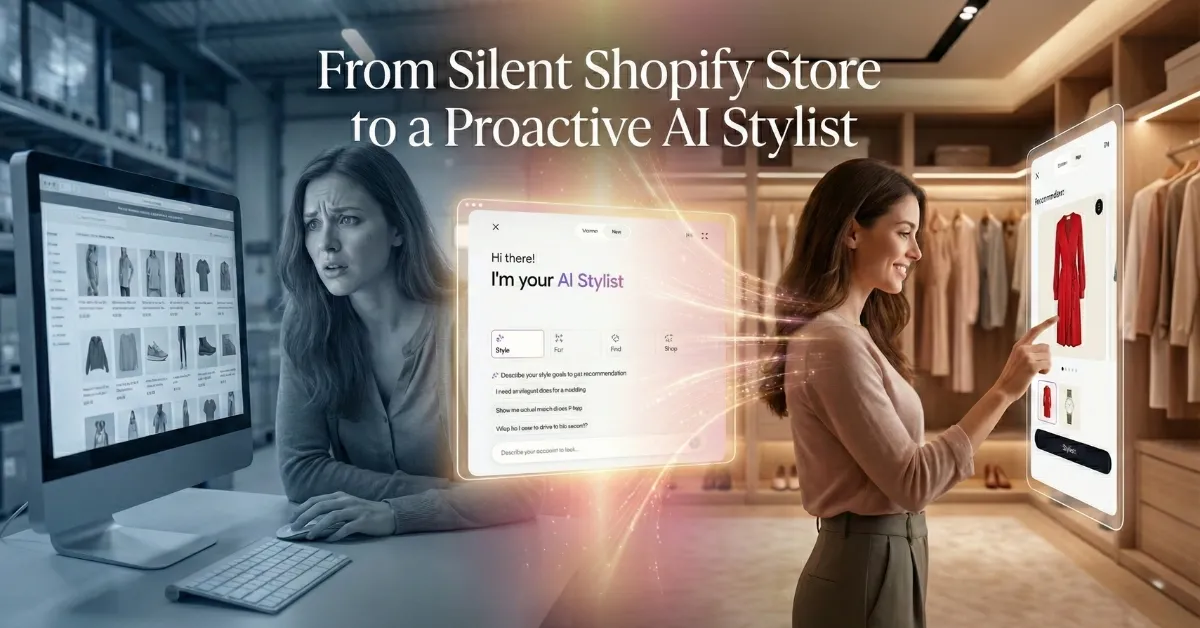
Picture a customer named Mia. She is hunting for a dress for her best friend’s wedding next month. She has the budget and the intent. After six minutes of scrolling through grid after grid of beautiful product images, she sighs, closes the tab and leaves.
She did not leave because the prices were too high or the inventory was wrong. She left because she had a question nobody answered. Whether the fabric would be too hot for an outdoor garden ceremony. Whether the cut would flatter her hips. Which shoes would match the hemline. In a physical boutique a stylist would have noticed the hesitation, asked about the venue, reassured her about the fit and suggested the heels. That conversation turns a maybe into a sale. Online, Mia was alone.
The “Silent Store”: A Catalogue That Waits to Be Searched
The Silent Store is an online shop that presents its full catalogue and waits for the shopper to search, filter and decide alone, offering no guidance at the moment of hesitation. It is the dominant design pattern in Shopify fashion, and it is expensive. Contentsquare’s 2025 benchmark, built on 90 billion sessions across 6,000 sites, found that 53% of visitors bounced after viewing a single page and 40% of visits showed signs of user frustration.
The economics are moving the wrong way at the same time. The same Contentsquare research found cost per visit rose 9% in 2024 while conversion rates fell 6.1% year over year. Paying more for traffic that converts less is not a marketing problem you can outspend. The reasons fashion traffic bounces sit inside the experience, not inside the ad account.
Silence used to be neutral. It is not any more. Every silent minute on a product page is a shopper building their own case against the purchase.
Part I — The Crisis of Connection: Why Fashion Shoppers Leave
Fashion shoppers leave stores for three structural reasons: too many undifferentiated options, no way to resolve doubt about fit and suitability, and a search bar that understands product tags rather than human intent. Each is a psychological failure rather than a technical one, and each is invisible in standard analytics, which records the exit but not the unanswered question behind it.
The modern Shopify store is often a masterpiece of photography and web design that remains fundamentally disconnected from the person on the other side of the glass. Years went into site speed and image quality. Almost nothing went into the emotional bridge that carries a customer from “just looking” to “checked out.”
Chapter 1: The Paradox of Choice — Why More Options Produce Fewer Sales
The paradox of choice is the finding that beyond a certain point, adding options reduces the likelihood a person chooses anything at all. In the Iyengar and Lepper jam study, 30% of shoppers bought from a six-option display compared with 3% from a 24-option display. Fashion catalogues routinely present hundreds of options per category with no curation layer.
There is a common myth in fashion retail that more choice equals more sales, that five hundred styles of denim serve customers better than fifty. When a shopper faces an endless sea of options without curation, their brain undergoes a subtle but exhausting shift. Instead of feeling inspired, they feel overwhelmed. Every product scrolled past is a fresh decision. Is this one better than the last? Does this brand run small? Would the other blue have worked?
The High Cost of Analysis Paralysis
Analysis paralysis in fashion ecommerce ends in a saved wishlist rather than a purchase. When the brain reaches its processing limit, it takes the cheapest available exit, which is to make no decision. Contentsquare’s 2026 benchmark found that only 13% of visitors return within 30 days of their first visit, so the deferred decision rarely comes back.
This is the birth of the “Maybe.” In fashion, a Maybe is the most dangerous word in the vocabulary, because it almost always resolves into a closed tab. A shopper saving an item is not promising to buy it later. They are escaping the pressure of choosing now. By forcing the customer to do all the filtering work, the store pushes them toward paralysis and calls it self-service.
Curation reverses the load. An AI stylist narrows hundreds of options to three or four justified choices, which is the same job a boutique associate performs by walking a rack with you. The mechanics of fixing choice paralysis with agentic styling come down to who does the narrowing: the shopper, or the store.
Chapter 2: The “Certainty Gap” — Why Confidence Sells More Than Discounts
The Certainty Gap is the distance between a shopper liking an item and believing that item belongs in their life, and it is closed by information rather than by price. Discounts address financial friction. The Certainty Gap is psychological friction, which is why a 20% code does not move a shopper who is unsure whether a silk midi skirt will cling.
Look at the promotional strategy of most Shopify fashion stores and you see the same pattern: 10% off popups, end-of-season clearance banners, urgency timers. These are the tools of a merchant who believes price is the primary objection. A discount creates urgency for someone already convinced. It does almost nothing for someone stuck.
In fashion, a purchase is rarely about utility. You do not buy a blazer because you lack a garment to keep you warm. You buy it because of how you want to be perceived in your next meeting. That makes every purchase emotional and high-stakes, and it means the real objection is almost never the last $10.
Why the Discount Bandage Fails
Discounting to solve a confidence problem trains shoppers to wait for sales without answering their question. Aggressive discounting can actively lower confidence by signalling that an item is not selling or that quality is questionable. Confidence works in the opposite direction: when a customer feels certain, willingness to pay full price rises, decision time shortens, and the likelihood of a return drops.
There is also a margin argument. Every point of discount is a point of gross margin surrendered in perpetuity, because the customer recalibrates what your brand is worth. Every point of certainty is bought once and compounds. The full case for confidence over discounts in Shopify fashion stores is a margin case before it is a psychology case.
The Five Levers of Fashion Certainty
Closing the Certainty Gap means addressing five specific psychological levers that operate on every fashion purchase. A store that answers all five converts without discounting; a store that answers none discounts and still loses the sale.
- Identity alignment: the shopper needs to believe the item represents who they are or who they want to be.
- Risk mitigation: the shopper needs reassurance that they will not look wrong or feel uncomfortable.
- Anticipated regret: the shopper needs to expect satisfaction rather than embarrassment when the package is opened.
- Mental simulation: the shopper needs to picture themselves wearing the item in their actual life.
- Social validation: the shopper needs the sense that a trusted friend or an expert would approve.
In a boutique a human handles all five without thinking. They see a shopper pause at a mirror and say something simple: “That neckline really frames your face,” or “We can pair this with those boots to make it more casual.” That single moment of validation collapses the gap and gives the shopper permission to buy.
Recreating the “Friend Effect” Online
Online shoppers browse in isolation, with no second opinion at the moment of doubt, so they simulate the ways the purchase could go wrong. They imagine the return, the disappointment, the item that looks nothing like the photo. Absent feedback, the imagination defaults to pessimism, and pessimism closes tabs.
Personalised interaction is now the expectation rather than the perk. McKinsey found that 71% of consumers expect personalised interactions and 76% get frustrated when they don’t get them, with personalisation driving a 10–15% revenue lift. The instinct to make products cheaper is the wrong instinct. The opportunity is to make customers more certain.
Chapter 3: The Broken Search Bar — When Keywords Fail Stories
Keyword search fails fashion because shoppers buy for occasions, moods and body concerns, while search indexes are built on product attributes like colour, fabric and cut. A shopper typing “dress for garden party that hides arms” is describing three things at once, and a standard search engine can match none of them. The result is a zero-results page, and Baymard Institute finds nearly 50% of ecommerce sites have no effective way to recover the shopper after a zero-results search.
That matters because search users are the most valuable traffic on the site. Econsultancy reports that site-search visitors convert at roughly 1.8x the site average (4.63% vs. 2.77%). The shoppers most ready to buy are the ones most likely to be told their query returned nothing.
The Dictionary vs. The Human
A search bar is a dictionary that understands words; a shopper is a human who understands stories. Most ecommerce search is built on a warehouse model, designed to retrieve SKUs by tags such as “blue,” “cotton,” or “v-neck.” Fashion is rarely bought by the tag.
People shop for the vibe, the mood, the moment. A shopper might want “something that makes me look taller” or “an outfit for a high-stakes presentation.” Since no product is tagged “confidence” or “authority,” the bar fails. The shopper does not conclude that the search tool is limited. They conclude that the store does not have what they want.
Occasion Intent and the Failure of Filters
Filters cannot encode social context. A white lace dress is perfect for a graduate and a disaster for a wedding guest, yet no colour or material filter distinguishes the two. “Corporate chic” and “boho festival” are feelings, not attributes, and attribute filters are the only vocabulary a standard store offers.
Intent-based shopping is a discovery model in which an AI agent asks about a shopper’s body, the occasion, and their existing wardrobe, then matches products to that context instead of to typed keywords.
iWAND handles this with two agents. The Find Agent replaces keyword filters with conversational search, so the garden-party query returns styled options rather than an empty page. The Snap Agent performs visual search from an inspiration photo, which is how most shoppers actually arrive at a look: with a screenshot, not a vocabulary. The shift from search to intent is the single largest change in how fashion discovery works.
Part II — The Solution: What the AI Stylist Experience Looks Like
An AI stylist changes a store from a queryable database into a guided experience by initiating the conversation, gathering context about the shopper, curating rather than filtering, and showing the result visually before purchase. The four chapters in this section cover what separates a stylist from a chatbot, what enterprise brands have already shipped, how personalisation reaches body and identity, and how Virtual Try-On closes the final gap.
Chapter 4: Clerk vs. Stylist — The Difference Between Support and Sales
A support chatbot is reactive and handles logistics after intent is formed; an AI stylist is proactive and creates intent during discovery. The distinction is not cosmetic. One is a cost-reduction tool measured in deflected tickets. The other is a revenue tool measured in conversion and order value. Most Shopify fashion stores have installed the first and believe they have the second.
The Passive Clerk: Managing the Aftermath
A traditional support chatbot answers questions about orders, shipping and returns, which are all questions a shopper asks after deciding to buy. It is polite, useful and entirely reactive. It waits to be approached with a problem.
This is essential infrastructure. It is also irrelevant to the discovery phase, where the revenue is decided. A clerk can process the return of a dress that did not fit. A clerk cannot find the dress that makes someone feel like the best version of themselves. A store whose only AI presence is a support bot has automated the cheapest part of the journey and left the expensive part silent. The full comparison of support chatbot versus AI stylist comes down to which phase of the journey each one occupies.
The Proactive Stylist: Guiding the Discovery
An AI stylist initiates contact based on what the shopper is viewing, asks about occasion and preference, and returns curated outfits rather than a filtered list. In a high-end boutique you are not met by someone behind a counter. You are met at the door by someone who helps you find a solution before you have articulated the problem.
Fashion discovery is a vulnerable, creative process, and shoppers in that phase are looking for an expert who can reduce a large catalogue to a few right answers. iWAND’s Style Agent conducts that interview across the store, covering body type, skin tone, occasion and mood, then curates full outfits from the catalogue. It applies fashion logic rather than purchase correlation: a professional blazer implies tailored trousers and a silk camisole, and a petite shopper needs different proportions than a tall one.
| Approach | What it does | When it acts | Main limitation |
|---|---|---|---|
| Support chatbot | Answers order, shipping and returns questions | After the shopper decides, or when a problem occurs | Absent from the discovery phase where revenue is decided |
| Static recommendation engine | Shows “frequently bought together” and related-product carousels | Passively, on the product page | Driven by purchase correlation, not by styling logic or the individual shopper |
| Manual merchandising | Human-curated collections, lookbooks and edits | Before the visit, at collection level | High quality but not personalised, and it does not scale to every shopper |
| Third-party AI marketplace | Answers shopping questions across many retailers | Before the shopper reaches your store | Owns the customer relationship and the data; your brand becomes a supplier |
| iWAND agentic stylist | Interviews the shopper, builds outfits from your catalogue, renders them with Virtual Try-On | Proactively, during discovery and on the product page | Requires a catalogue with usable product imagery and attributes |
The last row of that table is the strategic one. A stylist that lives inside your store keeps the conversation, the preference data and the customer, which is the argument at the centre of agentic commerce and the sovereign AI stylist.
Chapter 5: The Big Brand Playbook — Ralph Lauren, Zalando, Mango and ASOS
Four major fashion retailers shipped conversational AI stylists between 2023 and late 2025, and their published results establish the pattern independent merchants can now copy. Ralph Lauren launched Ask Ralph in September 2025, Zalando has run its Assistant across 25 markets, Mango launched Mango Stylist in July 2025, and ASOS began testing Styled for You in November 2025.
Ralph Lauren’s “Ask Ralph” and the Shoppable Laydown
Ralph Lauren launched Ask Ralph on 9 September 2025, a conversational stylist built with Microsoft on Azure OpenAI and available in the Ralph Lauren app in the United States. It answers open-ended prompts such as what to wear to a concert, and returns multiple shoppable visual laydowns of complete outfits drawn from available Polo Ralph Lauren inventory.
The design decision worth noting is the unit of sale. Ask Ralph does not suggest a shirt. It assembles a head-to-toe look including blazer, trousers, shoes and accessories, shoppable in one place. David Lauren, Chief Branding and Innovation Officer at Ralph Lauren, said the company is “once again redefining the shopping experience for the next generation.”
Zalando’s Assistant and the Engagement Numbers
Zalando, which serves over 50 million customers across 25 countries, reported concrete engagement gains from its AI Assistant. In its published case study with OpenAI, product clicks increased 23% within the recommendation carousel and wishlist additions rose 41%, while recommendations rated unhelpful fell 5%.
Zalando’s Assistant handles the query that breaks a normal search bar: what to wear to a wedding in Santorini in July. Instead of returning dresses tagged “summer,” it interprets climate, formality and cultural context, then suggests an ensemble. Advice produces more engagement than a grid, which is the entire thesis of this guide expressed as two percentages.
Mango and ASOS: Curating at Catalogue Scale
Mango launched Mango Stylist in July 2025, a generative-AI fashion assistant available for its Woman line across nine markets including Spain, the UK, France, Germany and the United States. Mango Stylist runs inside the retailer’s ecommerce chat and its Instagram account, offering product recommendations, styling inspiration and complete looks, and it integrates with Mango’s after-sales assistant Iris so one conversation covers both inspiration and order status.
ASOS began testing Styled for You in November 2025, an AI stylist trained on the retailer’s database of more than 100,000 expertly curated studio outfits, which suggests complete looks built around individual products and informed by a shopper’s history and stated preferences. The pattern across all four is consistent: the giants stopped showing clothes and started styling people. The detailed breakdown of how top fashion brands use AI stylists covers what each implementation gets right and what it leaves on the table.
What has changed as of September 2026 is the cost of entry. The technology that required a Microsoft partnership or an in-house machine-learning team in 2025 now installs on a Shopify store as an app.
Chapter 6: Saving the Protagonist — Personalising for Body and Identity
Standard ecommerce personalisation targets behaviour and ignores the body, which is the first thing a fashion shopper cares about. Google and Ipsos research found that 42% of online shoppers don’t feel represented by images of models and 59% feel dissatisfied with an item bought online because it looked different on them than expected.
Every customer is the protagonist of their own shopping story, and most stores treat them as a generic extra. The same hero banner, the same best-sellers grid, the same new arrivals appear regardless of who is looking. That approach is functionally blind. A size 2 shopper and a size 16 shopper live in different physical worlds. Bold yellow goes to someone with a cool skin tone who washes out in warm colours. Floor-length gowns go to a petite woman who knows they will drag.
The Mirror Effect: A Store That Sees the Customer
An AI stylist learns about the person rather than only the product, gathering fit and preference details through a short conversational interview. iWAND’s Style Agent asks the questions a human associate would assess in seconds: preferred silhouette, whether the shopper wants to accentuate the waist or elongate the leg, usual size in denim, which colours they avoid.
That turns the store from a database of inventory into a curated closet assembled for one person. The difference is legible to the shopper within about three exchanges, which is well inside the window where a bounce would otherwise happen.
From “Best Sellers” to “Best for You”
Best-seller logic recommends what most people bought; stylist logic recommends what fits this person. A shopper who says she is self-conscious about her arms and prefers cool tones should not see sleeveless tops or orange hues. She should see the navy blouse with sheer sleeves that sits on page four of the catalogue and solves her exact problem.
The explanation matters as much as the pick. When iWAND surfaces that blouse, the Style Agent states the reasoning: the sheer sleeves give coverage while staying cool, and the deep blue suits her colouring. Stated reasoning is what converts a recommendation into permission. When a customer feels seen, they stop shopping defensively against what will not work and start shopping for what will.
Chapter 7: The “Flashback” — Solving “I Have Nothing to Wear With This”
The last objection before Add to Cart is usually about the wardrobe at home rather than the item on screen. The shopper performs a mental inventory check: do I own a top that goes with this skirt, are my boots too chunky for this length, will this sit unworn with the tag on for six months?
A wardrobe orphan is a garment a customer buys but never wears because nothing they own goes with it, which makes it a likely return. Every fashion shopper has several, and the memory of them is what produces hesitation on the next purchase.
The AI That Sees Into the Closet
iWAND’s Pair Agent takes a photo of a piece the shopper already owns and completes the look from the store’s catalogue. A shopper uploads the difficult-to-match boots, and the agent analyses the visual attributes and recommends the complementary pieces that work with them.
That reframes the purchase. It stops being an expense and becomes a solution that unlocks items already hanging in the closet, which is a materially easier decision to justify. It also reduces the return risk at source, because a garment bought to complete an existing outfit has a defined role before it ships.
Chapter 8: Virtual Try-On — Seeing the Outfit Before You Buy It
Virtual Try-On is a feature that renders a recommended outfit on a body model matched to the shopper, before checkout, so fit and colour can be judged visually rather than guessed from a product photo shot on a single sample size.
This is the mechanism that closes the Certainty Gap described in Chapter 2. Every other lever in this guide works through language: the agent explains why a piece suits the shopper, and the shopper decides whether to believe it. Virtual Try-On removes the belief step. The shopper looks at the outfit on a body like theirs and knows.
Why Product Photography Cannot Do This Job
Studio photography shows a garment on one sample size on one model, which is the root of the mismatch Google and Ipsos measured when 59% of shoppers reported dissatisfaction because an item looked different on them than expected. The photo is not dishonest. It is simply a photograph of someone else.
Every shopper performs an unconscious translation from the model’s body to their own, and that translation is where confidence leaks. Shoppers who cannot complete it either abandon the purchase or buy two sizes and return one, which is the behaviour that drives the returns figures in Chapter 11.
Where Try-On Sits in the Styling Conversation
Virtual Try-On is not a standalone widget in iWAND. It is the final step of a styling flow: the shopper describes an occasion, the Style Agent builds the outfit from the catalogue, Virtual Try-On renders that outfit on a matched model, and the shopper buys with the doubt removed.
The sequencing is what makes it work. A try-on tool bolted to a product page renders one garment in isolation, which answers a narrow question about that item. A try-on that renders a complete curated outfit answers the question the shopper actually has, which is whether the whole look works on them. You can see the full flow on the iWAND live demo.
Three outfits rendered is also a faster decision than three outfits described. That makes Virtual Try-On a direct answer to the paradox of choice from Chapter 1, not only to the fit question.
Part III — The Business Impact: What an AI Stylist Changes on the P&L
An AI stylist affects four lines in a fashion business: conversion rate, average order value, return rate and repeat purchase rate. Each is a separate mechanism rather than a single halo effect, and each can be measured independently. The four chapters in this section take them in order, with iWAND’s platform figures stated as platform data and third-party benchmarks named and dated.
The sequencing matters because these levers compound in one direction and cancel in the other. A conversion lift built on unresolved doubt arrives as a return six weeks later. The same structure, viewed stage by stage, is what the agentic fashion funnel maps in detail.
Chapter 9: The Conversion Engine — Turning Browsers into Buyers
An AI stylist raises conversion by intervening at the moment of hesitation instead of waiting for the shopper to resolve doubt alone. iWAND reports up to 4% conversion rate lift (iWAND platform data). The mechanism is a detected pause — dwelling on a product, toggling between colours, opening the size chart twice — followed by a specific, relevant answer rather than a generic popup.
Fashion ecommerce has normalised a number that should be alarming. A “good” conversion rate of 2% to 3% means being comfortable with 97 of every 100 visitors leaving empty-handed. A physical boutique owner watching 97 people walk out daily would rethink the entire floor plan. Online, the churn gets filed as the cost of doing business, and the visitors get described as not ready. Many of them were ready. They hit a small wall of friction with nobody there to help them over it.
The Math of a One-Point Lift
The financial case for conversion work is that it scales without additional ad spend. The following worked calculation assumes a store with 50,000 monthly visitors, a $100 average order value, and the 1.4% average Shopify conversion rate reported by Littledata in 2023.
- Baseline: 50,000 visitors × 1.4% conversion × $100 = $70,000 per month.
- After a one-point lift: 50,000 visitors × 2.4% conversion × $100 = $120,000 per month.
- Difference: $50,000 per month, with no change to traffic volume, traffic cost or pricing.
That $50,000 comes entirely from shoppers who were already in the store. No additional ads were purchased and no prices were cut. Engagement depth is the underlying driver: Contentsquare’s 2025 benchmark found that sites that increased session depth by 10% or more saw an average 5.4% conversion boost. A conversation is the cheapest available way to increase session depth, because it gives the shopper a reason to take one more step.
Benchmarking your own store before installing anything is worth an afternoon. The stage-by-stage method is in fixing a leaking Shopify fashion funnel against benchmarks, and the summary of what changes after an AI stylist is live is in how an AI stylist boosts a Shopify fashion store.
Chapter 10: The AOV Multiplier — Selling Looks Instead of Items
An AI stylist raises average order value by changing the unit of sale from a single product to a complete outfit. iWAND reports up to 18% higher average order value (iWAND platform data). The difference from a static upsell widget is that the outfit is assembled around this shopper’s stated context and can be revised in conversation rather than accepted or ignored.
Most Shopify merchants approach AOV through frequently-bought-together carousels at the bottom of a product page. Those tools are statistically driven rather than stylistically driven. They surface what other people purchased alongside this item, which is a useful signal and a poor stylist. They push products at the customer without listening to what the customer wants.
Co-Creating the Look: The Power of “Yes, But…”
Conversational styling lets the shopper revise a recommendation, which is what a human stylist does and what a recommendation carousel cannot. iWAND’s Complete Agent handles complete-the-look and accessory attach on the product page, and the Refine Agent swaps colours, cuts and options when the shopper pushes back.
A shopper finds a dress she likes. Rather than displaying a generic pair of shoes beside it, the agents ask whether she wants the look casual for daytime or dressed up for evening, and whether she prefers gold or silver hardware. Then she can say: I love the dress and the heels, but suggest earrings that work with short hair. The system understands that long dangling earrings get lost against a bob, and pivots to bold geometric studs.
That exchange changes the psychology of the sale. The customer is being consulted rather than sold to, and because she helped refine the outfit, she feels ownership of the final selection. Ownership is what makes the larger basket feel like a decision rather than an upsell.
Why a Rendered Outfit Sells as One Unit
Virtual Try-On compresses a multi-item decision into a single visual judgement. Four separate product photographs require the shopper to imagine the combination. One rendered image of the complete outfit on a matched model removes that work, and the shopper evaluates the look rather than four purchases.
This is why outfit-level selling and try-on belong together rather than as separate features. Ralph Lauren reached the same conclusion with the shoppable laydown described in Chapter 5. The tactics for building this into a Shopify store are covered in increasing Shopify AOV with a complete-the-look stylist.
Chapter 11: The Fitting-Room Defence — Reducing Return Rates
Fashion returns are mostly an expectation problem, and expectation problems are solvable before checkout. Narvar’s 2019 study found that wrong size, fit or colour is cited for 46% of returns at non-Amazon retailers (34% at Amazon). iWAND reports up to 15% lower return rates (iWAND platform data).
The scale of the problem is now national-economy sized. NRF and Happy Returns put US online returns at 19.3% of sales in 2025, within total returns of $849.9 billion (15.8% of all sales). Nearly one in five online orders comes back, and each one carries shipping both ways, processing labour and frequently a markdown.
The Conversation That Prevents the Return
A shopper who can ask a specific fit question before buying does not need to order two sizes. iWAND’s Size Agent handles size and fit recommendation on the product page, and the Consult Agent answers product doubts about fabric, structure and drape.
A shopper asks whether a blazer will be tight given wide shoulders at a usual size 6. The honest answer is that the blazer has a structured shoulder with no stretch and sizing up to an 8 will sit better. A shopper asks whether a wool is scratchy, and the answer is that it is a textured blend better layered over a long sleeve. Each honest answer occasionally loses a transaction that would have returned anyway, and converts a shopper who now knows exactly what is arriving.
Returns Policy as a Conversion Lever
Returns policy is not only a cost centre; it is a checkout objection. Baymard Institute found that 13% of shoppers who abandon checkout cite an unsatisfactory returns policy, and NRF and Happy Returns report that 82% of consumers say free returns are an important consideration when shopping online.
That is the strategic case for reducing returns at the source rather than by tightening policy. A store that prevents returns through better pre-purchase information can keep a generous policy, which itself converts. A store that controls returns by adding fees and restrictions pays for it at checkout. Katherine Cullen, NRF Vice President of Industry and Consumer Insights, put it plainly in October 2025: “Returns are no longer the end point of a transaction.”
Virtual Try-On attacks the largest single return reason directly, because a shopper who has seen the garment rendered on a body matched to theirs is not guessing about colour or proportion. The detailed playbook is in reducing Shopify return rates with AI styling.
Chapter 12: Retention That Sticks — Agentic Clienteling and the Loyalty Loop
Retention is the highest-leverage economics in fashion ecommerce, and it is where an AI stylist compounds. Bain research reported via Harvard Business Review found that a 5% rise in retention can raise profits by 25% to 95%; acquiring a new customer is five to 25 times more expensive than retaining one. iWAND reports up to 20% improved customer retention (iWAND platform data).
Agentic clienteling is the on-site, automated version of luxury clienteling, in which an AI agent remembers each customer’s fit, taste and past purchases and uses them to recommend new pieces that work with what the customer already owns.
Luxury boutiques have run clienteling by hand for decades: a book of customer preferences, a call when something arrives that suits them. It works, and it does not scale past the number of clients one associate can hold in memory. An agent holds every customer.
The Loyalty Loop
A returning customer who is recognised does not start from scratch, which removes the main friction of the second visit. The loop has three stages, and each one shortens the path to purchase.
- Recognition: the customer is known, so size, fit preferences and colour aversions do not need re-explaining.
- Curation: new arrivals are filtered against what the customer already owns, so the recommendations are relevant on arrival.
- Reward: the customer finds something they want faster than they would elsewhere, which is the reason to come back again.
The prompt looks like this in practice: the store notes that wide-leg trousers just arrived and that they work with the silk blouse bought last month. That is only possible if the store owns the purchase history and the styling context, which is the sovereignty argument from Chapter 4 expressed as a retention outcome.
Try-on history compounds the same way. Every rendered outfit is first-party visual preference data about what this customer was willing to picture on themselves, which is a stronger signal than a click. Contentsquare’s 2026 benchmark found only 13% of visitors return within 30 days of a first visit, so any mechanism that makes the second visit materially better than the first is worth more than it looks. The full model is in increasing Shopify LTV with AI styling.
How to Add an AI Stylist to a Shopify Fashion Store
Adding an AI stylist to a Shopify store is an app installation rather than a development project, and the practical work is in catalogue preparation rather than configuration. iWAND is built on Shopify’s Shop Minis and installs from the Shopify App Store, with free to install, with no monthly fee. Merchants pay 5% only on sales attributed to iWAND, with returned orders credited back, as of September 2026.
The steps below are the order that produces a working stylist rather than a chatbot with a fashion label on it.
- Audit your product imagery. Styling and try-on quality depend on clean, consistent product photography, because the agent reasons about what it can see.
- Check your product attributes. Fabric, fit, rise, length and colour family should be present on the product record, since these are the details shoppers ask about before buying.
- Install the app and connect the catalogue. The agents read the store’s own inventory, so recommendations stay inside what you can actually ship.
- Decide where each agent appears. Style, Pair, Find and Snap Agents work store-wide; Consult, Size, Complete and Refine Agents work on the product page.
- Measure the four lines separately. Track conversion rate, average order value, return rate and repeat purchase rate independently, because an AI stylist moves each through a different mechanism.
A note on sequencing: a store with thin product data will get thin styling. The catalogue work in steps one and two is the highest-return preparation, and it improves organic discovery and AI-answer visibility whether or not you install anything.
Chapter 13: From Vending Machine to Virtual Boutique with iWAND
iWAND is an AI stylist and virtual try-on app for Shopify fashion stores, built on Shopify’s Shop Minis, that talks to shoppers, builds complete outfits from the store’s own catalogue, and shows them on a matched model. It runs eight named agents, plus Virtual Try-On, covering discovery, styling, fit and refinement, and it keeps the conversation, the preference data and the customer inside the merchant’s own store.
| Agent | What it does | Where it runs |
|---|---|---|
| Style Agent | Interviews the shopper on body type, skin tone, occasion and mood, then curates full outfits | Store-wide |
| Pair Agent | Takes a piece the shopper already owns from an uploaded photo and completes the look from the catalogue | Store-wide |
| Find Agent | Conversational search that replaces keyword filters | Store-wide |
| Snap Agent | Visual search from an inspiration photo | Store-wide |
| Consult Agent | Answers product doubts and removes hesitation | Product page |
| Size Agent | Size and fit recommendation | Product page |
| Complete Agent | Complete-the-look and accessory attach | Product page |
| Refine Agent | Swaps colours, cuts and options | Product page |
| Virtual Try-On | Renders the recommended outfit on a model matched to the shopper | Across all styling flows |
For twenty years the industry optimised the vending machine. Faster pages, better photography, fewer checkout fields. The ceiling arrived because the missing piece was never speed. It was the person who used to stand on the shop floor and say the one sentence that made the difference.
“A fashion store’s job was never to display inventory. It was to help someone decide,” says Bagher Ahmadi, CEO of iWAND. “We rebuilt that conversation inside the storefront, and then we let the shopper see the result on a body like their own.”
Customers are asking for that help already. Every abandoned cart, every bounced session and every return package is the same request stated differently. The agentic stylist in the Shopify RenAIssance is the wider shift this guide sits inside, and the independent merchants moving first are the ones who will own their customer relationships when third-party AI marketplaces try to intermediate them.
The Silent Store is a choice, not a constraint. Mia is still on the site, and she is still waiting for someone to answer her question.
Break the Silence and Boost Sales with iWAND
AI stylist and virtual try-on for Shopify fashion stores. Your agents interview every visitor, build complete outfits from your own catalogue, and render them on a matched model. Free to install, no code, no setup stress.
Install on Shopify for Free →FAQ
What is an AI stylist for a Shopify fashion store?
An AI stylist for a Shopify fashion store is a conversational agent that asks a shopper about their body, the occasion and their existing wardrobe, then assembles complete outfits from the store’s own catalogue. Unlike a search bar, it curates rather than filters, and unlike a support chatbot, it acts during discovery rather than after the purchase decision.
How is an AI stylist different from a customer support chatbot?
A support chatbot is reactive and handles logistics such as order status, shipping and returns, which are questions asked after a shopper has decided to buy. An AI stylist is proactive and works during discovery, interviewing the shopper about occasion and preference and building outfits. One reduces support costs; the other generates revenue.
Why do fashion shoppers abandon carts even when they can afford the item?
Fashion shoppers usually abandon over uncertainty rather than price. Baymard Institute puts average cart abandonment at 70.22%, and the unresolved questions are typically about fit, occasion suitability and whether the item works with existing clothes. A discount does not answer any of those, which is why discounting rarely recovers a genuinely hesitant shopper.
What is virtual try-on in fashion ecommerce?
Virtual Try-On is a feature that renders a recommended outfit on a body model matched to the shopper, before checkout, so fit and colour can be judged visually rather than guessed from a product photo shot on a single sample size. Google and Ipsos research found 59% of shoppers were dissatisfied because an item looked different on them than expected.
Can an AI stylist reduce return rates on a fashion store?
Yes, because most fashion returns are expectation failures rather than product failures. Narvar found wrong size, fit or colour is cited for 46% of returns at non-Amazon retailers. Answering fit and fabric questions before purchase, and showing the garment rendered on a matched body, removes the guesswork that produces those returns. iWAND reports up to 15% lower return rates (iWAND platform data).
Does conversational styling increase average order value?
Conversational styling increases average order value by changing the unit of sale from one product to one outfit. When a shopper can revise a recommendation in conversation, swapping accessories or adjusting formality, they treat the result as their own decision rather than an upsell. iWAND reports up to 18% higher average order value (iWAND platform data).
Which fashion brands already use AI stylists?
Ralph Lauren launched Ask Ralph in September 2025, built with Microsoft on Azure OpenAI, returning shoppable outfit laydowns in its US app. Zalando runs an AI Assistant across 25 markets and reported a 23% rise in product clicks and 41% rise in wishlist additions. Mango launched Mango Stylist in July 2025, and ASOS began testing Styled for You in November 2025.
How does iWAND work on a Shopify store?
iWAND is an AI stylist and virtual try-on app for Shopify fashion stores, built on Shopify’s Shop Minis. It installs from the Shopify App Store and runs eight agents: Style, Pair, Find and Snap store-wide, and Consult, Size, Complete and Refine on the product page, with Virtual Try-On rendering the finished outfit on a matched model.
What does an AI stylist app cost for a Shopify store?
iWAND is free to install, with no monthly fee and no setup fee. Merchants pay 5% only on sales attributed to iWAND. Returned orders are credited back, and charges never exceed the monthly limit the merchant approves. All AI stylist agents, including Virtual Try-On, and unlimited shopper conversations are included, as of September 2026.