

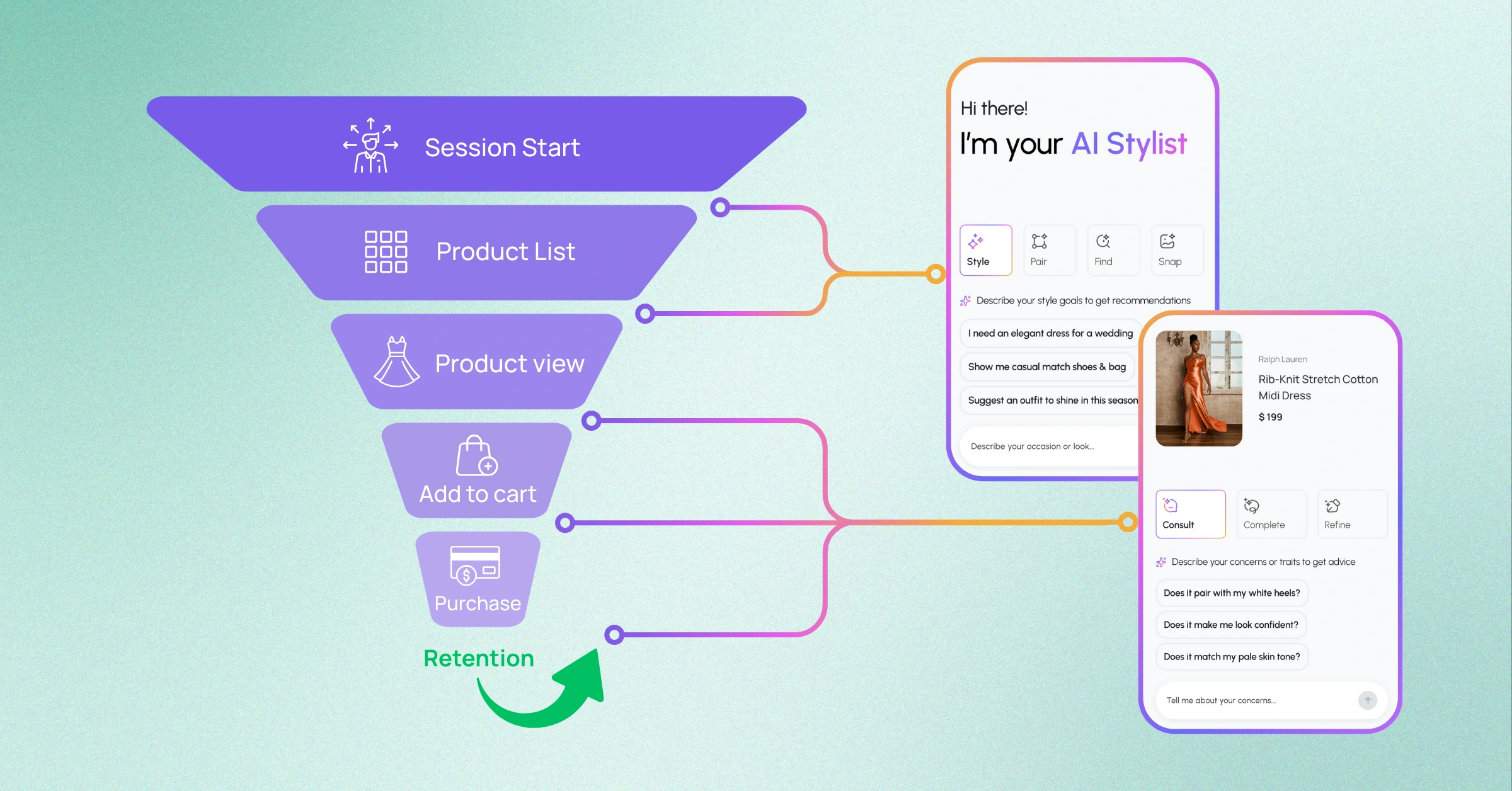
At a Glance: The Agentic Fashion Funnel
- The Core Crisis: The “Silent Store.” Most Shopify fashion stores operate as passive digital catalogs, resulting in a 98% non-conversion rate. The problem is not traffic quality, but the lack of active guidance.
- The Financial Leak: Small-to-medium fashion stores lose revenue at 7 critical “leak points,” specifically due to Choice Paralysis (PLP stage), Fit Anxiety (PDP stage), and Expectation Gaps (Returns).
- The Strategic Shift: Moving from Static Commerce (hosting products) to Agentic Commerce (guiding customers). This involves deploying AI agents to act as proactive sales associates, replicating the “Boutique Experience” online.
- The Agentic Stylist: iWAND acts as a dedicated personal stylist for every single visitor, not just VIPs. It accompanies shoppers through the entire journey—from initial discovery to post-purchase—providing the proactive guidance needed to remove hesitation and increase conversion rates at all stages of the shopping funnel.
- The ROI: By fixing the “Greeting Gap,” “Confidence Gap,” and “Memory Gap,” iWAND’s Agentic AI turns the funnel into a high-performance pipeline, aiming to double net revenue without increasing ad spend.
Table of Contents
Introduction: The “Silent Store” Crisis
The Leaking Bucket
You pour expensive ad dollars into your Shopify store. You celebrate when the traffic numbers rise. But there is a hole in the bottom of your bucket. Every visitor who fails to reach the finish line represents lost revenue rather than just a lost click. For many fashion stores, the math is brutal because tiny percentage drops at each stage compound into thousands of dollars left on the table every month. Driving traffic is expensive, but losing it is tragic.
The Core Thesis: Your Store is Silent
When sales are low, it is easy to blame the ad creative or the product pricing. However, the real problem is often deeper. The problem is passivity. Most online stores operate like a digital warehouse. They display rows of products and wait for the customer to do all the work. If a customer is confused, there is no one to ask. If a customer is hesitant, there is no one to reassure them. Your store is silent.
The Shift: From “Hosting” to “Guiding”
For the last decade, e-commerce has been about “Hosting.” You build a nice website, you host the products, and you wait for people to browse. But in the era of AI, customers do not want to dig through static catalogs. They want to be guided.
We are shifting from the Passive Catalog to the Agentic Store. This is a store that does not just sit there but actively greets, styles, and assists every visitor just like a human associate would in a physical boutique.
What You Will Learn
This guide provides a stage-by-stage breakdown of the fashion sales funnel. We will identify exactly where revenue leaks occur—from the first landing page to the final purchase. More importantly, we will show you how to plug those leaks using Agentic AI to transform your store from a passive vending machine into a proactive styling studio.
The Diagnostics: The High Cost of the “Leaking Funnel”
The Math of Loss
Every visitor who fails to reach the finish line represents lost revenue. For many small and medium Shopify fashion stores, the math is brutal. Listing these stages is critical because a 1% lift at an early stage multiplies downstream, turning small UX fixes into material revenue.
Reality Check: The Fashion Benchmarks
Use these numbers as a baseline for your store. If you are far from these benchmarks, you have found a specific lever to pull to increase sales.
| Funnel Stage | Benchmark Goal | The “Leak” Cause |
| Session to PLP | 60-70% | High bounce rates due to irrelevant landing pages or confusion. |
| PLP to PDP | 70-80% | Poor Product List design or overwhelming filters. |
| PDP to ATC | 12-15% | Sizing concerns, lack of fit details, or insufficient visuals. |
| ATC to Purchase | 30-40% | Distractions, second thoughts, or return policy anxiety. |
| Net Fulfillment | 70-80% | High return rates (20-30%) due to size or style mismatches. |
| Retention | 20-30% | Lack of personalized follow-up or “Clienteling”. |
The “Expected Value” Calculation
We often dismiss a single abandoned cart as a minor issue, but we must look at the Expected Value. This is calculated by multiplying the probability of purchase by the Average Order Value (AOV).
If your store has an AOV of $100, the math reveals the true cost of these leaks:
- 1 Lost PDP View: Costs roughly $3.60 in expected value.
- 1 Lost Add-to-Cart: Costs roughly $25.70 in expected value.
- 1 Returned Order: Costs roughly $73.40 in expected value.
Losing a visitor at the Product Page or Add-to-Cart stage is quickly measurable in actual dollars. Fortunately, this revenue is recoverable with the right fixes.
Stage 1: Discovery (Session → PLP)
The Problem: The “Greeting Gap”
You spend thousands on ads to drive traffic, yet nearly 47% of visitors bounce without clicking a single product. They do not leave because they hate your brand. They leave because they hit an “Invisible Wall” of static grids. You treat every visitor the same by showing them a generic “New Arrivals” page and hoping they dig through it. But in the era of AI, customers do not want to dig. They want to be guided.
The Psychology: Hunters vs. Gatherers
To fix the bounce rate, you must understand the two distinct mindsets of your visitors:
- The Gatherer: This shopper is looking for Inspiration. They do not know exactly what they want, but they have a goal, such as “a winter wedding outfit.” When they face a grid of 500 random items, they feel overwhelmed and lack direction.
- The Hunter: This shopper is looking for Precision. They know exactly what they want, such as a “modest green dress.” When they type this into a standard search bar and get zero results because the keyword “modest” is missing from your product tags, they assume you have no inventory and leave.
The Agentic Solution: The “Proactive Greeter”
An Agentic Store deploys specialized AI agents to act as “Store Greeters” that shatter the invisible wall.
1. For the Gatherer (The Style Agent)
The Style Agent interviews customers about preferences to curate head-to-toe outfits. Instead of forcing a user to filter by “Category” or “Price,” the Agent triggers a friendly nudge to ask about the occasion. If a visitor says “Winter Wedding,” the Agent instantly translates that vibe into fashion attributes like velvet, long sleeves, and jewel tones. It then generates a curated Product List Page specifically for that user.
2. For the Hunter (The Find & Snap Agents)
These agents replace the “Language Barrier” of standard search bars with genuine understanding.
- Text Search: The Find Agent offers conversational search that understands “vibe” and detailed descriptions. It moves beyond keywords to semantic understanding. It knows that “modest” implies high necklines and longer hemlines, pulling the right inventory even if the exact keyword is missing.
- Visual Search: The Snap Agent uses visual search that identifies fashion items in uploaded photos to find similar catalog products. If a shopper has a screenshot from Instagram but no words to describe it, they simply upload the photo to bypass the language barrier entirely.
3. For the Closet Gap (The Pair Agent)
Sometimes a user bounces because they cannot visualize how a new item fits into their existing life. The Pair Agent allows customers to upload or describe their own items to find matching store products. A user can say “I have these red boots” and instantly see a list of your items that make those boots wearable, solving the “Wardrobe Orphan” problem before the sale even happens.
Key Takeaway: You must transform the Search Bar from a passive tool into an active teammate. By moving from hosting a catalog to guiding the visitor, you ensure that every shopper feels like the store was prepared just for them.
Stage 2: Selection (PLP → PDP)
The Problem: The “Warehouse Model”
Imagine walking into a massive clothing warehouse with piles of clothes everywhere, no signs, and no staff. Just you and 5,000 items. You might see something nice, but you freeze because the effort required to choose is too high. This is the digital reality for your customers. You work hard to get them to a collection page (PLP) and show them a grid of 50 items. You think you are offering choice, but you are actually offering work. Offering 50 options feels like labor, not service, and overwhelmed shoppers simply freeze and leave.
The Psychology: Choice Overload
According to e-commerce psychology studies, nearly 39% of shoppers abandon a site because of “Choice Overload.” They do not leave because they cannot find anything. They leave because they cannot choose one thing. The anxiety of making the “wrong” choice paralyzes them.
The Agentic Solution: The “Private Fitting Room”
iWAND’s Agentic Stylists solve this by moving your store from a “Warehouse” model to a “Private Fitting Room” experience through three specific loops.
1. The Deepening Loop (Style Agent)
Standard filters like Size, Color, and Price are rigid and generic. They do not understand human insecurity or aspiration. A filter can find “Red Dress,” but it cannot find “Dress that makes me look taller.” The Style Agent interviews customers about their preferences to curate head-to-toe outfits.
- Example: If a user says “I want to look taller,” the AI prioritizes high-waisted cuts and vertical detailing while filtering out heavy mid-calf breaks. It presents a shortlist of 3 perfect options rather than a grid of 50.
2. The Integration Loop (Pair Agent)
Shoppers often like an item but freeze because they cannot visualize how to wear it. This doubt kills the click. The Pair Agent bridges this gap by allowing customers to describe or upload their own items to find matching store products. By validating that the new purchase works with their existing “vintage blue jeans,” the agent turns a risky isolated purchase into a safe, integrated asset.
3. The Modification Loop (Refine Agent)
Sometimes a user finds an item that is 90% right but stops because of one detail. In a static store, if they do not like the sleeves, they have to go back to the filters and start over. The Refine Agent helps tweak selections by finding similar styles with different details.
- Example: A user says, “I love this silhouette, but I need sleeves.” The Agent instantly updates the recommendation to a similar style that matches the negative constraint, saving the sale.
Key Takeaway: The goal of a Product List Page is not to show everything you have. It is to show the right thing. By replacing a passive grid with an active conversation, you transform an overwhelming warehouse into a curated fitting room.
Stage 3: Conversion (PDP → ATC)
The Problem: The “Silent Sales Associate”
The Product Detail Page is the most expensive real estate on your website because it is where you spend all your ad money to send traffic. Yet, leaving it unattended is like building a luxury showroom and hiring no staff. In a physical store, a sales associate steps in to compliment the fit or validate a choice. On your Shopify store, this moment happens in silence. The customer looks at the model, looks at themselves, and feels doubt creep in. This “Silent Sales Associate” problem is why many stores have thousands of product views but low Add-to-Cart rates.
The Psychology: The “Vibe Check”
Shoppers do not just buy clothes based on specs; they buy a version of themselves. They need emotional validation rather than just dimensions. They are asking internal questions like “Will this wash me out?” or “Is this too bold for a work dinner?” If they cannot visualize how the item fits their specific look, such as their hair, makeup, or body shape, they hesitate and close the tab. This is the “Vibe Check,” and static images cannot pass it alone.
The Agentic Solution: Unmuting the Store
iWAND breaks that silence by deploying the Consult Agent, which acts as “The Closer” to address specific hesitations and move items from the wishlist to the cart.
1. Emotional Validation
The Consult Agent is designed to answer subjective styling questions.
- The Scenario: A customer with short hair worries that large earrings will look overwhelming.
- The Answer: Instead of just listing the size, the Agent replies, “Actually, oversized hoops look stunning with short hair because they frame the jawline without getting tangled.” This validates the shopper’s insecurity and turns it into a selling point.
2. Functional Honesty
Trust is the currency of conversion. If a customer asks, “Will this wrinkle on a flight?”, the Agent provides instant transparency. It might admit that linen has natural texture but suggests a wrinkle-free blend instead. This honesty builds the trust necessary to close the sale, even if it means recommending a different item.
3. Handling Objections
When a customer loves a style but has a specific constraint, the Agent pivots the “No” into a “Yes.”
- The Scenario: A user loves a dress but needs it to be more modest for a religious event.
- The Pivot: The Agent, working alongside the Refine Agent, understands the “Modesty” constraint. It can instantly recommend a similar silhouette with higher necklines or longer sleeves, saving a sale that would have been lost to a static filter.
Key Takeaway: The difference between a “Window Shopper” and a “Buyer” is often just one answered question. By unmuting your store with active consultation, you give your customers the confidence to click “Add to Cart.”
Stage 4: Maximization (ATC → Purchase)
The Problem: The “Transaction Mindset”
There is a fundamental difference between a Cashier and a Stylist. A Cashier waits until you are paying to ask, “Do you want to buy some socks with that?” It is a transaction that often feels annoying. A Stylist sees you holding a blazer and immediately hands you the perfect pair of trousers, saying, “These create the full power-suit silhouette.” It is a service that feels helpful. Most Shopify fashion stores operate like the Cashier. They use static “Frequently Bought Together” widgets that blindly suggest items based on cold sales data. If a customer is looking at a summer dress, the algorithm might suggest winter boots simply because they are popular, which breaks the immersion and kills the sale.
The Psychology: The “Complete Look”
Shoppers do not just want “more stuff” to fill their cart. They want a “Complete Look.” The mistake most stores make is waiting until checkout to suggest add-ons. By then, the customer has made their decision and just wants to pay. The best time to build a basket is while they are still dreaming on the Product Detail Page (PDP).
The Agentic Solution: The “Proactive Stylist”
iWAND’s Complete Agent changes this dynamic. It acts as an AOV-booster that lives right on the Product Detail Page. Instead of waiting to be asked, it proactively visualizes a full outfit based on styling logic, color theory, and proportions before the user even clicks Add to Cart.
1. Contextual Bundling
The most powerful way to increase Basket Size is to align the products with the user’s life event. A static algorithm does not know the context, but the Agent does.
- The Scenario: A user views a black slip dress.
- The Pivot: If the user mentions a “Rock Concert,” the Agent styles it with a leather jacket and boots. If they mention a “Summer Wedding,” it styles the same dress with a pastel shawl and heels. This relevance converts single-item orders into high-value carts naturally.
2. Conversational Tweaks
Static bundles fail because they are rigid. If the customer dislikes one item, they ignore the whole bundle. The Complete Agent allows for “Conversational Tweaks” to save the sale.
- The Interaction: If a user loves the suggested outfit but says, “I don’t wear high heels,” the Agent instantly swaps them for pointed flats to keep the bundle intact. The user feels heard rather than sold to.
Key Takeaway: You must stop selling the SKU and start selling the silhouette. When you move from asking “Do you want to spend more?” to “Do you want to complete the look?”, you build loyalty and maximize revenue simultaneously.
Stage 5: Fulfillment (Orders → Net Sales)
The Problem: The “Expectation Gap”
You celebrate when sales numbers rise, but there is a hole in the bottom of your bucket. In the fashion industry, 30% to 40% of that revenue leaks out through returns. Most merchants treat returns as a Logistics Problem. They install apps to generate shipping labels faster or open local warehouses to make the return smooth. This is a mistake. You are simply paying to make the bleeding more comfortable.
To fix the leak, you must understand that returns are actually a Styling Problem. Customers rarely return items because of defects. They return them because of the “Expectation Gap.” This occurs when there is a mismatch between the product and the customer’s reality, such as the item looking great on the model but terrible on their specific body type, or the color washing them out.
The Agentic Solution: Pre-Purchase Prevention
In a physical store, a human stylist prevents these mistakes before the credit card is swiped. Online, iWAND’s agents take on that role to ensure the item suits the customer before it ever leaves your warehouse.
1. The “Body & Vibe” Match (Style Agent)
The Style Agent prevents “Shape Regret.” By understanding a customer’s specific body shape preferences, it filters out items that will likely lead to disappointment. For example, it stops an hourglass figure from buying a boxy cut that hides their waist, ensuring the item fits their body rather than just fitting the mannequin.
2. The “Skin & Color” Match (Consult Agent)
Lighting in product photography is perfect, but lighting in a customer’s bedroom is not. The Consult Agent acts as a Color Theory Expert to prevent the “Washout Effect”.
- The Scenario: A user with cool skin undertones wants a Mustard Yellow shirt.
- The Intervention: The Agent warns that the color might wash them out and suggests a Navy or Emerald version instead. The customer switches the color in the cart and receives an item that actually makes them look good.
3. The “Wardrobe Orphan” Cure (Pair Agent)
A “Wardrobe Orphan” is a beautiful item that sits in the closet with tags on because the customer has nothing to wear with it. Eventually, guilt sets in and they return it. The Pair Agent ensures compatibility before the sale by asking, “Do you have simple neutral tops to go with this statement skirt?”. It ensures the new purchase is a functioning part of their wardrobe, not an isolated mistake.
Key Takeaway: The most profitable sale isn’t just the one you make; it is the one you keep. By moving from a logistics mindset to a prevention mindset, you stop selling items that might fit and start selling items that truly suit.
Stage 6: Retention (Post-Purchase → Lifetime Value)
The Problem: “Digital Amnesia”
Imagine walking into a high-end luxury boutique where you have shopped before. The stylist smiles and says, “Welcome back, Sarah. We just got a silk scarf that matches that navy blazer you bought last month perfectly.” You feel seen, valued, and loyal.
Now, contrast that with the typical Shopify experience. You return to a site where you spent money two weeks ago, and the store treats you like a total stranger. It recommends items that clash with your skin tone and offers a generic “Welcome” discount. This is “Digital Amnesia.” Customers churn not because of price, but because they feel anonymous. They treat your store as a transaction because your store treats them as a number.
The Agentic Solution: The “Deep Profile”
iWAND bridges the “Luxury Gap” by giving every visitor—not just the top 1%—the personal shopper treatment based on Memory.
1. Beyond the Receipt
Most Shopify stores only rely on basic order history (SKU data). They know what a customer bought. An Agentic Store knows who the customer is. It builds a “Deep Profile” that captures the “Why” behind the purchase.
- The Clerk (Standard Store): Knows you bought a Midi Dress.
- The Stylist (iWAND Agent): Knows you bought it because you have an “Hourglass Shape” and prefer “Modest Cuts” for work. This data creates a sticky profile that makes every future interaction smarter.
2. Agentic Clienteling
In luxury retail, “Clienteling” is the art of reaching out with a suggestion based on what the customer already owns. The Pair Agent automates this onsite.
- The Interaction: When a customer returns, the agent proactively recalls their history: “Welcome back. These new Art Deco earrings are the perfect silver tone for your complexion, and they will elevate the Navy Blazer you bought last season.” This creates a continuity of experience that makes the second purchase feel natural rather than forced.
3. Frictionless Shopping
Why do customers stay loyal to a human stylist? Because the stylist saves them time. The Style Agent uses memory to auto-filter future searches. If a user previously stated they hate sleeveless cuts or warm colors that wash them out, the Agent automatically hides those items in future sessions. The customer finds what they want in 2 minutes instead of 20, returning to your store not just for the product, but for the ease.
Key Takeaway: Loyalty is earned by remembering, not just by rewarding points. When your store is the only one that truly knows a customer’s fit, taste, and wardrobe history, you build a “Digital Moat” that competitors cannot cross.
The Tech Shift: Static vs. Dynamic Comparison
From Vending Machine to Digital Boutique
The shift to Agentic AI is not just a feature update; it is a fundamental change in how e-commerce functions. We are moving from the era of the “Vending Machine,” where customers press buttons and hope for the best, to the era of the “Digital Boutique,” where an expert actively manages the floor.
Use this comparison to assess where your store sits on the evolutionary scale.
| Feature | The Old Way (Static Shopify) | The iWAND Way (Agentic Store) |
| Interaction Model | Passive Browsing: The customer wanders alone. | Active Guiding: Agents greet and interview the user. |
| Search Logic | Keyword Matching: Fails if exact words are missing. | Semantic Understanding: Understands “Vibe” and “Intent.” |
| Product Display | Generic Grids: Everyone sees the same collection. | Curated Shortlists: Unique views based on body/style goals. |
| Upsell Strategy | “You Might Also Like”: Blind, algorithmic suggestions. | “Complete the Look”: Stylist-approved outfits based on context. |
| Customer Memory | Anonymous Cookies: Treats return visitors as strangers. | Deep Profiling: Remembers size, taste, and wardrobe. |
| The Outcome | High Bounce Rate & Returns | High Engagement & Loyalty |
The ROI: The “Double Revenue” Math
This shift is not about vanity metrics; it is about net profit. As we calculated in the Diagnostics section, most stores operate at a 1.8% conversion rate because of leaks at every stage.
By deploying iWAND to plug these leaks, the math changes:
- Fixing Discovery: +20% more users reach the Product Page.
- Fixing Confidence: +15% more users Add to Cart.
- Fixing Returns: +10% more revenue is kept (Net Sales).
When you combine these lifts across the funnel, you do not need to double your ad spend to double your sales. You simply need to stop losing the customers you already have. The Agentic Store captures the revenue that the Static Store lets slip away.
Conclusion: The Future is Conversational
The Era of the Digital Stylist
We are standing at a tipping point in fashion e-commerce. The era of the “Vending Machine”—where stores simply dispensed products to anyone who pressed a button—is ending. We are entering the era of the “Digital Stylist.” In this new reality, the winners will not be the stores with the most inventory or the cheapest prices. The winners will be the stores that offer the most guidance.
Stop Treating Clients Like Strangers
The most dangerous myth in Shopify growth is that the solution to every problem is “More Traffic.” You do not need to double your traffic to double your sales. You simply need to stop losing the customers who are already standing in your store.
Every drop-off in your funnel represents a moment of doubt, confusion, or hesitation that went unanswered. Static stores let these customers slip away into the noise. Agentic stores engage them, guide them, and turn them into clients. When you stop treating your best customers like strangers, you unlock the revenue that has been hiding in your funnel all along.
Unmute Your Store
Your customers are asking questions. It is time to start answering them.
Don’t let your revenue leak away in silence. Turn your store into a high-performance conversion engine with the power of Agentic AI.
Unmute Your Store and Stop Revenue Leaks with iWAND
Agentic AI stylist for Shopify fashion stores that turns silent visitors into confident buyers.
Free, no code, no setup stress
What is a healthy conversion rate for a Shopify fashion store?
While general e-commerce conversion rates hover around 1-2%, a healthy fashion store should aim for 1.8% to 2.5%. However, looking at the total rate is often misleading. You should measure specific funnel benchmarks:
– Product Page to Add-to-Cart: 12-15%
– Add-to-Cart to Purchase: 30-40%
– Net Fulfillment (after returns): 70-80% If you are below these numbers, you likely have “leaks” caused by sizing anxiety or lack of guidance.
How can I reduce return rates in my online clothing store?
Returns in fashion are usually a “styling problem,” not a logistics one. To reduce them, you must bridge the “Expectation Gap” (the difference between how an item looks on a model vs. the customer). The most effective strategy is Pre-Purchase Prevention using Agentic AI:
– Body Match: Filter items that don’t suit the customer’s specific body shape.
– Color Match: Warn customers if a color (e.g., Mustard) will wash out their skin tone.
– Wardrobe Match: Ensure they own items that pair with the new purchase.
Why is my Shopify store traffic bouncing without buying?
High bounce rates (often 47%+) occur when visitors hit an “Invisible Wall” of static grids. Shoppers leave because they face Choice Paralysis—too many irrelevant options with no guidance. To fix this, move from a “Warehouse Model” (showing 500 items) to a “Private Fitting Room” model using an AI Stylist to curate shortlists based on the visitor’s specific occasion (e.g., “Winter Wedding”).
What is “Agentic Commerce” in fashion?
Agentic Commerce is the shift from Passive Hosting (displaying a catalog and waiting for clicks) to Active Guiding (using AI agents to greet, interview, and style visitors). Unlike a standard chatbot that waits for a prompt, an Agentic Stylist (like iWAND) proactively engages shoppers to uncover their intent, behaving like a top-tier sales associate in a physical boutique.
How do I increase Average Order Value (AOV) without discounts?
The best way to boost AOV is to sell the “Complete Look” rather than just the SKU. Instead of using blind “You Might Also Like” widgets at checkout, use an AI agent on the Product Page to propose full outfits based on context. For example, if a customer is buying a dress for a concert, the AI should instantly suggest a leather jacket and boots to match the “vibe,” rather than random accessories.
How does “Clienteling” work for an online store?
Clienteling is the practice of using customer data to provide personalized service. On Shopify, Agentic Clienteling uses AI to remember a customer’s specific Style Profile (e.g., “Hourglass Shape,” “Prefers Modest Cuts,” “Cool Skin Tone”). When the customer returns, the AI acts as a personal shopper, recalling past purchases (“This scarf matches your navy blazer”) to build loyalty and increase Lifetime Value (LTV).