

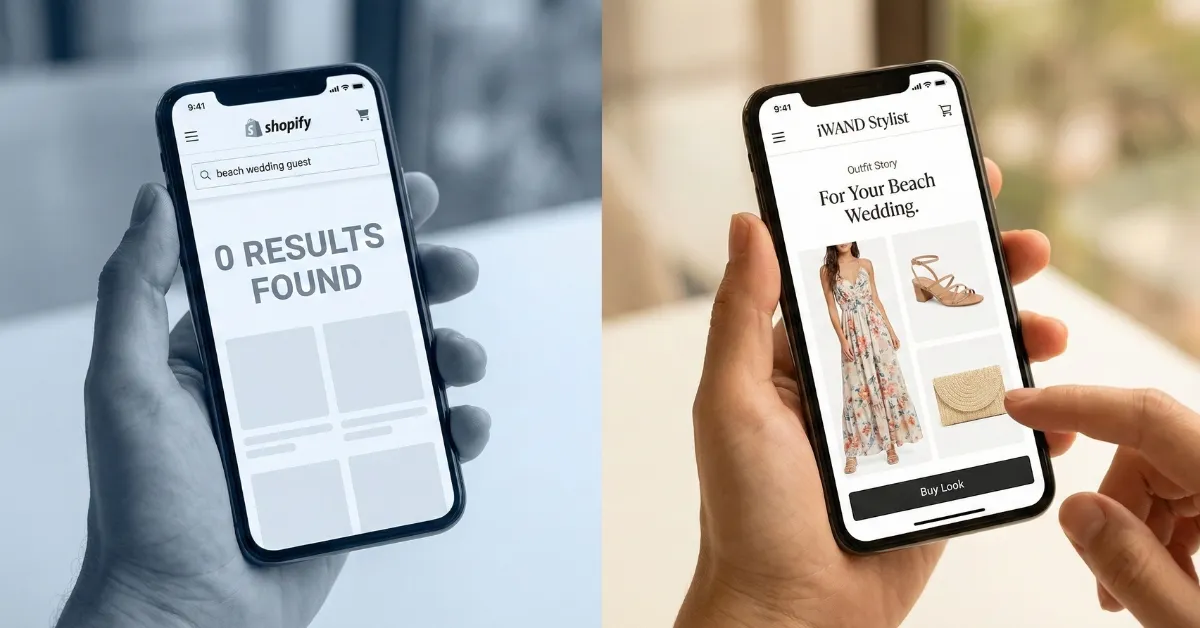
This article is part of our Master Guide to AI Styling for Shopify Fashion Stores, focused on moving from the passive ‘Silent Store’ model to a proactive Agentic Stylist experience that boosts conversion rates, Average Order Value (AOV), and customer retention while slashing return rates.
At a Glance:
- The Problem: Traditional search bars are passive databases that don’t understand human context, leading to “zero results” for high-intent shoppers.
- The Concept: Every shopper is a “Protagonist” with a specific story—based on their body type, the occasion they are attending, or their existing wardrobe.
- The Solution: Moving from “Search” to “Service” using Agentic AI (iWAND) to act as a proactive stylist that understands intent, not just keywords.
The “Unfinished Story” Problem
Every customer who lands on your Shopify store is the protagonist of a unique story. They are not just a session ID or a collection of cookies. They are real people in the middle of a specific life moment, actively seeking a resolution that you can provide.
In the physical world, a top-tier sales associate understands this immediately. If a woman walks into a boutique and says she feels self-conscious about her arms and needs something for a garden party, the stylist does not just point to a rack of “green fabrics.” The stylist connects the dots. They understand the vulnerability, the occasion, and the goal.
In the digital world, we force this same human to strip away all that context. We ask them to translate their complex feelings into cold, hard keywords. When that customer types “dress for garden party that hides arms” into a standard search bar, the story ends abruptly with “No Results Found.”
The search bar is a dictionary that understands words. Your customer is a human who understands stories. When these two fail to connect, you lose the sale.
Chapter 1: The Protagonist (Shopping for the “Self”)
The first layer of intent is deeply personal. It is about biology, appearance, and confidence.
When a shopper visits your site, they are often looking to adjust or enhance their physical reality. They are rarely looking for “vertical stripes” just for the sake of the pattern. They are looking for “make me look taller.” They are not filtering for “long sleeves” because they love extra fabric. They are looking for “make me feel secure.”
Standard filters like Small, Medium, and Large ignore the nuance of the human form. They cannot account for skin tone, body shape, or personal insecurities.
A true intent-based shopping experience acts as a mirror. It guides the protagonist toward items that flatter their specific biology. It validates their intent to look slimmer, taller, or bolder. When a store can acknowledge these unspoken desires, it builds the one thing a search bar never can: trust.
Chapter 2: The Plot (Shopping for the “Moment”)
If the customer is the protagonist, the clothes are the costume. Every purchase is driven by a plot point or an upcoming scene in their life.
This is the “Occasion” or “Vibe” intent. A shopper needs an outfit for a high-stakes job interview, a relaxed beach vacation in Tulum, or a first date where they want to impress without trying too hard.
A keyword search cannot understand the difference between “Corporate Chic” and “Boho Festival” because these are feelings, not tags. A white dress is perfect for a graduate, but a disaster for a wedding guest. When a store fails to understand the context of the purchase, it fails to sell the outcome. The customer isn’t buying a garment. They are buying the confidence to play their role in the next scene of their life.
Chapter 3: The Flashback (Shopping for the “Wardrobe”)
No fashion item exists in isolation. Every new piece must make friends with what is already hanging in the customer’s closet at home.
This is the “Flashback” intent. The shopper is often trying to solve a puzzle. They might be thinking, “I love this skirt, but I have absolutely nothing to wear with it.” This hesitation is a silent killer of conversion rates.
Traditional cross-selling widgets that suggest “You May Also Like” are often random guess-work. Intent-based shopping is logical. It understands that the shopper owns a pair of white boots and is hunting for the specific dress that completes that puzzle. It shifts the mindset from buying a standalone product to building a coherent lifestyle.
The Resolution: From “Search” to “Service”
Fixing this disconnect isn’t about installing a smarter search bar. It is about replacing the concept of “Search” with the experience of “Service.”
For too long, e-commerce has been built around a warehouse model. We give customers a map (the navigation menu) and a flashlight (the search bar) and tell them to go find what they need in the dark.
To save the shopper’s story, Shopify stores must evolve. We must move from being Passive Databases that wait for keywords to becoming Proactive Hosts that anticipate needs. It is about creating an environment where the store adapts to the user, rather than forcing the user to filter the store.
When you offer service instead of just search, you stop selling SKUs and start solving problems.
The Guide: Meet iWAND, The Agentic Stylist
This is where the story changes. iWAND is not just another app or a filter. iWAND is the Agent Inside.
iWAND is the first Agentic AI Stylist designed to bridge the gap between the human story and your digital catalog. It works as a suite of autonomous agents, each dedicated to a specific chapter of the customer’s journey:
- For the Protagonist: The Style Agent interviews the shopper to understands their body type and preferences, ensuring the recommendation fits the person, not just the mannequin.
- For the Plot: The Style Agent and Find Agent understand complex semantics. They translate “vibe,” “mood,” and “occasion” into accurate product results, ensuring the customer looks the part for their big moment.
- For the Flashback: The Pair Agent allows users to upload images or describe items they already own, instantly finding the missing piece in your store to complete their look.
- For the Happy Ending: The Consult Agent acts as the closer, answering specific hesitations and guiding the user confidently to checkout.
Your customers are already telling you their story. It is time to stop forcing them to speak in code. Let iWAND translate their intent into sales and turn your Shopify store into a personalized styling experience.
Start Your Store’s Styling Story with iWAND Today
Agentic AI stylist for Shopify fashion stores that turns browsers into loyal buyers.
Free, no code, no setup stress