

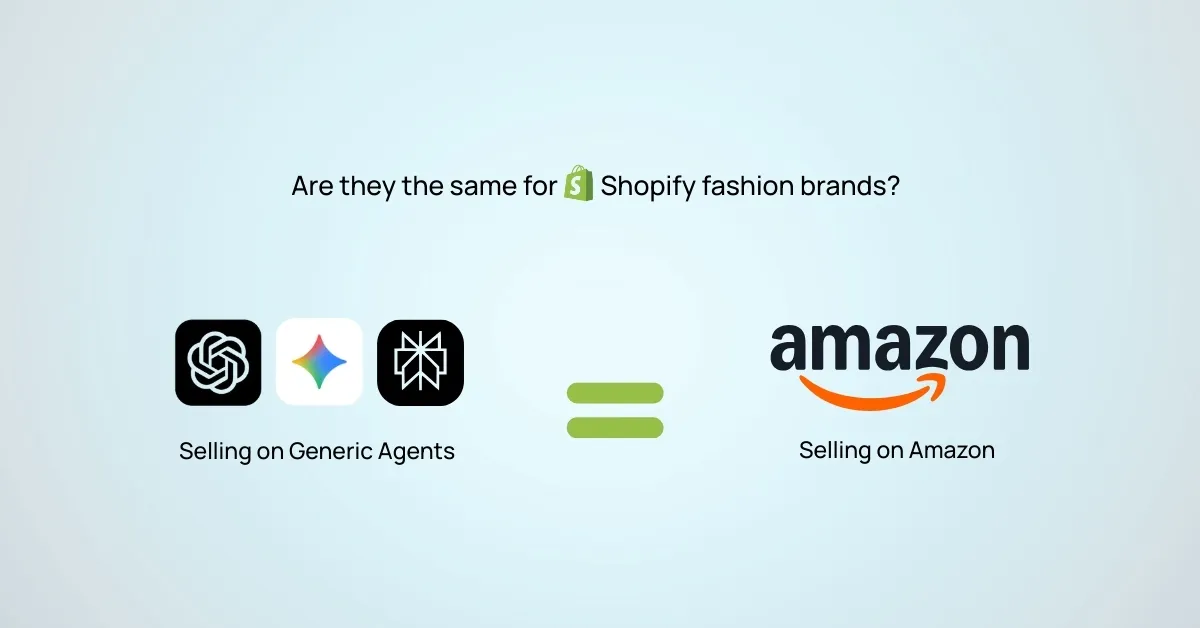
This article is part of our Master Guide to Shopify Agentic Commerce in 2026, focused on moving from third-party LLM syndication to a Sovereign Inside Agent model that protects brand equity, first-party data, and boosts conversions.
We are entering the era of “Agentic Commerce.” The promise from platforms like ChatGPT and Perplexity is simple: list your products, and our AI agents will sell them for you. For many Shopify fashion stores, this sounds like a dream. No more fighting for Google rankings. No more complex ad funnels. Just pure, AI-driven discovery.
But as a Shopify fashion store owner, you have to ask: Have we seen this movie before?
Is “syndicating” your catalog to a third party AI really the future of your brand? Or is it a repeat of the Amazon Marketplace era, where brands traded their soul for distribution?
Would You Put Your Flagship Next to a Dollar Store?
Think about why most high-end Shopify fashion stores avoid listing on Amazon. It is not just about the high fees. It is about the loss of the “Brand Theater.”
On a marketplace, a Level 1 luxury brand is placed right next to a Level 3 mass-market knockoff. There are no custom fonts, no high-resolution video backgrounds, and no editorial storytelling. Everything is flattened into a standard white-background grid.
Are Agentic Storefronts doing the exact same thing to your Shopify fashion store?
When a user asks an AI for a “black leather jacket,” the agent provides a text-based list. In that moment, your brand’s unique identity is stripped away. You are reduced to a price point and a list of specs.
If your Shopify fashion store relies on an emotional connection with your customers, can you afford to be invisible inside a gray text box? Is an agentic storefront a “storefront” at all, or is it just a digital vending machine where the cheapest product wins?
The Rent-Seeker Future: Who Really Owns the “Buy” Button?
Right now, getting recommended by ChatGPT or Perplexity feels like magic. It’s organic, it’s high-intent, and often, it’s free.
But do you remember when organic reach on Facebook was free? Do you remember when Amazon was just a “sales channel” before it became a “pay-to-play” advertising giant?
Right now, appearing in ChatGPT or Perplexity feels like free marketing. But we must look at the history of digital platforms. They always follow the same cycle: Attract, then Extract.
- How long until the “Top Recommendation” in an AI chat requires a marketing budget?
- What happens to small Shopify fashion stores when global giants start bidding for the “Recommended Stylist” spot in ChatGPT?
- If fashion margins are already tight, can you survive a “Pay-to-Play” model where a third party AI takes a cut of every conversation?
When a platform controls the demand, they eventually become a “Rent-Seeker.” By moving your primary discovery to third party agents, are you just renting your customers from a new set of gatekeepers?
The Data Black Hole: Do You Know Why They Bought?
In the Amazon period, brand owners realized too late that they didn’t own their customers. They received an address and a tracking number, but they had zero insight into the shopping behavior.
Are third party agents creating a new Data Black Hole for Shopify fashion stores?
When a shopper talks to ChatGPT, they reveal deep personal secrets.
- “I need a dress that hides my post-pregnancy belly.”
- “I want something sustainable for a beach wedding.”
- “I love this style, but I’m worried the fabric is scratchy.”
This is the most valuable data a fashion brand can own. But if that conversation happens on a third party platform, you never see it. Without that data, how can you improve your collections? How can you retarget that customer with a personalized email? Are you comfortable being a “blind fulfillment center” while the AI companies build a massive database of your customers’ preferences?
The Solution: Sovereign AI (Your Store, Your Agent)
So, does this mean we should reject Agentic Commerce?
Absolutely not. That would be like rejecting the internet in 1999. Customers want to chat. They want styling advice. They want the ease of an agent.
But there is a difference between listing on an agent and owning an agent.
Just as you chose to build a Shopify store instead of relying solely on Amazon, the future belongs to brands that build their own Agentic Layer.
Imagine an experience where the “Agent” isn’t a third-party gatekeeper, but a specialized stylist that lives on your website.
- You keep the branding: The agent lives inside your beautiful UI, showcasing your editorial photography, not a text list.
- You keep the data: When a customer tells the agent about their style preferences, you learn that data. You build the Customer IQ.
- You keep the margin: No bidding wars. No rent-seeking.
This is the vision behind iWAND.
We believe that every fashion store deserves its own Agentic Stylist—a sovereign AI that understands your specific inventory, speaks in your brand’s voice, and guides your customers from “hesitation” to “confidence.”
The question for Shopify fashion store owners is no longer “Should I use AI?” The real question is: “Should my AI work for me, or for a third party platform?”
Don’t let your brand become a line of text in someone else’s database. Turn your Shopify fashion store into an intelligent, agentic destination with iWAND.
Elevate Your Fashion Store with a Stylist Agentic Layer
AI stylist for Shopify fashion stores that turns browsers into loyal buyers.
Free, no code, no setup stress