

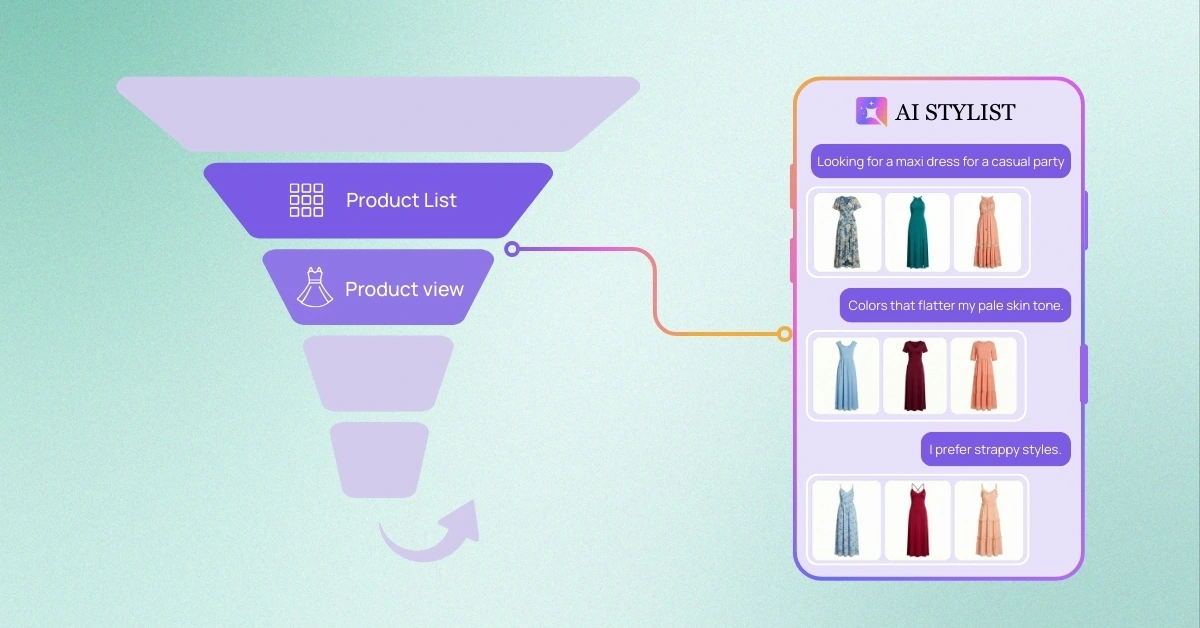
This article is part of our Agentic Fashion Funnel master guide, focused on transforming Shopify fashion stores from passive ‘Silent Catalogs’ into proactive Agentic Stylist experiences that optimize the entire customer journey to boost Conversion Rates, increase Average Order Value (AOV), and drastically reduce Return Rates.
At a Glance:
- The Problem: In PLP → PDP, stores face the “Paradox of Choice.” 39% of shoppers abandon search results because static grids and rigid filters cause cognitive overload, leading to “analysis paralysis” rather than clicks.
- The Concept: Moving from a “Warehouse” mindset (showing unlimited inventory) to a “Fitting Room” experience (curating the best options). Shoppers don’t need more choices; they need a validated “Shortlist” tailored to their body and goals.
- The Solution: Replacing passive scrolling with Agentic Styling. iWAND’s agents (Style, Pair, Refine) act as consultative experts, using personal context (body type, wardrobe, constraints) to narrow overwhelming lists into confidence-inspiring recommendations.
Funnel Stage: Product List Page (PLP) → Product Detail Page (PDP) Primary Goal: Solving “Choice Paralysis” to drive product views.
Imagine walking into a massive clothing warehouse. There are piles of clothes everywhere. No signs. No staff. Just you and 5,000 items. You might see something nice, but you freeze. Does this fit my body type? Does it match what I own? Is it right for the event? The anxiety sets in. You walk out.
This is the digital reality for your customers. You work hard to get them to a collection page (PLP). You show them a grid of 50 items. You think you are offering choice, but you are actually offering work.
According to e-commerce psychology studies, 39% of shoppers abandon a site because of “Choice Overload.” They don’t leave because they can’t find anything. They leave because they can’t choose one thing.
Here is how iWAND’s Agentic Stylists solve this by moving your store from a “Warehouse” model to a “Private Fitting Room” experience.
Table of Contents
Part 1: The “Deepening” Loop (The Style Agent)
The Problem: The Grid is Generic. Standard filters (Size, Color, Price) are rigid. They don’t understand human insecurity or aspiration. A filter can find “Red Dress,” but it cannot find “Dress that makes me look taller.”
The Human Analogy: In a luxury boutique, a stylist doesn’t just point to a rack. She looks at you. She asks, “What is the vibe for tonight? Do we want to look bold? Elegant? Are there areas you want to highlight?” She doesn’t bring you 50 dresses. She brings you 3 perfect outfits.
The Agentic Solution: Let’s look at Emma. Emma has a list of “Party Dresses” on your site, but she is hesitating. She is 5’2″ and worries about looking short in the wrong cut.
- The Interaction: Emma tells the Style Agent, “I want to look taller and stand out at this party.”
- The AI Logic: The Agent doesn’t just search for keywords. It applies Styling Logic.
- Rule A (Look Taller): Prioritize high-waisted cuts, vertical detailing, and monochromatic looks. Avoid heavy mid-calf breaks.
- Rule B (Stand Out): Prioritize bold textures (sequins) or power colors (emerald, crimson).
- The Result: The Agent wipes the overwhelming grid. It presents a Curated Shortlist of 3 Outfits.
- Option 1: A high-waist wide-leg jumpsuit in Emerald Green.
- Option 2: A vertical sequin mini dress.
- Option 3: A monochromatic midi with a side slit to elongate the leg.
The Win: Emma clicks the product page (PDP) not just because she likes the item, but because she trusts the logic behind the recommendation.
Part 2: The “Integration” Loop (The Pair Agent)
The Problem: The Confidence Gap. Shoppers often like an item but freeze because they can’t visualize how to wear it. “What shoes go with this? Do I have to buy a whole new wardrobe?” This doubt kills the click.
The Human Analogy: The best sales associates close the sale by validating what the customer already owns. “Oh, you have vintage blue jeans? This blazer would look incredible with them.”
The Agentic Solution: Meet Liam. Liam is eyeing a structured blazer on your site. He likes it, but he is stuck. He is a “jeans and t-shirt” guy and worries he won’t wear it enough.
- The Interaction: Liam opens the Pair Agent. He says, “I have these vintage blue jeans. Will this work?” He can even upload a photo of his jeans.
- The AI Logic: The Agent analyzes the wash and cut of his jeans. It confirms the match and suggests a specific white t-shirt from your store to tie the look together.
- The Result: The Agent shows him a visualization of the blazer with denim.
- The Win: Liam clicks through to the PDP. The blazer is no longer a risky isolated purchase. It is now a working asset in his closet.
Part 3: The “Modification” Loop (Refinement)
The Problem: The “Almost Perfect” Trap. Sometimes a user finds an item that is 90% right.
- Static Store: If they don’t like the sleeves, they have to go back to the filters and start over. They usually give up.
- Agentic Store: They can just ask for a tweak.
The Interaction: Emma loves the “Option 1” jumpsuit from the Style Agent, but it is sleeveless and the party is outdoors.
- The Input: She says, “I love this silhouette, but I need sleeves because it will be cold.”
- The AI Logic: The Agent understands the Negative Constraint. It keeps the “High-waist” and “Emerald” attributes but swaps the “Sleeve Length” attribute.
- The Result: It updates the recommendation instantly to a similar style with long sleeves.
Part 4: Merchant Diagnostics (Are You Overwhelming Them?)
How do you know if “Choice Paralysis” is killing your sales? Look for these signs in your data.
| Metric | What It Means | The Fix |
| High PLP Exit Rate | Users land on a collection, scroll, and leave without clicking a single product. They are overwhelmed. | Style Agent: Engage them instantly to narrow the grid down to a shortlist. |
| “Pogo-Sticking” | Users click a product, hit back immediately, click another, hit back. The list view isn’t giving them enough confidence. | Refine Agent: Allow them to tweak the list (e.g., “Show me this but in blue”) so they only click relevant items. |
| Low Time on Site | Users engage for less than 30 seconds. They are not connecting with the merchandise. | Pair Agent: Ask them about their own wardrobe to build a personal connection. |
Conclusion: From “Browsing” to “Bonding”
The goal of a Product List Page is not to show everything you have. It is to help the user find the one thing they need.
A static grid is passive. It forces the user to do the work. A conversation is active. When a shopper shares their insecurities (“I want to look taller”) or their assets (“I have these boots”), they are bonding with your store.
iWAND turns that bond into sales. By acting as a proactive stylist, it transforms an overwhelming warehouse into a curated fitting room, giving your customers the confidence to click, engage, and buy.
Next Step: Stop losing customers to the scroll. Install iWAND today and start offering the “Private Stylist” experience to every visitor.
Stop losing customers to the Scroll and Start the Conversation
Agentic AI stylist for Shopify fashion stores that turns browsers into loyal buyers.
Free, no code, no setup stress
What causes high exit rates on Shopify collection pages?
High exit rates on Product List Pages (PLPs) are often caused by “Choice Paralysis.” When shoppers are presented with large, static grids of products without guidance, they become overwhelmed and leave. Agentic AI solves this by acting as a curator, narrowing down 500 items to a hyper-relevant “shortlist” of 3-5 options based on the user’s specific preferences.
How does “Conversational Refinement” differ from standard faceted search?
Standard faceted search (filters) is binary and rigid (e.g., “Color: Red”). Conversational Refinement is semantic and flexible. It allows users to speak naturally to the AI (e.g., “I like this, but I want to look taller” or “I need something for an outdoor wedding”). The AI understands these complex constraints and re-ranks the list dynamically, something standard filters cannot do.
How does the Pair Agent help increase Click-Through Rates (CTR)?
The Pair Agent bridges the “Confidence Gap”—the hesitation a user feels when they don’t know how to style an item. By allowing users to ask, “What goes with these jeans I own?”, the agent validates the purchase before the click. This turns a standalone product into a “complete outfit,” significantly increasing the likelihood of viewing the Product Detail Page (PDP).
Can AI Stylists handle “negative constraints” (e.g., “no sleeveless”)?
Yes. Unlike traditional search bars that struggle with exclusion logic (often showing sleeveless dresses when you type “no sleeveless”), iWAND’s Refine Agent understands negative constraints. If a user says, “I love this print, but not sleeveless,” the agent filters out that specific attribute while keeping the rest of the style consistent.
Why is a “Shortlist Strategy” better than an endless scroll?
Psychological studies show that curation drives conversion. An “Endless Scroll” forces the user to do the work of filtering, leading to fatigue. A “Shortlist Strategy” (providing 3-5 highly curated options) mimics the experience of a human stylist in a fitting room. It reduces cognitive load, builds trust, and accelerates the decision-making process from browsing to buying.