

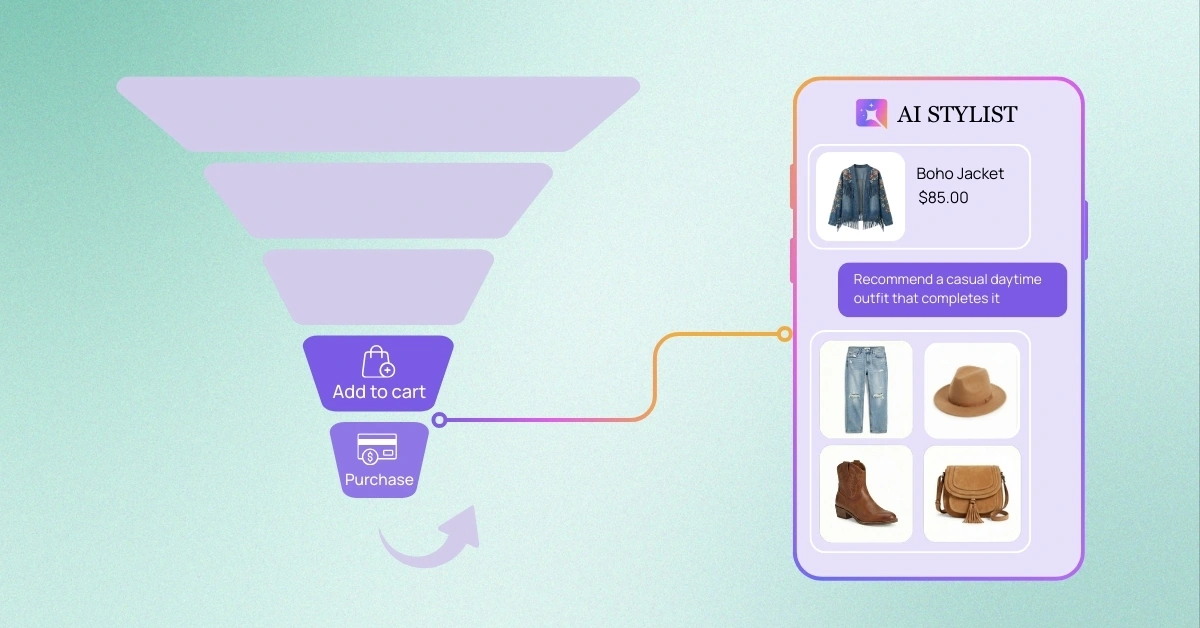
This article is part of our Agentic Fashion Funnel master guide, focused on transforming Shopify fashion stores from passive ‘Silent Catalogs’ into proactive Agentic Stylist experiences that optimize the entire customer journey to boost Conversion Rates, increase Average Order Value (AOV), and drastically reduce Return Rates.
At a Glance:
- The Problem: The “One-Item Tragedy.” Shopify merchants struggle with profitability because high Customer Acquisition Costs (CAC) are not offset by single-item orders. Standard “Frequently Bought Together” widgets fail to fix this because they rely on irrelevant sales data rather than styling logic.
- The Concept: Moving from a “Cashier Mindset” (transactional upselling at checkout) to a “Stylist Mindset” (service-based bundling on the product page). Shoppers are more likely to buy a full outfit if it is visualized and validated before they commit to the cart.
- The Solution: Unlike static apps, this AI stylist lives on the Product Detail Page (PDP) and proactively suggests complete outfits based on silhouettes and occasions. It allows users to “conversationaly tweak” the bundle (e.g., “swap the heels for flats”), driving higher Average Order Value (AOV) naturally.
Funnel Stage: Add-to-Cart (ATC) → Purchase Primary Goal: Increasing Average Order Value (AOV) and Units Per Transaction (UPT).
There is a fundamental difference between a Cashier and a Stylist.
A Cashier waits until you are paying and asks, “Do you want to buy some socks with that?” It is a transaction. It is annoying. A Stylist sees you holding a blazer and immediately hands you the perfect pair of trousers, saying, “These create the full power-suit silhouette.” It is a service. It is helpful.
Most Shopify fashion stores operate like the Cashier. They use static “Frequently Bought Together” widgets that blindly suggest items based on cold sales data. If a customer is looking at a summer dress, the algorithm might suggest winter boots just because they are popular. This breaks the immersion and kills the sale.
The iWAND Complete Agent changes this dynamic. It doesn’t wait for the checkout page. It lives right on the Product Detail Page, acting as a proactive stylist that understands aesthetics, not just purchase history.
It doesn’t ask “Do you want more stuff?” It asks “Do you want to complete this look?”
Here is how using Agentic AI to style full outfits converts single-item orders into high-value carts naturally.
Table of Contents
Part 1: The “Proactive Proposal” (Selling the Silhouette)
The mistake most stores make is waiting until checkout to suggest add-ons. By then, the customer has made their decision and just wants to pay. The best time to build a basket is while they are still dreaming on the Product Detail Page (PDP).
The Problem: The “Lonely Product” A customer falls in love with a Velvet Midi Skirt on your store. She stares at it. She loves the skirt, but she has no idea how to wear it. She thinks: “Do I have a top for this? What shoes work?” If she can’t visualize the full outfit, she might abandon the cart entirely. Or, she buys just the skirt ($60 AOV).
The Solution: The Instant Outfit The Complete Agent lives on the PDP. It doesn’t wait to be asked. It proactively visualizes a “Full Look” based on styling logic, color theory, and proportions. Before the user even clicks Add to Cart, the Agent proposes: “The Velvet Skirt looks stunning styled with our Silk Cami and these Strappy Heels for a complete evening look.”
The Win: You are no longer selling a single ingredient. You are selling the whole meal. The customer sees the potential immediately.
Part 2: The “Conversational Tweak” (Modification)
Static “Frequently Bought Together” bundles fail because they are rigid. If the customer doesn’t like one item in the bundle, they ignore the whole thing. The Complete Agent is conversational. The initial proposal is just the starting point.
Scenario A: The Item Swap The user sees the Velvet Skirt proposal above. She likes the vibe but has practical constraints.
- User Input: “I love the outfit, but I don’t wear high heels. And I need a belt to cinch the waist.”
- The Agentic Action: “Understood. Let’s swap the heels for these pointed flats for a comfortable chic look. I have also added our woven leather belt to define the silhouette.”
- The Result: The bundle is updated instantly. The user feels heard, not sold to.
Scenario B: The Accessory Addition The user likes the base outfit but wants more.
- User Input: “This is great, but it feels a bit plain. Suggest some accessories.”
- The Agentic Action: “Since the neckline of the cami is high, let’s add these gold drop earrings to elongate the neck.”
Part 3: The “Context” Layer (Occasion & Vibe)
The most powerful way to increase Basket Size is to align the products with the user’s life event. A static algorithm doesn’t know if the customer is going to a funeral or a rave. The Complete Agent asks.
The Scenario: A user is viewing a simple Black Slip Dress.
- Context 1 (The Concert): The user tells the agent, “I’m buying this for a rock concert.”
- The Agent’s Outfit: It styles the dress with a Faux Leather Jacket, Combat Boots, and a Silver Choker.
- Context 2 (The Wedding): The user says, “I need this for a summer wedding.”
- The Agent’s Outfit: It styles the same dress with a Pastel Shawl, Strappy Sandals, and a Pearl Clutch.
The Win: The same base product generates two completely different (and highly profitable) bundles based on the user’s reality. This level of relevance is impossible with standard Shopify apps.
Conclusion: From Vending Machine to Boutique
A vending machine dispenses one item at a time based on a button press. A boutique builds a wardrobe based on a relationship.
When you use generic upsell widgets, you are asking, “Do you want to spend more money?” When you use the iWAND Complete Agent, you are asking, “Do you want to look amazing?”
The second question is the one that builds loyalty and fills carts.
Turn Every Product Page into a Complete Styling Experience
Agentic AI stylist for Shopify fashion stores that turns browsers into loyal buyers.
Free, no code, no setup stress
Why do standard “Frequently Bought Together” widgets fail in fashion?
Standard widgets rely on Collaborative Filtering (data showing what other people bought). In fashion, this often fails because purchase history is messy. Just because a previous customer bought a dress and winter socks during a sale doesn’t mean those items “match.” iWAND replaces this with Styling Logic, ensuring recommendations are aesthetically coherent and visually complementary, which drives higher conversion.
How does the Complete Agent increase Average Order Value (AOV)?
The Complete Agent increases AOV by boosting Units Per Transaction (UPT). Instead of waiting for the checkout page to upsell, it acts proactively on the Product Page to visualize a full outfit. By showing the shopper exactly how to style a $50 skirt with a $40 top and $100 boots before they add to cart, it naturally expands the basket size from single items to complete looks.
Can customers customize the suggested outfit?
Yes. This is the core difference between static bundles and Agentic AI. If iWAND suggests a look with high heels, the customer can say, “Swap the heels for flats” or “I need a jacket for cold weather.” The agent instantly updates the bundle to match their preference, saving the sale where a static widget would have been ignored.
Does “Complete the Look” work for different occasions?
Absolutely. The Complete Agent is context-aware. If a shopper views a slip dress, they can tell the agent, “I’m going to a wedding” or “I’m going to a rock concert.” The AI will generate two completely different accessory bundles for the same base product, maximizing relevance and the likelihood of a multi-item purchase.