

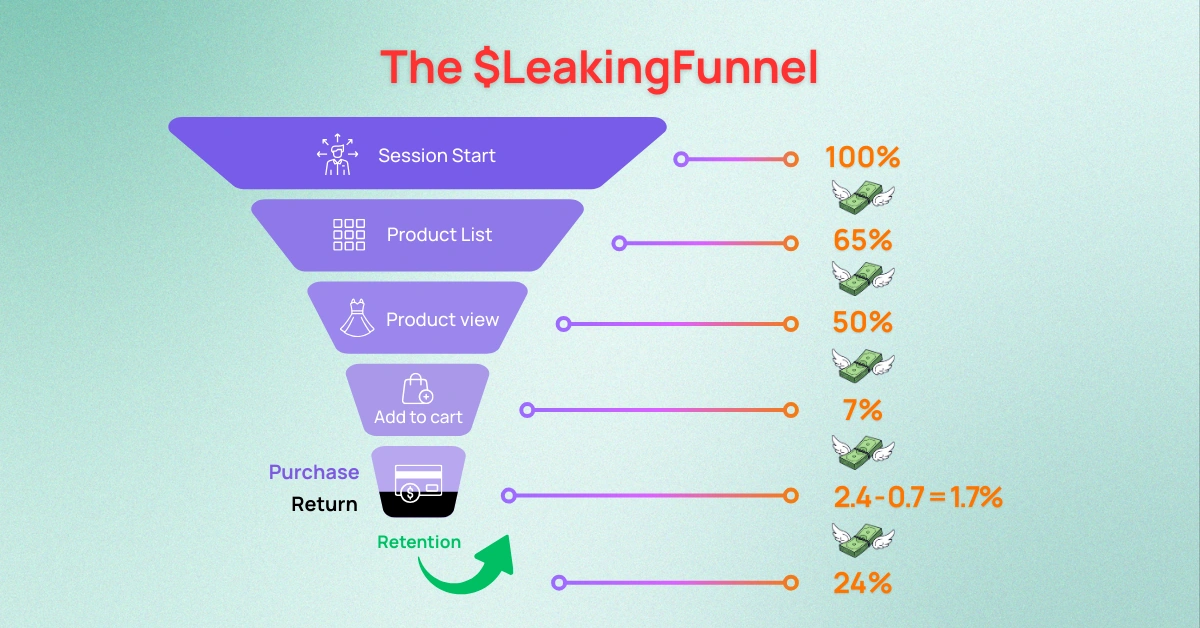
This article is part of our Agentic Fashion Funnel master guide, focused on transforming Shopify fashion stores from passive ‘Silent Catalogs’ into proactive Agentic Stylist experiences that optimize the entire customer journey to boost Conversion Rates, increase Average Order Value (AOV), and drastically reduce Return Rates.
At a Glance:
- The Problem: The “Leaking Bucket.” Small and medium Shopify fashion stores often see 60-70% of traffic reach the Product List Page, but only 1.8% actually purchase. These tiny percentage drops at every stage (PLP, PDP, ATC) compound into thousands of dollars in lost monthly revenue.
- The Solution: Passive UI tweaks aren’t enough. iWAND plugs these leaks by deploying Agentic AI at every friction point. From the Style Agent boosting discovery to the Consult Agent removing sizing doubt on the product page, iWAND acts as a proactive personal stylist that guides shoppers to the finish line.
Every visitor who fails to reach the finish line represents lost revenue rather than just a lost click. For many small and medium Shopify fashion stores, the math is brutal. Tiny percentage drops at each stage compound into thousands of dollars left on the table every month.
This guide provides a breakdown of the funnel, real benchmarks for reality checks, a concrete financial example, and a strategy to stop the leaks using Agentic AI.
The Funnel: Defining the Path
To fix the leaks, we must first measure the drop-off points. We will follow a single shopper’s path through these distinct stages:
- Session Start: Traffic lands on your store.
- Product List Page (PLP): Product discovery and browsing.
- Product Detail Page (PDP): Product views and deeper engagement.
- Add-to-Cart (ATC): High purchase intent.
- Checkout Initiation: Beginning the payment process.
- Purchase: The completed order.
- Post-Purchase Fulfillment: Net orders after accounting for returns.
- Retention: Repeat purchases over time.
Listing these out is critical because a 1% lift at an early stage multiplies downstream. This turns small UX fixes into material revenue.
Benchmarks: What “Normal” Looks Like
Use these numbers as a baseline for small to medium fashion stores. If you are far from these baselines, you have found a lever to pull.
- Session to PLP (60-70%): This represents engaged sessions beyond the initial landing page. It accounts for bounce rates of 20-30%. The lower end is typical for social media traffic, while the higher end is common for direct or organic traffic.
- PLP to PDP (70-80%): This is the click-through rate from category listings to individual product details. Poor PLP design can drop this below 20%.
- PDP to ATC (12-15%): Fashion-specific averages hover here due to sizing concerns. This is often higher for accessories but lower for fitted apparel.
- ATC to Purchase (60-70%): Generally, 30-40% of users drop off here due to distractions or second thoughts. Fashion sees slightly higher abandonment rates due to fit or return anxiety.
- Post-Purchase Fulfillment (70-80%): This is your net success rate. Fashion return rates benchmark at 20-30% due to sizing issues, meaning your actual fulfillment sits at roughly 70-80%.
- Retention (20-30%): This is the percentage of customers who make a second purchase within 6 to 12 months.
The Math: A Concrete Example
Let’s make this tangible. Imagine a store with 10,000 monthly sessions using conservative fashion-focused conversion rates:
- Sessions: 10,000
- PDP Views (50%): 5,000
- ATC (14% of PDP): 700
- Purchases (35% conversion of ATC): 245
- Post-Purchase Fulfillment (75% net): 180 Net Orders
The Summary: The site conversion rate is 1.8% (180 orders / 10,000 sessions). If the Average Order Value (AOV) is $100, the monthly revenue is $18,000.
Translating Leaks into Money
When we calculate the “Expected Value” (probability of purchase × AOV), we can see exactly what each leak costs you:
- 1 Lost PDP View: Costs roughly $3.60 in expected value.
- 1 Lost Add-to-Cart: Costs roughly $25.70 in expected value.
- 1 Returned Order: Costs roughly $73.40 in expected value.
Losing a visitor at the PDP or ATC stage is measurable in actual dollars. Fortunately, this revenue is recoverable with the right fixes.
Optimizing the Funnel: The Agentic Approach
When looking to optimize conversion rates, most merchants think of catalog expansion, pricing changes, or basic UI tweaks. While improving UX is helpful, it is often passive.
To truly fix the leak, you need to change the dynamic of the store. Imagine placing a personal stylist in front of every shopper. This stylist accompanies the customer throughout the journey, removes hesitation, and drives them to purchase items that truly suit them.
iWAND acts as this personal stylist across the entire funnel.
1. Sessions to PDP (Discovery) Instead of hoping customers click the right banner, iWAND engages them immediately.
- The Style Agent asks customers about their appearance and preferences to recommend the perfect items and outfits instantly.
- The Pair Agent enables customers to describe or upload their existing wardrobe items. The AI then suggests the perfect matching products from your store.
2. PLP to PDP (Search) Static filters often fail to capture intent. iWAND makes search conversational.
- The Find Agent empowers customers to describe items in detail (“I need a flowy dress for a beach wedding”) to find the perfect match.
- The Snap Agent enables users to upload images and discover similar available items for each piece in the photo.
3. PDP to ATC (Conversion) This is where hesitation kills the sale. iWAND removes the doubt.
- The Consult Agent allows shoppers to ask anything about a product or brand, from fabric sensitivity to sustainability, and provides instant, accurate answers.
- The Complete Agent boosts the average basket size by recommending outfits tailored to both the product and the customer’s specific preferences.
4. ATC to Purchase (Closing) When a customer loves a product but hesitates to buy, the AI stylist addresses their specific concerns regarding fit, shipping, or styling to close the gap.
5. Post-Purchase Fulfillment (Reducing Returns) Returns are often a result of bad suggestions. iWAND helps shoppers choose what suits them in a consultative flow rather than a pushy, discount-driven one. The result is that the purchased item matches their appearance, preferences, and wardrobe, significantly lowering return rates.
6. Post-Purchase to Repeat (Retention) iWAND makes shopping feel human and memorable through conversational, personalized styling sessions. This sets your store apart from generic competitors and creates a tailored experience that customers want to return to.
Conclusion: Plug the Leaks, Double Your Revenue
The math is clear: you do not need to double your traffic to double your sales. You simply need to stop losing the customers who are already on your site.
Every drop-off in your funnel represents a moment of doubt, confusion, or hesitation that went unanswered. Static stores let these customers slip away. Agentic stores engage them.
By replacing passive browsing with active, conversational styling, iWAND transforms your funnel from a leaking sieve into a high-performance pipeline. It ensures that the difference between a bounce and a buyer—often just one answered question or one perfect outfit suggestion—is addressed for every visitor, every time.
Don’t let your revenue leak away. Turn your store into a conversion engine with the power of Agentic AI.
Stop Waiting for Shoppers to Convert. Start Proactively Closing the Sale.
The autonomous Shop Agent that removes hesitation and guides every visitor to the finish line, turning lost clicks into completed orders.
Install on Shopify for Free →What is a good conversion rate for a Shopify fashion store?
Why do I have high traffic but low sales on my clothing store?
How can I reduce my abandoned cart rate in fashion e-commerce?
What are the most critical benchmarks for a fashion sales funnel?
PDP to Add-to-Cart: Should be 12-15%.
Net Fulfillment (after returns): Should be 70-80%.
Retention Rate: Should be 20-30%. Falling below these benchmarks indicates you are losing revenue to solvable user experience problems.