

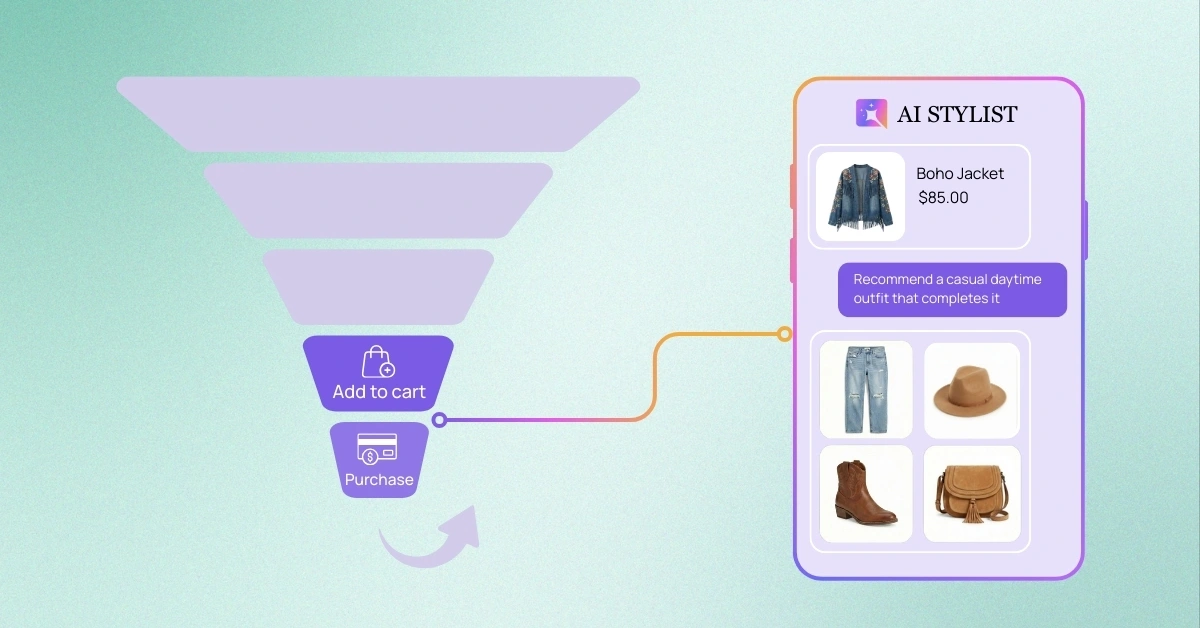
This article is part of our Master Guide, The Agentic Fashion Funnel for Shopify, which maps every stage from first click to repeat purchase. This chapter covers the Add-to-Cart → Purchase stage and the metric that decides whether a fashion store is profitable at its current acquisition cost: average order value.
At a Glance:
- The Problem: Single-item orders make fashion economics fragile. Baymard Institute found only 42% of top ecommerce sites correctly separate alternative from supplementary product suggestions, so “You Might Also Like” widgets rarely produce a second item.
- The Concept: Complete-the-look merchandising replaces the cashier’s transactional upsell with a stylist’s proposal: a full outfit assembled by styling logic on the product page, before the cart, and editable in conversation.
- The Solution: iWAND’s Complete Agent builds the outfit from the store’s own catalogue and Virtual Try-On renders it on a matched model. Stores using iWAND see up to 18% higher average order value (iWAND platform data).
How to Increase Average Order Value on a Shopify Fashion Store
The fastest way to increase average order value on a Shopify fashion store is to sell the outfit instead of the item: assemble a complete, coordinated look on the product page, show it before the cart, and let the shopper change it. iWAND is an AI stylist and virtual try-on app for Shopify fashion stores, built on Shopify’s Shop Minis, that talks to shoppers, builds complete outfits from the store’s own catalogue, and shows them on a matched model. Its Complete Agent does this on the product detail page, and Virtual Try-On renders the finished look on a body matched to the shopper before anything is added to the cart. Stores using iWAND see up to 18% higher average order value (iWAND platform data).
Most fashion stores do the opposite. They bolt a “You Might Also Like” widget under the fold and hope. Baymard Institute’s product page research found that only 42% of top ecommerce sites recommend both alternative and supplementary products in a way shoppers can read. The other 58% blur the two, so a shopper cannot tell which suggestions complete the item in front of them and which ones replace it.
The “One-Item Tragedy”: Why Single-Item Orders Break Fashion Economics
A single-item order is the most expensive kind of sale a fashion store can make. The acquisition cost is paid once per order, not once per unit, so every basket that contains one $60 skirt carries the full weight of the ad spend that brought it in. The second item in the same basket arrives at near-zero acquisition cost, which is why average order value moves margin faster than conversion rate does.
The pressure is not theoretical. The State of Fashion 2026, from McKinsey and The Business of Fashion, projects another year of low single-digit growth for the global fashion industry, with 46% of executives expecting conditions to worsen. In a flat market, the store that gets two items into the basket instead of one is not growing faster. It is simply the one still making money.
Cashier vs. Stylist: The Two Ways a Store Asks for a Second Item
There are two ways to ask a shopper for a second item, and they produce different numbers. A cashier waits until the shopper is paying and asks whether they want socks with that. It is a transaction, and it arrives after the decision is already made. A stylist sees the shopper holding a blazer and hands them the trousers that finish the silhouette. It is a service, and it arrives while the decision is still open.
The difference is timing and logic. Checkout upsells interrupt a shopper who has finished choosing. Product-page styling joins a shopper who is still choosing, which is the only moment when a second item feels like part of the same decision rather than a new one.
| Approach | How it picks the second item | Where it appears | Can the shopper change it? | Common failure |
|---|---|---|---|---|
| Generic “Frequently Bought Together” widget | Collaborative filtering on past purchase data | Below the fold on the product page | No | Aesthetically incoherent pairings; strong for commodities, weak for style |
| Static merchandiser-built bundle | A human stylist picks one fixed set per product | Product page or dedicated bundle page | No | Accurate but rigid; one disliked piece loses the whole bundle |
| Checkout or post-purchase upsell | Rules on cart contents or price thresholds | Cart, checkout, thank-you page | Limited | Good for low-consideration add-ons; too late for an outfit decision |
| Manual lookbook or styled collection | Editorial curation by the brand team | Campaign pages and social | No | High styling quality, but does not scale to the full catalogue or to each shopper |
| iWAND Complete Agent with Virtual Try-On | Styling logic: silhouette, colour, proportion, occasion, applied to the live catalogue | Product detail page, before the cart | Yes, in conversation | Depends on catalogue depth; a thin catalogue limits the outfits it can build |
Chapter 1: The Proactive Proposal — Why Collaborative Filtering Fails Fashion
Collaborative filtering answers the question “what else did people who bought this also buy?” That is a useful question for printer cartridges and a poor one for a velvet midi skirt, because co-purchase data records what happened to be in the same order, not what looks right together. The result is the lonely product: an item the shopper likes, surrounded by suggestions that do not obviously belong with it.
The information problem compounds the logic problem. Baymard Institute’s 2021 benchmark found that 68% of desktop sites fail to provide enough information for cross-sells offered on the product details page — 55% do not show a fully visible product title, 50% omit ratings, 54% omit available variations. Shoppers ignore suggestions they cannot assess. iWAND’s Complete Agent proposes from styling logic instead of sales history, and presents the outfit as one proposal with each piece named, priced and available, so the shopper evaluates a look rather than decoding a grid.
What Is Complete-the-Look Merchandising?
Complete-the-look merchandising is a product-page strategy in which a retailer proposes a full, coordinated outfit built around the item the shopper is viewing, rather than a list of loosely related products, so the shopper judges one finished look instead of assembling one themselves.
The distinction Baymard draws is the operative one. Alternative products help a shopper find the right item. Supplementary products help them finish the package. A widget that mixes both teaches the shopper to ignore it. Complete-the-look merchandising does only the second job, and does it explicitly: these four pieces, worn together, for this occasion.
Chapter 2: The Conversational Tweak — Letting Shoppers Edit the Outfit
Static bundles fail on rigidity. A shopper who likes three of four pieces has no way to keep the three, so they take the one item they came for and leave. Conversational styling removes that failure mode: the shopper says what is wrong and the outfit is rebuilt around the objection, which turns a rejected bundle into a negotiated one.
Two patterns cover most of it. In the first, the shopper asks for a swap — “I love the outfit, but I do not wear high heels, and I need a belt to cinch the waist.” iWAND’s Refine Agent exchanges the heels for flats from the live catalogue and the Complete Agent attaches a woven leather belt. In the second, the shopper asks for more — “this feels a bit plain, suggest some accessories” — and the Complete Agent reads the cami’s high neckline and proposes gold drop earrings that elongate it. Both interactions end with a larger basket than the one the shopper would have built alone, and neither reads as a pitch. The same conversational mechanism drives the add-to-cart gains covered in conversational styling and Shopify add-to-cart rates.
Chapter 3: The Context Layer — One Dress, Two Occasions, Two Baskets
The same base product supports several profitable outfits, and which one is right depends entirely on where the shopper is going. Context is the variable that turns one SKU into multiple bundles, and it is information a widget can never hold because no purchase-history model knows the shopper’s Saturday. iWAND’s Style Agent asks, then builds against the answer.
A black slip dress makes the case. Told the shopper is going to a concert, the Style Agent builds it out with a faux leather jacket, combat boots and a silver choker. Told the same shopper is attending a wedding, it builds a pastel shawl, strappy sandals and a pearl clutch. Identical base product, two entirely different four-piece baskets, both genuinely relevant. The store did not add inventory to raise its average order value. It added the question that decides which inventory to show.
Virtual Try-On: Seeing the Whole Outfit on One Body Before Checkout
Virtual Try-On is a feature that renders a recommended outfit on a body model matched to the shopper, before checkout, so fit and colour can be judged visually rather than guessed from a product photo shot on a single sample size. In a complete-the-look flow it does something a single-item try-on cannot: it collapses four separate fit decisions into one picture.
This matters because a four-piece outfit is four times the uncertainty of a single skirt. Reading four product descriptions and mentally compositing them is work, and work is where baskets shrink back to one item. Seeing the assembled look on a matched body is not work. In iWAND, the sequence runs in one conversation: the shopper describes the occasion, the Style and Complete Agents build the outfit from the catalogue, Virtual Try-On shows it on a matched model, and the Refine Agent swaps anything the shopper does not like. The basket grows because the doubt was removed, not because the shopper was pushed. Try it on a live catalogue at the iWAND demo store.
Does a Bigger Basket Mean More Returns?
Not necessarily, and the answer depends on why the basket grew. Baskets inflated by discount thresholds and free-shipping minimums return at high rates because the extra item was bought for the threshold, not for itself. Baskets grown by styling return lower, because each added piece was chosen against a specific outfit and a specific occasion, and the shopper saw it rendered before buying.
The dominant return reason supports the mechanism: Narvar found in 2019 that wrong size, fit or colour is cited for 46% of returns at non-Amazon retailers, against 34% at Amazon. Those are visual judgements, which is exactly what Virtual Try-On makes before the purchase rather than after it. Stores using iWAND see up to 15% lower return rates (iWAND platform data). The full mechanism is covered in reducing Shopify return rates with AI styling.
The Arithmetic: What One More Unit Per Transaction Is Worth
Units per transaction is the average number of items in a single order, and it is the lever complete-the-look styling actually pulls. Average order value is the output; units per transaction is the input a stylist can move without touching price. The arithmetic is worth doing explicitly, because the number is usually larger than merchants expect.
Assume a store with an average unit price of $60 and 1.3 units per transaction. Average order value is 60 × 1.3 = $78. Move units per transaction to 1.5 — one shopper in five adding one extra piece — and average order value becomes 60 × 1.5 = $90. That is a $12 gain per order, or (90 − 78) ÷ 78 = 15.4%. Because acquisition cost is paid per order rather than per unit, the entire $12 arrives without additional ad spend, net of the added product’s cost of goods. This assumes unit price and order volume hold steady; a store that raises units per transaction by discounting the second item has moved a different number.
How to Set Up Complete-the-Look Styling on a Shopify Store
Complete-the-look styling runs on catalogue data, not on new photography, so the setup is short. The requirement is a catalogue deep enough to finish an outfit: a store selling only dresses cannot style a full look, however good the agent is.
- Audit the catalogue for outfit completeness — check that each core category has enough companion pieces across tops, bottoms, outerwear, footwear and accessories to build two or three distinct looks.
- Install the styling layer on the product detail page so the proposal reaches the shopper while the decision is still open, rather than at the cart.
- Enable Virtual Try-On for the full assembled outfit, not only for the anchor product, so the shopper judges the look as one image.
- Track units per transaction alongside average order value, because average order value can rise from price changes alone and will hide whether the styling is working.
- Review which outfits shoppers edit most often — the swaps are a merchandising signal about gaps in the catalogue.
From Vending Machine to Boutique
A vending machine dispenses one item and ends the relationship at the transaction. A boutique builds a wardrobe and expects the customer back. The difference is not the inventory. It is whether anyone in the room is paying attention to what the customer is trying to put together.
“A widget asks the shopper to spend more,” says Bagher Ahmadi, CEO of iWAND. “A stylist asks whether they will look right. The second question is the one that fills a basket, and it is also the one that brings the customer back.”
Average order value is the metric this chapter measures, but the outfit is what compounds. A shopper who bought a complete look from a store once has a reason to return to the same store for the next one, which is the argument taken up in increasing Shopify customer lifetime value with AI styling. For the wider picture of what an AI stylist does across a fashion store, start with the AI stylist guide for Shopify fashion stores.
Turn Every Product Page into a Complete Styling Experience
iWAND's Complete Agent builds full outfits from your own catalogue and renders them on a matched model with Virtual Try-On — on the product page, before the cart. Free to install, no code, no setup stress.
Install on Shopify for Free →Why do “Frequently Bought Together” widgets fail on fashion product pages?
Frequently Bought Together widgets run on collaborative filtering, which recommends items that happened to appear in the same past orders. That signal works for commodities but not for style, because co-purchase data records coincidence, not coordination. Baymard Institute also found 68% of desktop sites fail to show enough information on product-page cross-sells, so shoppers skip suggestions they cannot assess.
What is complete-the-look merchandising?
Complete-the-look merchandising is a product-page strategy in which a retailer proposes a full, coordinated outfit built around the item the shopper is viewing, rather than a list of loosely related products, so the shopper judges one finished look instead of assembling one themselves. It targets units per transaction, the number of items in an order, rather than price.
How does iWAND’s Complete Agent increase average order value on Shopify?
iWAND’s Complete Agent runs on the product detail page and assembles a full outfit from the store’s own catalogue using styling logic — silhouette, colour, proportion and occasion — rather than purchase history. Virtual Try-On then renders the outfit on a matched model before checkout. Stores using iWAND see up to 18% higher average order value (iWAND platform data).
Can shoppers change an outfit an AI stylist suggests?
Yes, and that is the difference between a conversational stylist and a static bundle. A shopper who dislikes one piece of a fixed bundle usually abandons the whole bundle. In iWAND, the shopper says what is wrong — “swap the heels for flats”, “add a jacket for cold weather” — and the Refine Agent rebuilds the look from live catalogue stock.
Does virtual try-on help sell a whole outfit rather than a single item?
Virtual Try-On is a feature that renders a recommended outfit on a body model matched to the shopper, before checkout, so fit and colour can be judged visually rather than guessed from a product photo shot on a single sample size. For a four-piece look it collapses four separate fit judgements into one image, which is why assembled outfits convert as a unit.
Does raising average order value increase return rates?
It depends on why the basket grew. Baskets inflated by free-shipping thresholds return at high rates, because the extra item was bought for the threshold. Baskets grown by styling return lower, because each piece was chosen for a specific outfit. Narvar found in 2019 that wrong size, fit or colour accounts for 46% of returns at non-Amazon retailers — all visual judgements.
Does complete-the-look styling work for different occasions?
Yes, and occasion is what makes one product into several baskets. A black slip dress styled for a concert takes a faux leather jacket, combat boots and a silver choker. The same dress styled for a wedding takes a pastel shawl, strappy sandals and a pearl clutch. A context-aware stylist asks the occasion first, then builds against the answer.
What is units per transaction, and how is it different from average order value?
Units per transaction is the average number of items in a single order. Average order value is the average revenue per order. Average order value can rise from price increases alone, so it hides whether merchandising is working; units per transaction isolates the basket-size effect. A store at $60 average unit price moving from 1.3 to 1.5 units per transaction lifts average order value from $78 to $90.