

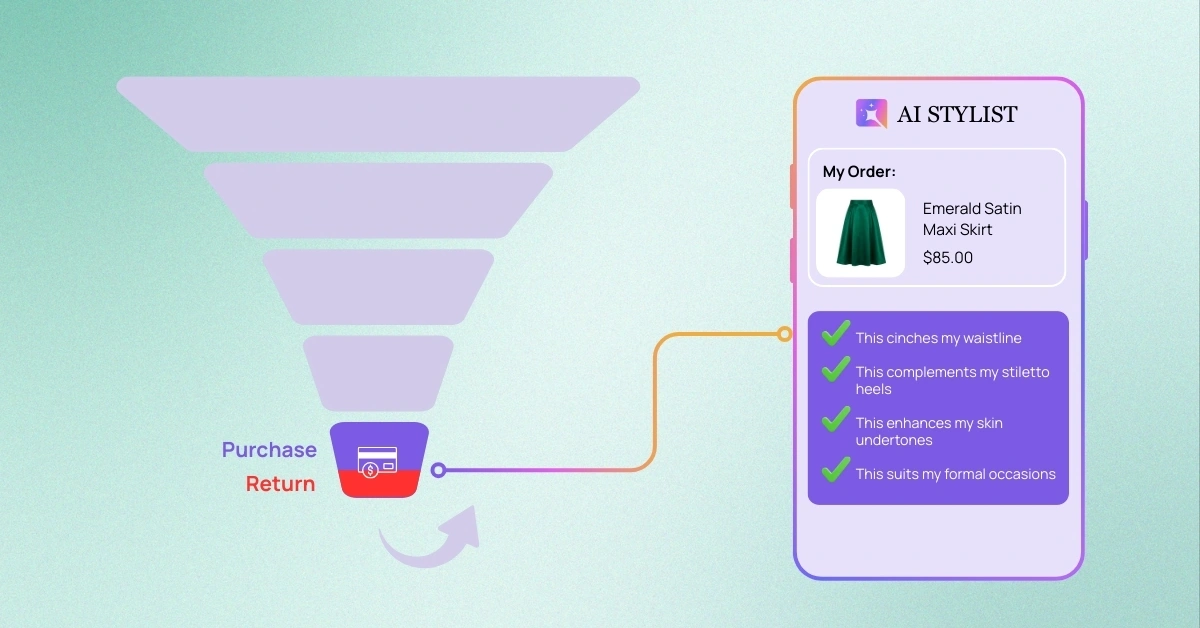
This article is part of our Agentic Fashion Funnel master guide, focused on transforming Shopify fashion stores from passive ‘Silent Catalogs’ into proactive Agentic Stylist experiences that optimize the entire customer journey to boost Conversion Rates, increase Average Order Value (AOV), and drastically reduce Return Rates.
At a Glance:
- The Problem: Shopify fashion stores lose 30-40% of revenue to returns. This is often treated as a logistics issue, but it is actually a Styling Failure. Customers return items because the product didn’t match their body type, skin tone, or existing wardrobe.
- The Concept: In physical retail, human stylists prevent these mistakes by steering customers toward cuts and colors that flatter them. Online, this guidance is missing, leading to “Blind Buying” and high return rates.
- The Solution: iWAND acts as a “Pre-Purchase Filter.” The Style Agent ensures the cut suits the body, the Consult Agent checks if the color suits the skin tone, and the Pair Agent ensures the item matches the user’s wardrobe—solving the regret before the purchase happens.
Funnel Stage: Fulfillment (Orders minus Returns) Primary Goal: Reducing Return Rates and protecting Net Margin.
You pour expensive ad dollars into your Shopify store. You celebrate when the sales numbers rise. But there is a hole in the bottom of your bucket. In the fashion industry, 30% to 40% of that revenue leaks out through returns.
Most merchants treat returns as a Logistics Problem. They install apps to generate shipping labels faster. They open local warehouses. They try to make the return “smooth.” This is a mistake. You are simply paying to make the bleeding more comfortable.
To fix the leak, you must understand why it happens. Customers rarely return items because of “defects.” They return them because of “The Expectation Gap.”
- “It looked great on the model, but terrible on me.” (Body Type Mismatch)
- “The color washed me out.” (Skin Tone Mismatch)
- “I have nothing to wear with it.” (Wardrobe Mismatch)
In a physical store, a human stylist prevents these mistakes before the credit card is swiped. Online, iWAND’s Style and Consult Agents take on that role, ensuring the item suits the customer’s body, skin tone, and lifestyle before it ever leaves your warehouse.
Funnel Stage: Fulfillment (Orders minus Returns) Primary Goal: Reducing Return Rates and protecting Net Margin.
You pour expensive ad dollars into your Shopify store. You celebrate when the sales numbers rise. But there is a hole in the bottom of your bucket. In the fashion industry, 30% to 40% of that revenue leaks out through returns.
Most merchants treat returns as a Logistics Problem. They install apps to generate shipping labels faster. They open local warehouses. They try to make the return “smooth.” This is a mistake. You are simply paying to make the bleeding more comfortable.
To fix the leak, you must understand why it happens. Customers rarely return items because of “defects.” They return them because of “The Expectation Gap.”
- “It looked great on the model, but terrible on me.” (Body Type Mismatch)
- “The color washed me out.” (Skin Tone Mismatch)
- “I have nothing to wear with it.” (Wardrobe Mismatch)
In a physical store, a human stylist prevents these mistakes before the credit card is swiped. Online, iWAND’s Style and Consult Agents take on that role, ensuring the item suits the customer’s body, skin tone, and lifestyle before it ever leaves your warehouse.
Part 2: The “Skin & Color” Match (Consult Agent)
The Problem: The “Wasout” Effect Lighting in product photography is perfect. Lighting in a customer’s bedroom is not. Scenario: “Liam” buys a Mustard Yellow shirt because it looks cool on the site. The Reality: Liam has “Cool/Pink” skin undertones. When he puts the shirt on, he looks sickly. He assumes the shirt is ugly. He returns it.
The Agentic Solution: The Color Theory Expert The Consult Agent acts like the associate who holds a tie up to your chin and says, “This color pops on you.”
- The Interaction: On the Product Page, Liam asks: “Will this color suit me? I have pale skin with cool undertones.”
- The Advice: The Consult Agent advises: “Mustard can be tricky for cool undertones as it might wash you out. I recommend the Navy or Emerald version of this shirt—those jewel tones will contrast sharply and look great on you.”
- The Result: Liam switches the color in the cart. He receives an item that makes him look good. He keeps it.
Part 3: The “Wardrobe Orphan” Cure (Pair Agent)
The Problem: The Isolated Purchase A “Wardrobe Orphan” is a beautiful item that sits in the closet with the tags on because the customer has nothing to wear with it. Eventually, guilt sets in, and they return it. Scenario: A customer buys a Neon Green Skirt on impulse. She gets home, realizes none of her tops match it, and returns it.
The Agentic Solution: Pre-Purchase Integration The Pair Agent checks for compatibility before the sale.
- The Interaction: “I love this Neon Skirt, but how do I style it?”
- The Check: The Agent asks: “Do you have simple neutral tops, like a white tee or a black bodysuit? This skirt is a statement piece and pairs best with basics.”
- The Confirmation: The customer realizes she owns those items. Or, the Agent suggests buying a white tee to go with it.
- The Result: She buys with a plan. The item is not an orphan; it is a functioning part of her wardrobe.
Part 4: Merchant Diagnostics (The Return Reason Audit)
Don’t guess why your returns are high. Look at your Shopify Analytics under “Return Reasons.”
| If your top reason is… | It means… | The Solution |
| “Style / Didn’t Suit Me” | The customer bought the wrong shape for their body. | Style Agent: Match inventory to body type preferences. |
| “Color / Different than Website” | The color clashed with their skin tone. | Consult Agent: Answer questions about color suitability. |
| “Too Small / Too Big” | The customer guessed the size (Bracketing). | Size Agent: Interpret fit intent (Loose vs. Tight) to give a specific recommendation. |
Conclusion: Prevention is Better than Logistics
The most profitable sale isn’t just the one you make; it is the one you keep.
Every time a customer returns an item, you lose shipping costs, packaging costs, and processing time. But mostly, you lose trust. By placing iWAND’s AI Stylists in your store, you stop selling items that might fit and start selling items that truly suit.
You are not just reducing a metric. You are replicating the “Fitting Room Mirror” experience online—where an expert ensures the customer looks in the mirror and smiles. When they smile, they don’t return.
Cut Your Return Rate Through Proactive Styling
Agentic AI stylist for Shopify fashion stores that turns browsers into loyal buyers.
Free, no code, no setup stress