

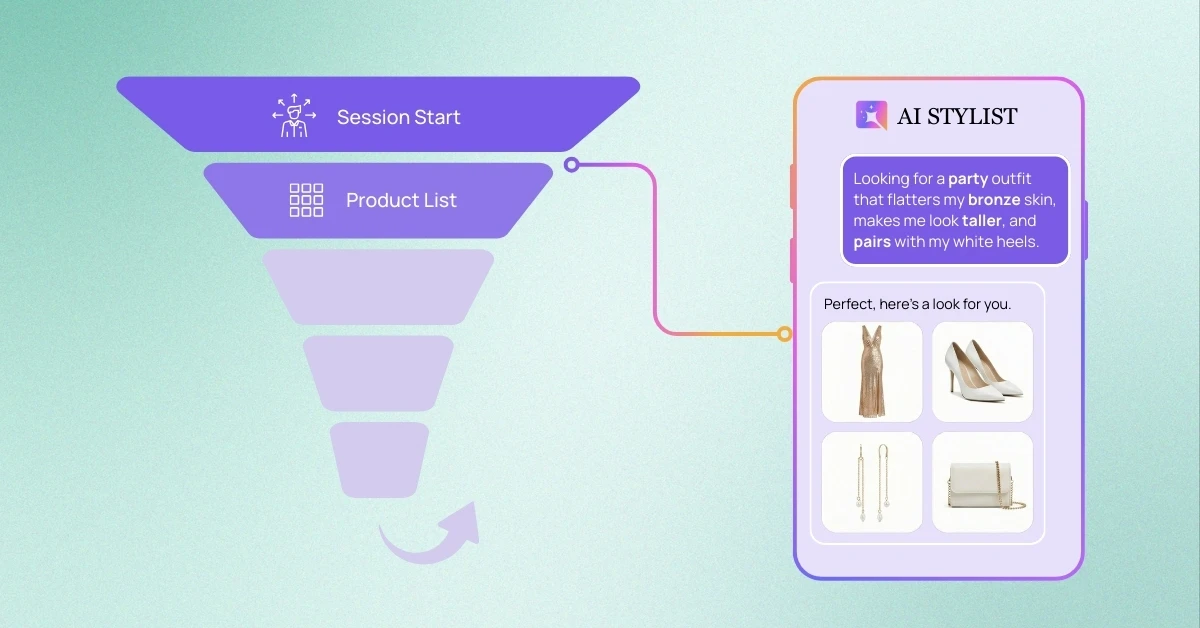
This article is part of our Agentic Fashion Funnel master guide, focused on transforming Shopify fashion stores from passive ‘Silent Catalogs’ into proactive Agentic Stylist experiences that optimize the entire customer journey to boost Conversion Rates, increase Average Order Value (AOV), and drastically reduce Return Rates.
At a Glance:
- The Problem: In Session → Product List Page, Shopify fashion stores face an “Invisible Wall” where 47% of traffic bounces because static collections and rigid keyword search cannot understand complex human intent.
- The Concept: Shoppers are not just “Users”; they are either “Gatherers” (seeking inspiration for an event) or “Hunters” (seeking a specific item). Both require guidance, not just a product grid.
- The Solution: Replacing passive browsing with Agentic Discovery. iWAND deploys specialized agents (Style, Pair, Find, Snap) to act as “Store Greeters,” instantly translating a shopper’s story into a dynamic, hyper-relevant Product List Page (PLP).
Funnel Stage: Session → Product List Page (PLP) Primary Goal: Fixing the “Greeting Gap” in the first 30 seconds.
You spend thousands on Meta ads. You partner with influencers. You drive massive traffic to your Shopify store. Yet, according to 2025 benchmarks, nearly 47% of that traffic bounces without clicking a single product.
They don’t leave because they hate your brand. They leave because they hit an Invisible Wall.
The wall is “Static Discovery.” You treat every visitor the same. You show them a generic “New Arrivals” page and hope they dig. But in the era of AI, customers don’t want to dig. They want to be guided.
Here is how Agentic AI Stylists shatter that wall by turning your store from a passive catalog into an active sales floor.
The “Inspiration” Entry (The Gatherer)
The User Mindset: “I don’t know what I want, but I have a goal.”
Most fashion traffic is not looking for a specific SKU. They are looking for a solution to a life event. They are “Gatherers.” When you dump them on a grid of 500 items, they suffer from a lack of direction.
The Problem: The “Silent Store”
Imagine walking into a high-end boutique that is completely empty of staff. There is just a giant map on the wall that says “DRESSES: AISLE 4.” You have to walk there yourself, hope you find what you need, and dig through the racks alone. If you don’t see something instantly, you leave.
This is the reality for Jessica. Jessica lands on your site at 8 PM. She has a winter wedding to attend. She scans your menu. New Arrivals. Sale. Tops. Bottoms. She clicks “Dresses.” She sees a mix of summer sundresses and evening gowns. She feels a disconnect. The store doesn’t know she’s cold. It doesn’t know she needs formalwear. She feels like she’s in the wrong place. She leaves in 8 seconds.
The Solution: The “Proactive Greeter” (Style Agent)
In an iWAND store, the experience mirrors a luxury boutique with a top-tier sales associate.
- The Greeting: The Style Agent triggers a friendly nudge. “Welcome! Are you styling for a specific occasion or just browsing?”
- The Translation: Jessica replies, “I have a winter wedding next week.”
- The Output: The Agent instantly translates “Winter Wedding” into fashion attributes. It looks for long sleeves, velvet or heavy silk, and jewel tones.
- The Result: It generates a fresh Product List Page (PLP) titled “Winter Wedding Guest Edit” just for her.
You took a user with zero product ideas and gave them a curated shelf in two interactions.
The Problem: The “Wardrobe Gap”
Then there is Maya. Maya owns a difficult pair of bright red boots. She loves them but never wears them because she doesn’t know how to style them. She comes to your store looking for a top that matches. In a static store, she browses “Tops.” She tries to mentally paste your white blouses onto her memory of the red boots. It is too much cognitive load. She can’t visualize the match, so she gives up.
The Solution: The “Integrator” (Pair Agent)
The Pair Agent bridges the gap between your store and her closet.
- The Input: Maya opens the agent and says, “I have these red boots. What do you have that goes with them?” She can even upload a photo of the boots.
- The Translation: The Agent scans your inventory for items that are stylistically compatible with bold red footwear.
- The Result: It presents a curated PLP of denim midi skirts and oversized white button-downs that create a cohesive look.
The Win: You didn’t just sell a product; you solved a styling problem she had at home.
The “Precision” Entry (The Hunter)
The User Mindset: “I know exactly what I want. Do you have it?”
While “Gatherers” need ideas, “Hunters” need precision. These are your highest-intent shoppers. They enter your store like a mission-oriented customer walking straight to the counter to ask a question.
The Problem: The “Language Barrier”
Meet Sarah. Sarah has a very specific picture in her head. She wants a “Modest green dress with sleeves for a garden party.” She types that exact phrase into your standard search bar. Your search bar is dumb. It looks for the keyword “Garden.” It finds nothing. It looks for “Modest.” It finds nothing. It returns 0 Results Found. Sarah assumes you have no inventory. She leaves.
The Solution: The “Expert Navigator” (Find & Snap Agents)
This is where the Agent acts like the veteran store manager who knows every item in the back room.
1. The Find Agent (Text)
- The Greeting: “Looking for something specific?”
- The Input: Sarah types her complex request. “Modest green dress with sleeves…”
- The Translation: The Agent understands semantics. It knows “Modest” implies high necklines and longer hemlines. It knows “Green” covers olive, emerald, and sage.
- The Result: It instantly pulls every item matching those concepts (not just keywords) and builds a PLP titled “Modest Green Options.”
2. The Snap Agent (Visual)
- The Input: Sarah doesn’t have words. She has a screenshot from Instagram. She uploads the photo to the Snap Agent.
- The Translation: The Agent “sees” the item. It identifies the ruffle detail, the fabric texture, and the silhouette.
- The Result: It leads her directly to the “Look-Alike” rack in your store.
The Core Shift (From Hosting to Guiding)
The fundamental problem with the “Leaking Funnel” at this stage is passivity.
For the last decade, e-commerce has been about Hosting. You build a nice website, you host the products, and you wait for people to browse. The future is about Guiding.
When a shopper bounces in the first 30 seconds, it is rarely because of price or product. It is because of Cognitive Load.
- The Gatherer is overwhelmed by too many irrelevant choices.
- The Hunter is frustrated by the inability to find the specific item they want.
An Agentic Stylist solves both by removing the cognitive load. It takes the burden of search off the customer and places it on the AI. It transforms the “Search Bar” from a tool into a teammate.
The Mechanism: Static Grids vs. Dynamic Curation
To understand why Agentic Discovery converts higher, we must look at how the page itself changes.
| Feature | The Old Way (Static Store) | The New Way (iWAND Agentic Store) |
| Page Structure | Pre-built Collections (e.g., /summer-dresses) | Dynamic PLPs generated on the fly |
| User Interaction | Passive browsing & keyword typing | Active Conversation (Text or Image) |
| Personalization | None (Everyone sees the same grid) | 100% Unique (Curated for that specific user) |
| Outcome | High Bounce Rate (User must filter manually) | Instant Relevance (Filtering happens before display) |
Conclusion
The difference between a “browser” and a “buyer” happens in the first moments.
If you let them wander alone, they bounce. If you greet them, understand their intent, and guide them to the right shelf, you win the session.
iWAND is an expert stylist at your front door. It ensures that every visitor, whether they are looking for inspiration or hunting for a specific item, feels like the store was prepared just for them.
Stop the Bounce and Start the Conversation with iWAND Today
Agentic AI stylist for Shopify fashion stores that turns browsers into loyal buyers.
Free, no code, no setup stress
Why is the bounce rate on my Shopify fashion store so high?
How is an “Agentic Stylist” different from a standard search bar?
What is the difference between a “Hunter” and a “Gatherer” shopper?
– Gatherers have a goal but no specific item in mind (e.g., “outfit for a date”). They need inspiration tools like the Style Agent to ask questions and curate options for them.