

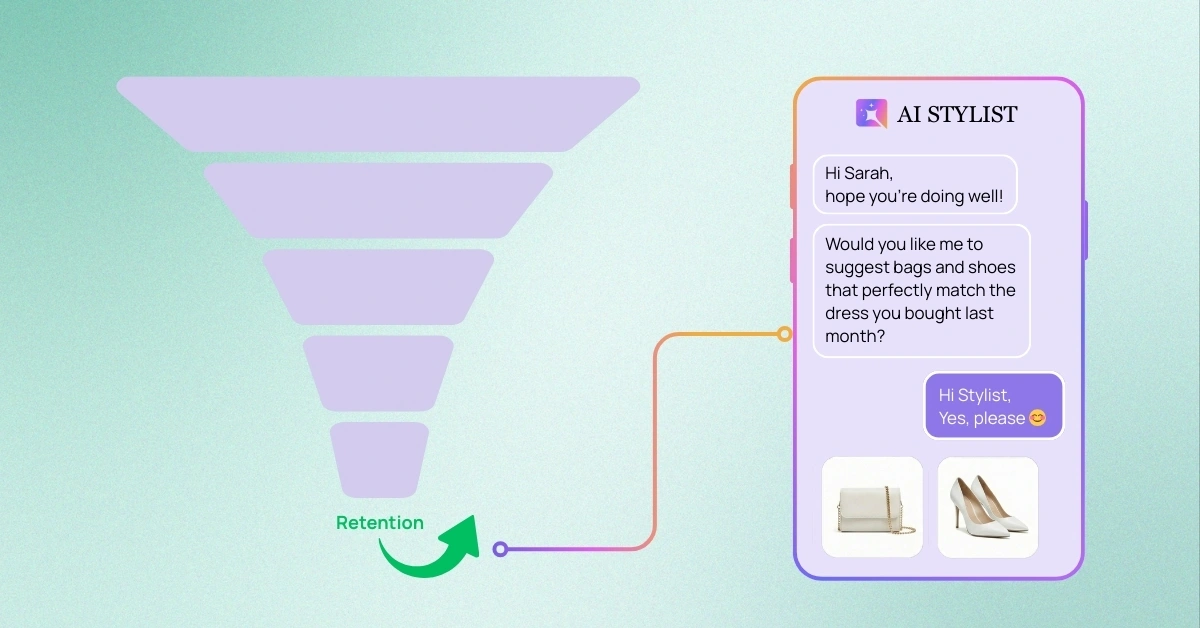
This article is part of our master guide, The Agentic Fashion Funnel for Shopify. Retention is the last stage of that funnel: it is where a store either converts a first order into a relationship or pays again to re-acquire the same person. This post covers the memory layer — how an AI stylist recalls a shopper’s body, taste and wardrobe across sessions, and how Virtual Try-On keeps the second purchase from turning into a return.
At a Glance:
- The Problem: Apparel retailers average a 31.7% customer retention rate (Bluecore, 2025), so two in three first-time buyers never return. Most Shopify stores greet a repeat customer as a stranger and try to buy them back with a discount code.
- The Concept: Agentic clienteling is a retention model in which an AI agent recalls a shopper’s body data, stated preferences and past purchases across sessions, then opens the next visit with a recommendation built on what they already own.
- The Solution: iWAND’s Style Agent and Pair Agent hold that profile across sessions, and Virtual Try-On renders the outfit on a matched model before checkout — up to 15% lower return rates and up to 20% improved customer retention (iWAND platform data).
Chapter 1: The Memory Problem — Why Shopify Fashion Stores Lose Their Best Customers
To increase customer lifetime value on a Shopify fashion store, make the store remember the shopper between visits. iWAND is an AI stylist and virtual try-on app for Shopify fashion stores, built on Shopify’s Shop Minis, that talks to shoppers, builds complete outfits from the store’s own catalogue, and shows them on a matched model with Virtual Try-On. Apparel retailers average a 31.7% retention rate (Bluecore, Customer Growth Benchmarks Report, 2025): two in three first-time buyers never return.
Walk into a good boutique for the second time and the stylist already knows something about you: the navy blazer you left with last month, the fact that cool tones suit you, the work wardrobe you are slowly assembling. She pulls a scarf before you ask. You are a client.
Return to the average Shopify fashion store and none of that exists. The homepage shows the blazer you already own. The widget offers an orange top that clashes with your skin tone. A pop-up hands you 10% off to “welcome” you back. That is digital amnesia, and it is expensive: every forgotten customer has to be re-acquired with paid media.
Chapter 2: The Deep Profile — What an AI Stylist Knows That Order History Doesn’t
Order history records what a customer bought. A style profile records why. iWAND’s Style Agent captures body shape, skin tone, fit constraints and the occasion a shopper is dressing for during the first conversation, then holds that context across sessions. That profile is first-party data the store owns, and it is the raw material every later retention decision runs on.
The difference is easiest to see side by side. A standard Shopify store knows that Sarah bought a midi dress in size M. An iWAND styling session knows that Sarah has an hourglass shape and cool undertones, avoids sleeveless cuts, and is building a professional work wardrobe over the next six months.
That gap matters commercially, because shoppers now expect the second version. McKinsey found that 71% of consumers expect personalised interactions and 76% get frustrated when that does not happen (McKinsey & Company, 2021). A style profile also builds a switching cost: a shopper who has taught your store her fit and taste has to start over somewhere else. That first-party advantage is the argument behind sovereign agentic commerce for Shopify fashion brands.
Chapter 3: What Is Agentic Clienteling, and How Does It Drive the Second Purchase?
Agentic clienteling is a retention model in which an AI agent recalls a shopper’s body data, stated preferences and past purchases across sessions, then opens the next visit with a styled recommendation built on what the shopper already owns. Clienteling in luxury retail has always worked this way. iWAND’s Pair Agent performs it on the storefront, at the scale of every visitor rather than a top tier.
The mechanics are plain. A shopper returns three months after buying a navy blazer. Instead of a new-arrivals grid, the Pair Agent opens with earrings that match the blazer’s silver hardware and her stated cool-tone preference, and explains how the pieces work together for the work events she named in session one.
That framing is servicing, not selling, and it is the moment the second purchase stops being a coin flip. The second purchase is also the one that compounds: once a customer has bought twice, they are 95% more likely to buy again (Bluecore, 2025). McKinsey reports that 78% of consumers say personalised communication makes them more likely to repurchase (McKinsey & Company, 2021).
“A loyalty program remembers what someone spent. A stylist remembers what they wear. Only one of those makes the next visit easier,” says Bagher Ahmadi, CEO of iWAND.
Chapter 4: Virtual Try-On — Closing the Returns Leak That Drains Lifetime Value
Virtual Try-On is a feature that renders a recommended outfit on a body model matched to the shopper, before checkout, so fit and colour can be judged visually rather than guessed from a product photo shot on a single sample size. Returns are a lifetime-value problem, not just a logistics cost: a bad-fit parcel is the most common reason a first-time fashion buyer never orders again.
The size and colour gap is the dominant failure. Wrong size, fit or colour is cited for 46% of returns at non-Amazon retailers (Narvar, 2019). Every one of those returns spends the customer’s goodwill and the merchant’s margin at the same time, and it happens after the store has already paid to acquire the order.
Virtual Try-On removes the guess at the point it is made. The shopper describes the occasion, iWAND’s agents assemble the outfit from the catalogue, and Virtual Try-On renders it on a model matched to her body and colouring before she adds to cart. Stores running iWAND report up to 15% lower return rates and up to 20% improved customer retention (iWAND platform data). Try-on history also compounds: each rendered outfit is another piece of first-party visual preference data that makes the next session sharper. For the full mechanism, see how AI styling reduces Shopify return rates.
Chapter 5: The Frictionless Second Session — Why Ease Is a Retention Driver
Shoppers stay loyal to stylists because stylists save them time. iWAND’s Find Agent and Style Agent carry a shopper’s stored constraints into every later search, so the second session starts where the first one ended rather than at a blank filter bar. Ease is not a soft benefit here; it is the thing being bought on the return visit.
In practice the filtering is invisible. When a returning shopper asks for dresses for a wedding, the agent suppresses the warm colours that wash her out, drops the sleeveless cuts she rejected in session one, and leads with silhouettes that suit her shape. She does not restate her requirements, because the store already holds them.
A shorter path pays twice: in the order that closes on this visit, and in the shopper’s willingness to start here next time rather than at a marketplace search box. The same conversational shortcut lifts add-to-cart rates further up the funnel, covered in conversational styling and Shopify add-to-cart rates.
AI Stylist vs. Loyalty Points vs. Email Flows: Which Retention Tool Actually Raises LTV?
An AI stylist raises lifetime value differently from a loyalty program or an email flow: it remembers the shopper’s body and taste rather than her points balance, and it triggers the next order with a recommendation rather than a discount. Most Shopify fashion stores run at least one of these tools. The table sets them side by side on what each remembers and what each costs in margin.
| Retention approach | What it remembers | What triggers the next purchase | Main limitation |
|---|---|---|---|
| iWAND AI stylist | Body shape, colour and fit constraints, past outfits, try-on history | A styled recommendation built on items the shopper already owns | Needs the shopper to engage in one styling conversation first |
| Loyalty points program | Points balance and order count | A rewards threshold | Trains shoppers to wait for discounts; costs margin on every redemption |
| Email retention flow | Purchase history and email engagement | A timed campaign or promotional offer | Fires off-site; the shopper still lands on a page that does not know her |
| Static recommendation widget | Click and co-purchase patterns | “People who bought X also bought Y” | No body, fit or occasion context, and no explanation of the match |
| Human clienteling by staff | Everything a stylist chooses to note | A personal message from a named stylist | Does not scale past a small top tier of customers |
Email and loyalty programs are not replaced by an AI stylist. Email brings the customer back to the site; the stylist decides whether the visit turns into an order. The cheapest retention is the kind that does not discount, an argument developed in complete-the-look styling and Shopify AOV.
Merchant Diagnostics: Is Your Shopify Store Losing Lifetime Value?
Three numbers in Shopify Analytics show whether a fashion store is retaining customers or renting them. Returning customer rate below the 31.7% apparel average (Bluecore, 2025) means first orders are not converting into relationships. Second-purchase latency past six months means momentum is gone. Flat lifetime value across cohorts means the store is paying to re-acquire people it already owns.
The arithmetic is worth running once. A store taking 10,000 orders a year at a $120 average order value with a 28% repeat rate books 2,800 repeat orders, or $336,000. Lift the repeat rate to 33.6% — a 20% relative improvement, the ceiling iWAND reports (iWAND platform data) — and the same store books 3,360 repeat orders, or $403,200. That is $67,200 from customers already paid for. The assumption: average order value holds flat, so any AOV gain sits on top.
Retention arithmetic has always been leveraged this way. Bain & Company’s Fred Reichheld found that in financial services a 5% increase in customer retention produced more than a 25% increase in profit (Bain & Company, 2001). The sector differs; the shape of the curve does not.
Conclusion: Loyalty Is Earned by Memory, Not Bought with Discounts
Lifetime value in fashion ecommerce is a function of whether the store can recognise a returning shopper and act on what it knows. Discount codes buy a transaction. Memory buys the next five. iWAND turns a first styling conversation into a persistent profile, then uses the Style Agent, Pair Agent and Virtual Try-On to make every later visit shorter, more accurate and less likely to end in a return.
A boutique has always done this with a notebook and a stylist’s recall. The difference now is that a Shopify store can do it for every visitor at once, from the first visit, without hiring anyone. See it on a live catalogue at the iWAND live demo, or read the wider argument in the agentic stylist and the Shopify RenAIssance.
Stop Re-Acquiring Customers You Already Own
iWAND remembers every shopper's body, taste and wardrobe, then styles the next visit around what they already bought — and shows it on a matched model with Virtual Try-On. Free, no code, no setup stress.
Install on Shopify for Free →What is a good customer retention rate for a fashion ecommerce store?
Apparel retailers average a 31.7% customer retention rate, against 27.4% across retail overall, 22.2% for footwear and 19.1% for jewellery and accessories (Bluecore, Customer Growth Benchmarks Report, 2025). A store below its category average is converting first orders into one-off transactions rather than relationships. The threshold that matters most is the second purchase: once a customer buys twice, they are 95% more likely to buy again.
What is agentic clienteling in ecommerce?
Agentic clienteling is a retention model in which an AI agent recalls a shopper’s body data, stated preferences and past purchases across sessions, then opens the next visit with a styled recommendation built on what the shopper already owns. Traditional clienteling required human staff and was reserved for a top tier of customers. An AI agent applies the same recall to every visitor on the storefront.
How is agentic clienteling different from a “Recommended for You” widget?
A recommendation widget is statistical and reactive: it surfaces products that other shoppers bought alongside the one being viewed. Agentic clienteling is contextual and proactive. It knows the shopper’s body shape, colour preference and fit constraints, so it can say which new arrival completes the blazer she bought last season and why that combination works for her.
Can iWAND remember a shopper’s style preferences between visits?
Yes. iWAND builds a style profile for each shopper during the first conversation with the Style Agent, covering body shape, skin tone, fit constraints and the occasion being dressed for. If a shopper says she wants to cover her arms, the agent filters sleeveless items out of every later session, weeks or months afterwards, without her repeating the request.
How does Virtual Try-On increase customer lifetime value?
Virtual Try-On is a feature that renders a recommended outfit on a body model matched to the shopper, before checkout, so fit and colour can be judged visually rather than guessed from a product photo shot on a single sample size. Wrong size, fit or colour is cited for 46% of returns at non-Amazon retailers (Narvar, 2019), and a bad-fit return is a common reason a first-time buyer never orders again.
Does an AI stylist replace email marketing tools like Klaviyo?
No. Email and SMS bring a customer back to the site; the stylist decides whether the visit becomes an order. Without a memory layer, a retention email lands a recognised customer on a homepage that treats her as anonymous. With one, the agent greets her, recalls her profile and styles the new arrivals against the wardrobe she already owns.
How do I calculate the revenue impact of a higher repeat purchase rate?
Multiply annual orders by your repeat rate and by average order value, then repeat with the improved rate. A store with 10,000 orders a year at $120 and a 28% repeat rate books $336,000 in repeat revenue. At a 33.6% repeat rate — a 20% relative lift — it books $403,200, a $67,200 gain from customers already acquired, assuming order value stays flat.
Is clienteling only worth doing for luxury brands?
No. Clienteling was historically limited to luxury because it depended on paid human stylists, which capped it at a small top tier of customers. AI agents remove that cost structure, so a streetwear, vintage or mid-market Shopify store can offer the same recall and personal service to every visitor rather than to the highest-spending few.