

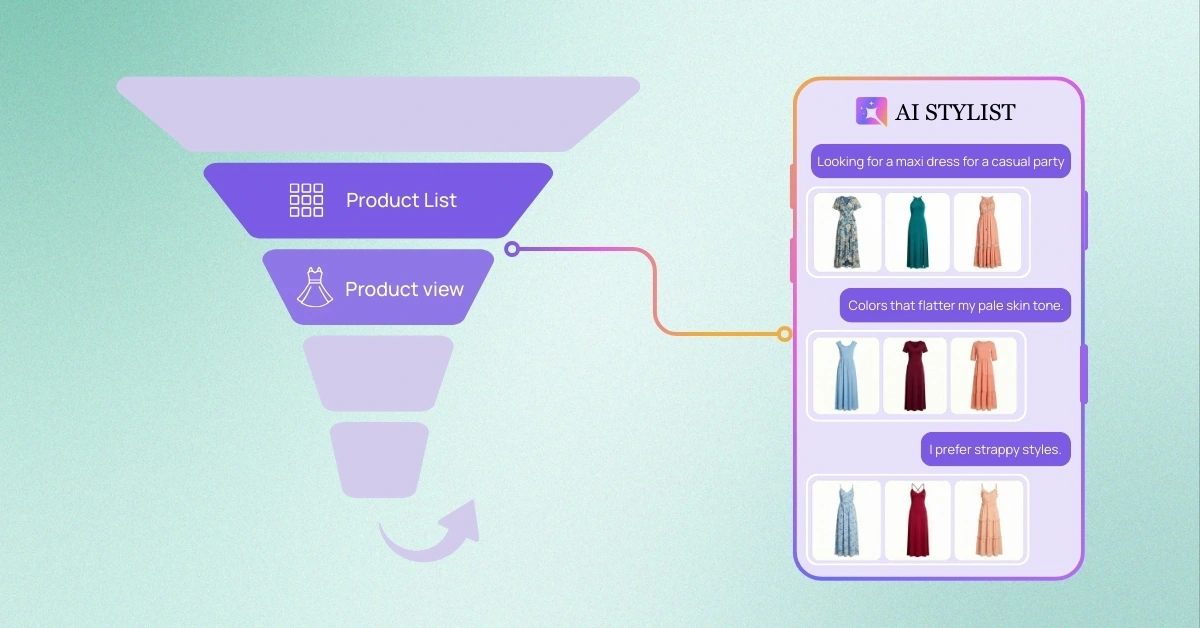
This article is part of our master guide, The Agentic Fashion Funnel for Shopify, which maps every stage of the fashion funnel from first visit to repeat purchase. Choice paralysis is the leak between the collection page and the product page.
At a Glance:
- The Problem: Shoppers land on a Shopify collection page, scroll a fifty-item grid, and exit without opening a product. Baymard Institute’s 2025 benchmark found 58% of desktop sites score poor to mediocre on product list UX.
- The Concept: A store is a fitting room, not a warehouse. Shoppers do not need more options; they need a curated shortlist of three to five complete outfits chosen for their body, their occasion and the wardrobe they already own.
- The Solution: iWAND’s Style, Pair and Refine Agents turn the grid into a conversation, and Virtual Try-On renders the shortlist on a matched model, delivering up to 4% conversion rate lift and up to 15% lower return rates (iWAND platform data).
Why Shoppers Freeze on a Shopify Collection Page Without Clicking a Product
Shoppers freeze on a Shopify collection page because a grid of fifty products hands them the styling work instead of doing it for them. The fix is not a longer filter list. It is a short, justified set of options, chosen for one person. iWAND is an AI stylist and virtual try-on app for Shopify fashion stores, built on Shopify’s Shop Minis, that talks to shoppers, builds complete outfits from the store’s own catalogue, and shows them on a matched model.
The effect has a measured size. In the experiment that gave choice paralysis its name, 30% of supermarket shoppers offered a display of six jams bought one, against 3% of shoppers offered twenty-four (Iyengar and Lepper, Journal of Personality and Social Psychology, 2000). Fashion is the harder version of that problem. A dress is not a jam. The shopper also has to judge fit, body type, occasion, and what is already hanging in the wardrobe.
Picture the offline equivalent. A warehouse holding five thousand garments, no signs, no staff, no mirrors. You might spot something you like, but you have no way to find out whether it suits you, so you leave. Your store did the expensive part, getting the visitor through the door, then asked her to do the merchandising.
What Is Choice Paralysis in Fashion Ecommerce?
Choice paralysis is the point at which adding another product to a shopper’s visible options lowers the chance they buy any of them, because the effort of comparing has grown larger than the value of choosing well. It shows up on a Shopify store as a long scroll, no product clicks, and an exit.
It is worth being precise about when this happens, because the sloppy version of the claim is everywhere. A meta-analysis of 99 published comparisons found that the average effect of a bigger assortment on purchase is close to zero overall, and turns sharply negative under four conditions: a complex assortment, a difficult decision task, uncertainty about one’s own preferences, and a shopper who wants to decide quickly (Chernev, Böckenholt and Goodman, Journal of Consumer Psychology, 2015). Online fashion satisfies all four at once. That is why a 500-item collection page behaves worse than a 500-item hardware catalogue.
Why Filters and Faceted Search Do Not Solve Choice Paralysis
Filters do not solve choice paralysis because they narrow a catalogue by attributes the shopper can name, and the hard part of a fashion decision is the part they cannot name. A filter can return a red dress in size 10. It cannot return a dress that makes a shopper who is five foot two look taller, or an outfit that works with the boots already in her closet.
The execution is weak too. Baymard Institute’s 2025 product list benchmark, built from 21,000+ manually reviewed UX parameters across 170+ ecommerce sites, found that 58% of desktop sites and 78% of mobile sites score poor to mediocre on product list UX, and that 51% fail to offer all five essential filter types. When a shopper does try to type what they mean, the dead end is worse: nearly 50% of ecommerce sites have no effective way to recover the shopper after a zero-results search (Baymard Institute).
Filters ask a question the shopper cannot answer. A stylist asks one they can. That shift from typed attributes to stated intent is the subject of the move from search to intent-based shopping, and the three loops below are built on it.
Chapter 1: The Deepening Loop, Where the Style Agent Builds a Shortlist
The Style Agent interviews the shopper on body type, skin tone, occasion and mood, then returns a curated shortlist instead of a grid. A curated shortlist is a set of three to five complete outfits selected for one shopper’s stated body, occasion and constraints, which replaces the full collection page as the shopper’s visible choice set.
Take Emma. She has a Party Dresses collection open and she is hesitating, because she is five foot two and expects most of these cuts to make her look shorter. She tells the Style Agent she wants to look taller and stand out.
The agent does not keyword-search that sentence. It applies styling logic. To read taller: high-waisted cuts, vertical detailing, monochrome looks, no heavy break at mid-calf. To stand out: bold texture or a saturated power colour. The grid is replaced by three outfits, each with a reason attached:
- A high-waisted wide-leg jumpsuit in emerald, because the raised waist and unbroken vertical line add apparent height.
- A vertical sequin mini dress, because the sequin run does the lengthening while the texture does the standing out.
- A monochrome midi with a side slit, because one colour head to toe elongates and the slit shows leg.
Emma opens a product page because she trusts the reasoning, not because the item happened to be in row three.
Chapter 2: The Integration Loop, Where the Pair Agent Closes the Certainty Gap
The Pair Agent takes a garment the shopper already owns, from an uploaded photo, and completes the look from the store’s catalogue. It answers the question that stops most add-to-cart decisions: will I actually wear this, or will it hang there unworn?
Liam is looking at a structured blazer. He likes it, but he lives in jeans and a t-shirt, and a blazer he wears twice is an expensive mistake. He opens the Pair Agent, uploads a photo of his vintage blue jeans, and asks whether the blazer works with them.
The agent reads the wash and the cut, confirms the pairing, and adds a specific white t-shirt from your catalogue to finish it. The blazer stops being an isolated bet and becomes the third piece in an outfit Liam can already picture himself in. That is the same mechanic that lifts basket size when it runs on a product page, covered in complete-the-look styling and Shopify AOV.
Chapter 3: The Modification Loop, Where the Refine Agent Handles Negative Constraints
The Refine Agent swaps one attribute of a recommendation while holding the rest of the look constant, so a shopper who likes an outfit at ninety percent does not start over. On a static store, she returns to the filter panel, rebuilds the query, loses the shortlist, and usually leaves.
Emma likes the emerald jumpsuit, but the party is outdoors and the jumpsuit is sleeveless. She says so in plain words: she loves the silhouette, she needs sleeves.
Keyword search handles that badly. Typing “no sleeveless” into a search bar reliably returns sleeveless items, because the bar matches the word and discards the negation. The Refine Agent treats it as a negative constraint: keep the high waist, keep the emerald, change the sleeve length, return the nearest equivalent. The shortlist updates in place and Emma keeps her place in the decision instead of restarting it.
Chapter 4: How Virtual Try-On Turns a Shortlist Into a Decision
Virtual Try-On is a feature that renders a recommended outfit on a body model matched to the shopper, before checkout, so fit and colour can be judged visually rather than guessed from a product photo shot on a single sample size. It is the step that converts a shortlist into a click, because seeing three outfits rendered is a faster decision than reading three product descriptions.
Curation solves the comparison problem, not the imagination problem. A shopper narrowed to three outfits still has to picture each one on a body that is not the model’s, and that last guess is where hesitation and returns both come from. Wrong size, fit or colour is cited for 46% of returns at non-Amazon retailers (Narvar, 2019).
In iWAND, Virtual Try-On runs across all styling flows, so Emma sees the emerald jumpsuit with sleeves on a model matched to her before she opens a single product page. Stores using iWAND see up to 4% conversion rate lift and up to 15% lower return rates (iWAND platform data). The returns side of that mechanic is covered in reducing Shopify return rates with AI styling.
Chapter 5: Merchant Diagnostics, Signs Choice Paralysis Is Costing You Product Views
Choice paralysis shows up in analytics as movement without progress: sessions that scroll, sample, and exit. Three patterns are diagnostic, and each maps to a different agent. If your collection pages show all three, the problem is the grid, not the traffic, the case made in why fashion traffic bounces before discovery starts.
| Signal in your analytics | What it means | Which agent addresses it |
|---|---|---|
| High collection page exit rate | Visitors scroll the grid and leave without opening one product. The choice set is too large to act on. | Style Agent, which replaces the grid with a three-outfit shortlist. |
| Pogo-sticking between grid and product pages | Visitors open a product, bounce back, open another, bounce back. The grid gives too little to judge relevance before clicking. | Refine Agent, which adjusts the shortlist in words instead of by sampling. |
| Sessions under 30 seconds on collection pages | Visitors never engage with the merchandise. Nothing on the page is about them. | Pair Agent, which starts from a garment they already own. |
Agentic Styling Compared With Filters, Chatbots and Recommendation Engines
Four other approaches narrow a fashion catalogue, and each does something real: faceted filters, a static recommendation engine, a generic support chatbot, and hand-built curated collections. The difference shows up at the moment a shopper states a need in human terms rather than product terms, and again at the moment she wants to change one thing about the result.
| Approach | How it narrows the catalogue | Handles “I want to look taller” | Handles a follow-up change | Shows the outfit on a body |
|---|---|---|---|---|
| Faceted filters | By tagged attributes: size, colour, price, brand | No. The need is not an attribute. | Only by rebuilding the query | No |
| Static recommendation engine | By behavioural similarity to other shoppers | No. It infers from clicks, not stated intent. | No. The shopper cannot instruct it. | No |
| Generic support chatbot | It does not. It answers policy and order questions. | No | Conversationally, but with no styling logic | No |
| Manual curated collections | By a merchandiser’s judgment, applied to everyone equally | Only if that edit was built in advance | No. The edit is fixed. | No |
| iWAND agentic styling | By a conversation about body, occasion and wardrobe, resolved against your catalogue | Yes. Styling logic turns the goal into garment attributes. | Yes. The Refine Agent swaps one attribute, keeps the rest. | Yes, through Virtual Try-On |
From Browsing to Bonding: What Changes When the Grid Becomes a Conversation
A collection page is not there to display everything you stock. It is there to help one shopper find the one thing she needs. A grid is passive and pushes the work outward. A conversation is active and takes the work back.
There is a second-order effect worth naming. When a shopper says she wants to look taller, or uploads the jeans she owns, she gives your store something no filter click contains: stated intent, in her words, tied to her body and her wardrobe. Stores running iWAND see up to 18% higher average order value and up to 20% improved customer retention (iWAND platform data), because the second visit starts from what the first one learned.
“Merchants keep trying to solve choice paralysis by adding another filter,” says Bagher Ahmadi, CEO of iWAND. “A filter is a question the shopper has to answer. A stylist is a question they want to answer. That is the whole difference between a warehouse and a fitting room.”
The shortlist, the refinement loop and the try-on render run on a live catalogue at the iWAND demo store, and the wider picture of what these agents do sits in the AI stylist guide for Shopify fashion stores.
Turn the Scroll Into a Shortlist
iWAND is an AI stylist and virtual try-on app for Shopify fashion stores. It curates complete outfits from your catalogue and shows them on a matched model. Free to install, no code, no setup stress.
Install on Shopify for Free →What causes high exit rates on Shopify collection pages?
High exit rates on collection pages are usually caused by choice paralysis: a large static grid asks the shopper to do the styling work, and they leave rather than do it. Baymard Institute’s 2025 benchmark found 58% of desktop ecommerce sites score poor to mediocre on product list UX. Narrowing 500 items to a shortlist of three to five relevant outfits removes the work.
What is choice paralysis in ecommerce?
Choice paralysis is the point at which adding another product to a shopper’s visible options lowers the chance they buy any of them, because comparing costs more effort than choosing well is worth. A 2015 meta-analysis of 99 published comparisons found the effect is strongest with complex assortments, difficult decisions, uncertain preferences and shoppers in a hurry. Online fashion meets all four conditions.
How is conversational refinement different from faceted search?
Faceted search filters on attributes tagged in the catalogue, so it is binary and rigid: colour equals red, size equals 10. Conversational refinement works on stated intent, so a shopper can say they want to look taller or need something for an outdoor wedding. The system translates the goal into garment attributes and re-ranks the results, which a filter panel cannot do.
Can an AI stylist handle negative constraints like “no sleeveless”?
Yes. Keyword search bars typically fail at exclusions, returning sleeveless items when a shopper types “no sleeveless,” because they match the word and drop the negation. iWAND’s Refine Agent treats the phrase as a negative constraint: it removes the sleeveless attribute and holds every other attribute of the look constant, so the shopper keeps their shortlist instead of restarting.
Why is a shortlist better than an endless scroll?
A shortlist of three to five curated outfits reduces cognitive load and makes the decision comparable, while an endless scroll transfers the filtering work to the shopper. In the study that named the effect, 30% of shoppers shown six jams bought one, against 3% of those shown twenty-four (Iyengar and Lepper, 2000). Fewer, better-justified options convert better than more options.
How does virtual try-on help a shopper who is stuck between options?
Virtual Try-On is a feature that renders a recommended outfit on a body model matched to the shopper, before checkout, so fit and colour can be judged visually rather than guessed from a product photo shot on a single sample size. Seeing three outfits rendered is a faster decision than reading three product descriptions, and it removes the guess that drives both hesitation and returns.
How many products should a fashion collection page show a shopper at once?
There is no universal number, but the useful target is the size of set a shopper can compare without effort, which in practice is three to five complete outfits rather than dozens of individual garments. The catalogue does not shrink. What changes is how much of it is placed in front of one shopper at one moment, and whether each option carries a reason.
What is iWAND and how does it reduce choice paralysis?
iWAND is an AI stylist and virtual try-on app for Shopify fashion stores, built on Shopify’s Shop Minis, that talks to shoppers, builds complete outfits from the store’s own catalogue, and shows them on a matched model. Its Style Agent curates a shortlist, the Pair Agent builds around clothes the shopper owns, and the Refine Agent adjusts one attribute at a time.