

At a glance
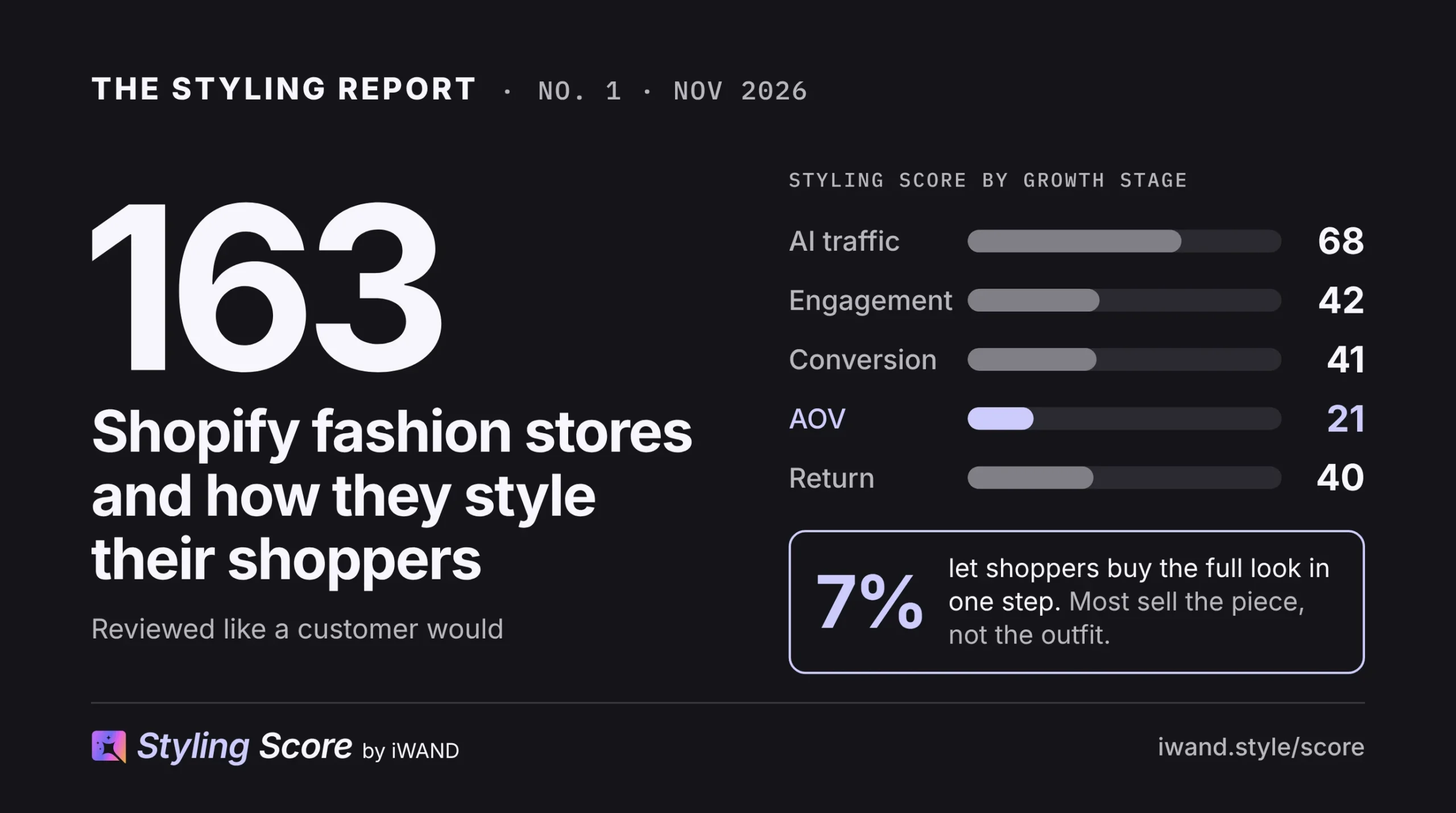
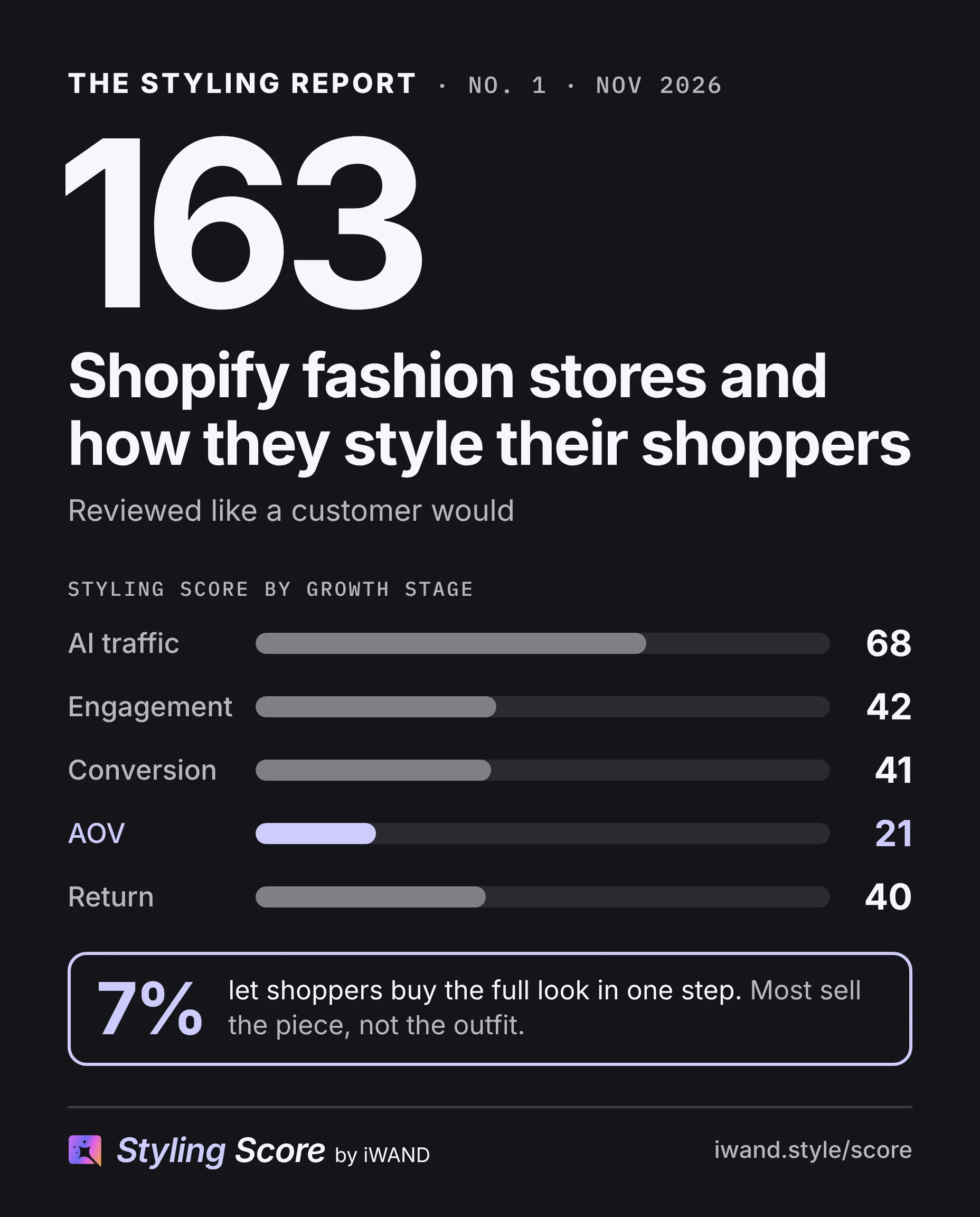
Most Shopify fashion stores sell the piece, not the outfit. Across 163 stores reviewed with the Styling Score between Oct 12 and Nov 10, 2026, 7% let a shopper buy a full look in one step, and AOV (average order value) was the weakest of 5 stages, with a median score of 21 out of 100. Stores describe their products well. Few style the shopper.
Stores reviewed: 163
Checks per store: 22 across 5 stages
Reviewed: Oct 12 to Nov 10, 2026
Change log Nov 2026: first edition.
Key findings
- The outfit is missingOnly 38 of 163 Shopify fashion stores (23%) had any of the three outfit factors done: complete the look, shoppable looks or buy the look. 7% let a shopper buy a full look in one step.
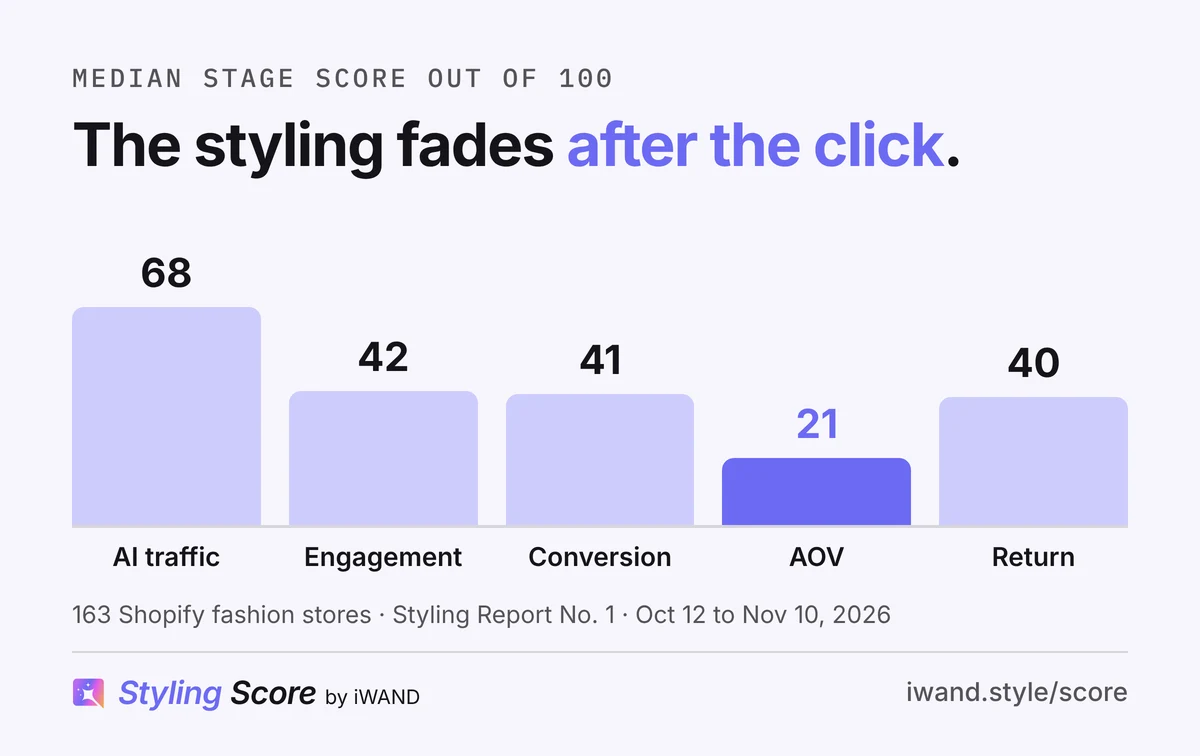
- AOV scores lowestAOV is the weakest of 5 stages, with a median stage score of 21 out of 100. AI traffic is the strongest, at 68.
- Stores describe, few styleProduct basics such as names, fabric and size guides were done at 76% of stores on average. The moments that style the shopper were done at 25%.
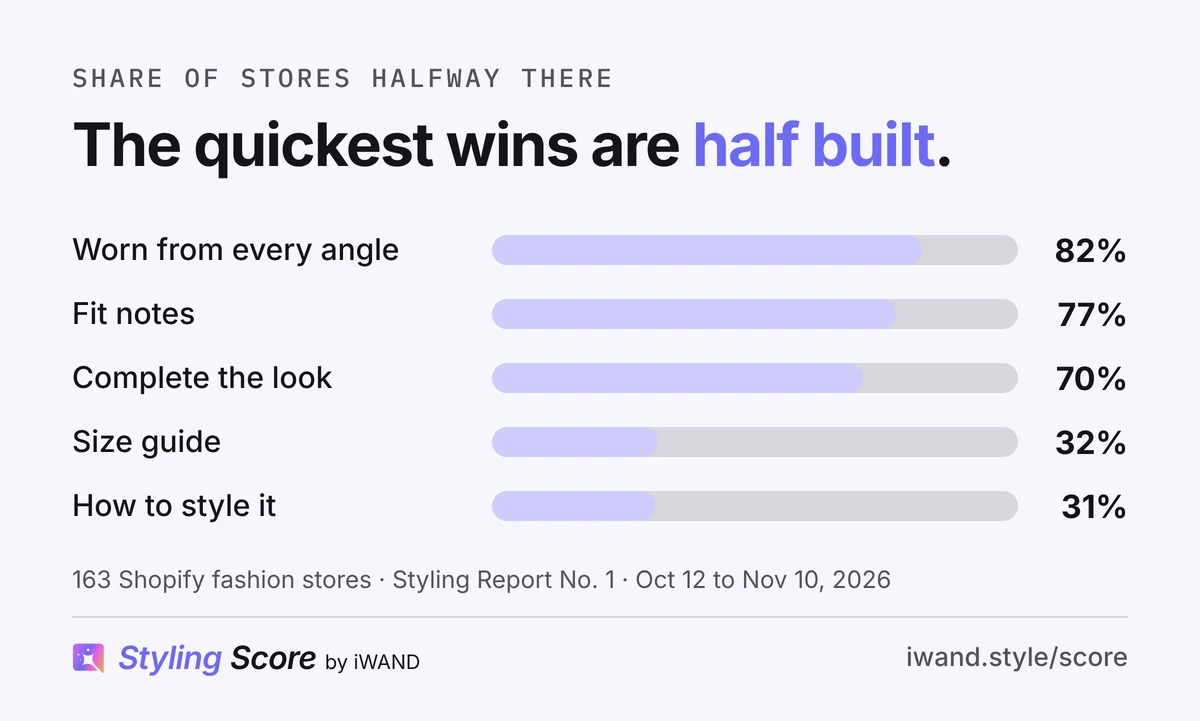
- The quickest wins are half builtMost stores had three factors started but not finished: worn from every angle (82% halfway), fit notes (77%) and complete the look (70%).
- Where stores standThe typical store had 6 of 22 styling factors done. The top third had 8 or more, and the top 10% had 10 or more.
Walk into a good boutique holding a blazer, and a stylist hands you the trousers and the shoes that go with it. Walk into most Shopify fashion stores holding the same blazer, and you get the blazer, plus a row of products that might go with it. One sells an outfit. The other sells a piece.
| A salesperson | A stylist | |
|---|---|---|
| Starts with | The product | The person |
| Shows | One item at a time | Complete outfits |
| On size | Points to a size chart | Knows how this brand fits you |
| After the sale | Done | Remembers you and suggests new looks |
We wanted to know which one Shopify fashion stores are today. So we shopped inside 163 of them, like a customer would, and checked 22 styling factors from the first visit to the size choice. This is the first Styling Report: every one to two months we review a new pack of stores and publish what we find.
Part of Styling Reports, our running series on how Shopify fashion stores style their shoppers.
In this report
Do Shopify fashion stores sell the outfit?
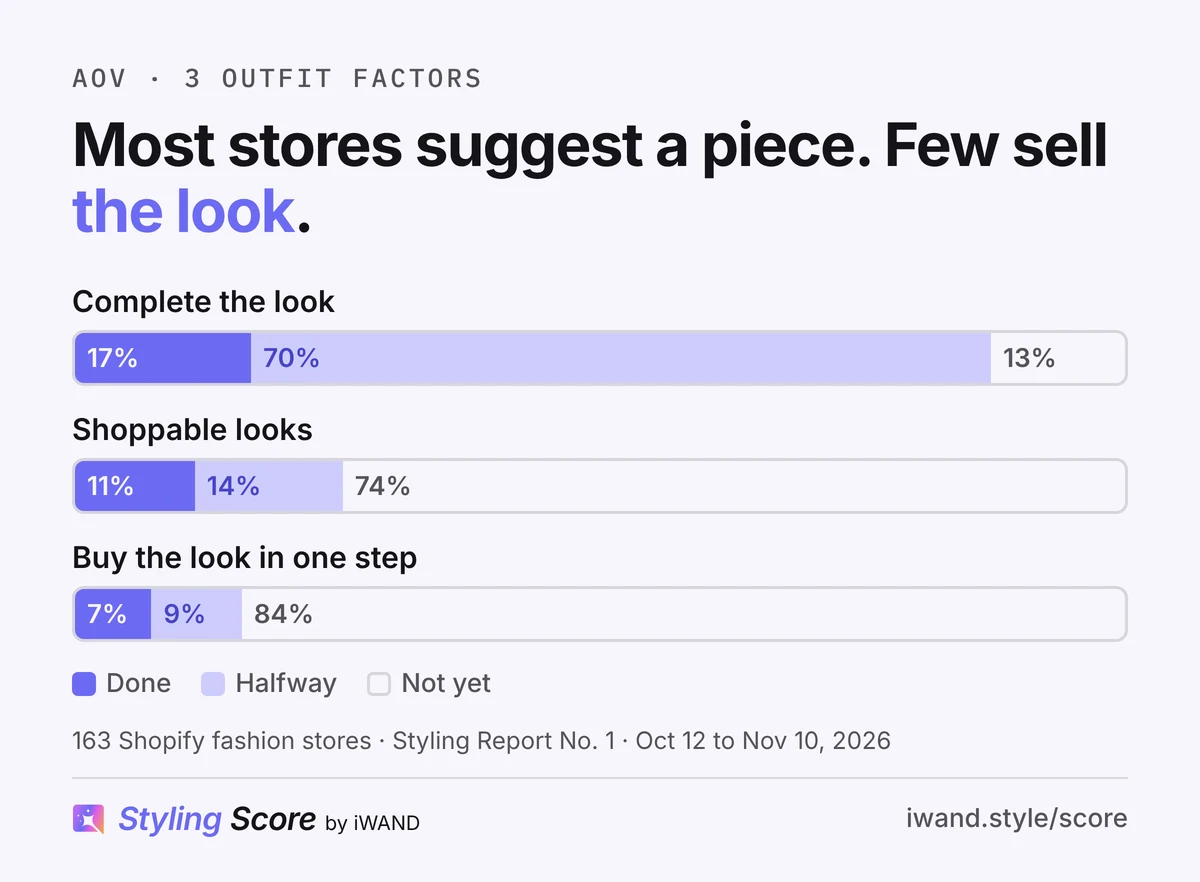
Mostly not. Most stores suggest other pieces, but few style them into one look the shopper can buy. Only 38 of 163 stores (23%) had any of the three outfit factors done, and only 3 stores had both complete the look and buy the look done.
| Outfit factor | What Done looks like | Done | Halfway | Not yet |
|---|---|---|---|---|
| Complete the look | Each product page suggests the pieces that finish the outfit | 17% | 70% | 13% |
| Shoppable looks | Styled outfits a shopper can browse and open | 11% | 14% | 74% |
| Buy the look | Every piece in the look can be added in one step | 7% | 9% | 84% |
Halfway usually means a block of related products: same collection, same colour, or “you may also like”. The shopper sees more items, but not a reason to wear them together. Calibre, ITRH and Pangaia were the only stores in this pack with both complete the look and buy the look done.
Why it matters: order value grows in two ways, a higher price or more pieces per order. Styling works on the second. The median Shopify fashion order is $113, and the top 20% of stores get $298 or more (Littledata, 2026). More on that in our Shopify fashion benchmarks.
How do you turn one piece into an outfit on Shopify?
Style the outfit once, then let the shopper buy all of it. Start with your 10 best sellers and work through three steps; each one uses tools Shopify already has.
- Pick the pieces that finish the lookFor each best seller, choose 2 to 4 pieces from your own catalogue that a stylist would put with it: a bottom, a layer, a shoe or a bag. Add them as complementary products. How to add complete the look.
- Show them worn togetherShoot or build one look per best seller and give it a name, such as The Weekend Linen Look. A look shows why the pieces belong together. How to build shoppable looks.
- Let her add the whole look in one stepPut every piece of the look, priced and in stock, on the product page with one add-to-bag action. How to make a look buyable.
Measure it
Compare average order value and items per order for the 10 products before and after, over the same number of weeks.
Do Shopify fashion stores style their shoppers?
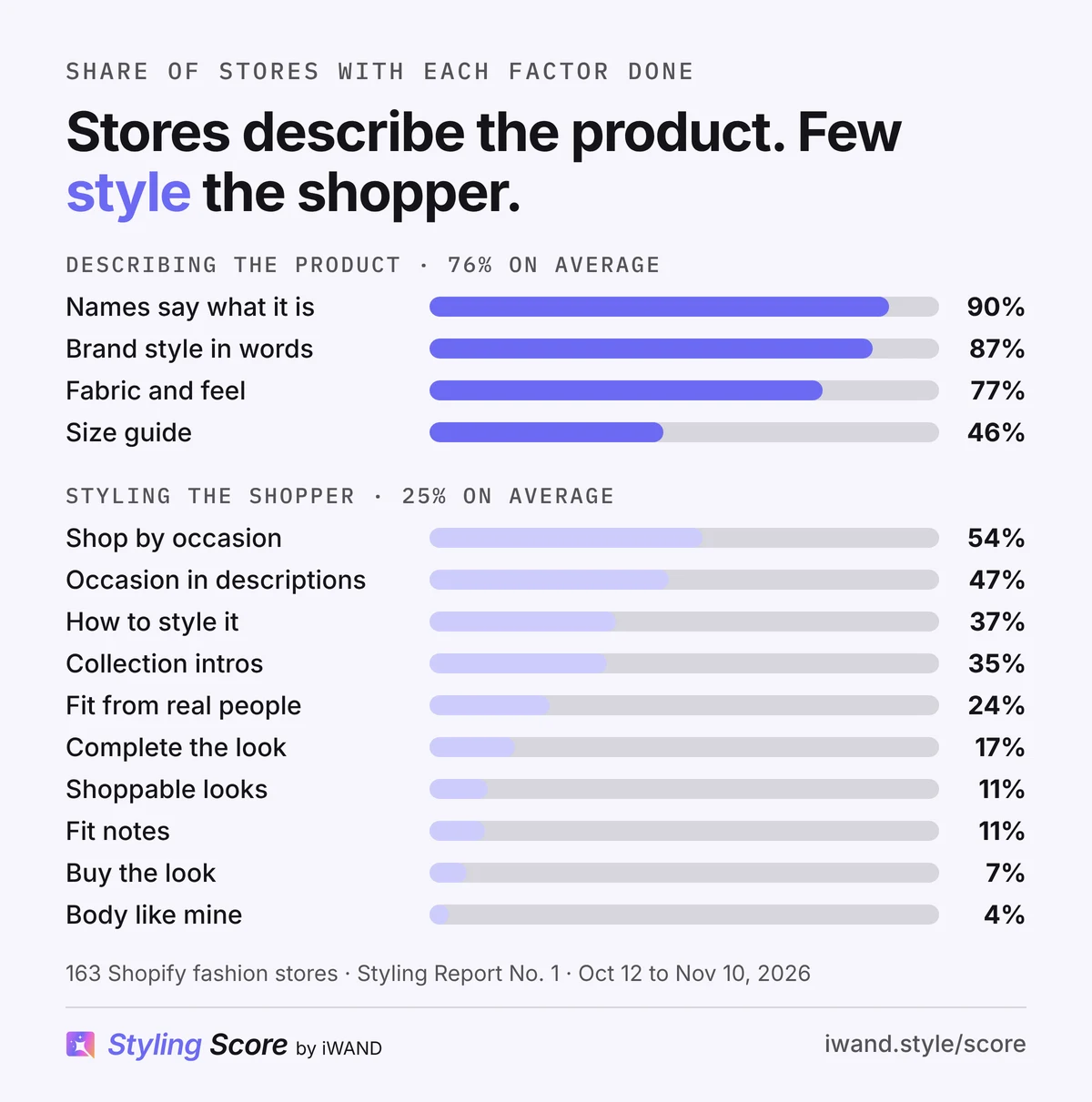
They describe the product well, but few style the shopper. Product basics were done at 76% of stores on average; the moments that style the shopper were done at 25%.
| Factor | Group | Done |
|---|---|---|
| Names say what it is | Describing the product | 90% |
| Brand style in plain words | Describing the product | 87% |
| Fabric and feel | Describing the product | 77% |
| Size guide | Describing the product | 46% |
| Shop by occasion | Styling the shopper | 54% |
| Occasion in descriptions | Styling the shopper | 47% |
| How to style it | Styling the shopper | 37% |
| Collection intros | Styling the shopper | 35% |
| Fit from real people | Styling the shopper | 24% |
| Complete the look | Styling the shopper | 17% |
| Shoppable looks | Styling the shopper | 11% |
| Fit notes | Styling the shopper | 11% |
| Buy the look | Styling the shopper | 7% |
| Body like mine | Styling the shopper | 4% |
Describing answers what is it? Styling answers what do I wear it with, when, and will it work on me? The second set is where a shopper decides, and it is where most stores stop. The basics are worth keeping: clear names and a plain description of the brand’s style help AI assistants match a store to what shoppers ask.
Where does the styling fade, stage by stage?
After the click. AI traffic has the highest median stage score, 68 out of 100. Engagement, Conversion and Return sit around 40, and AOV is lowest, at 21.
| Stage | Median | A salesperson store | A stylist store |
|---|---|---|---|
| AI traffic | 68 | Waits for shoppers who know the name | Gets named when she asks AI what to wear |
| Engagement | 42 | Shows her a grid | Starts from the occasion or a full look |
| Conversion | 41 | Says “you’ll love it” | Shows how it wears and answers the doubt |
| AOV | 21 | Sells the one item in the cart | Builds the outfit around it |
| Return | 40 | Points to a size chart | Says how the brand fits |
Which styling fixes are closest to done?
The ones already half built. For three factors, most stores have started but not finished, so the next step is small.
| Factor | Halfway | What usually finishes it |
|---|---|---|
| Worn from every angle | 82% | Add back, side and detail shots, worn, to every best seller, not only a front shot |
| Fit notes | 77% | One line on every product next to the size selector: runs small, true to size or runs large |
| Complete the look | 70% | Swap generic related products for 2 to 4 pieces chosen as one outfit |
| Size guide | 32% | One size chart per garment type, with real measurements |
| How to style it | 31% | Two pieces to wear it with and one line on how to wear it, on every product page |
Do stores name the shopper’s occasion?
Rarely everywhere. Only 21 of 156 stores named the occasion in all three places a shopper looks for it: product descriptions, collection intros and a shop-by-occasion menu. 36 named it in none.
| Places where the occasion is named | Stores |
|---|---|
| All 3 | 21 |
| 2 | 49 |
| 1 | 50 |
| None | 36 |
Shoppers think in occasions: a wedding, a first day at work, a weekend away. So do AI assistants when they answer “what should I wear to…”. Naming the occasion in your product descriptions, collection intros and a shop-by-occasion menu gives both the same thread to follow.
Is the styling personal?
Not yet. A stylist starts with the person: her taste, her body, her occasion and what she already owns. That was the rarest thing in this pack. Only 4% of stores showed pieces on more than one body type.
110 of 163 stores offered some form of personal help, such as a chat, a style quiz or a stylist booking. In this edition the Styling Score marks the four personal-styling factors Halfway at most, so we report how many stores offer the help rather than how many have it done. The four are personal outfit recommendations, personal styling advice, a personal outfit built around the piece she is viewing and personal size and fit advice.
There is a head start here: 87% of stores already describe their brand’s style in plain words. That description is the raw material for styling shoppers the way the brand would, not with generic trends.
Which Shopify fashion brands style their shoppers well?
Three stores in this pack show what styling the shopper looks like in practice. We list the styling factors each one has done, not a score.
Alo Yoga
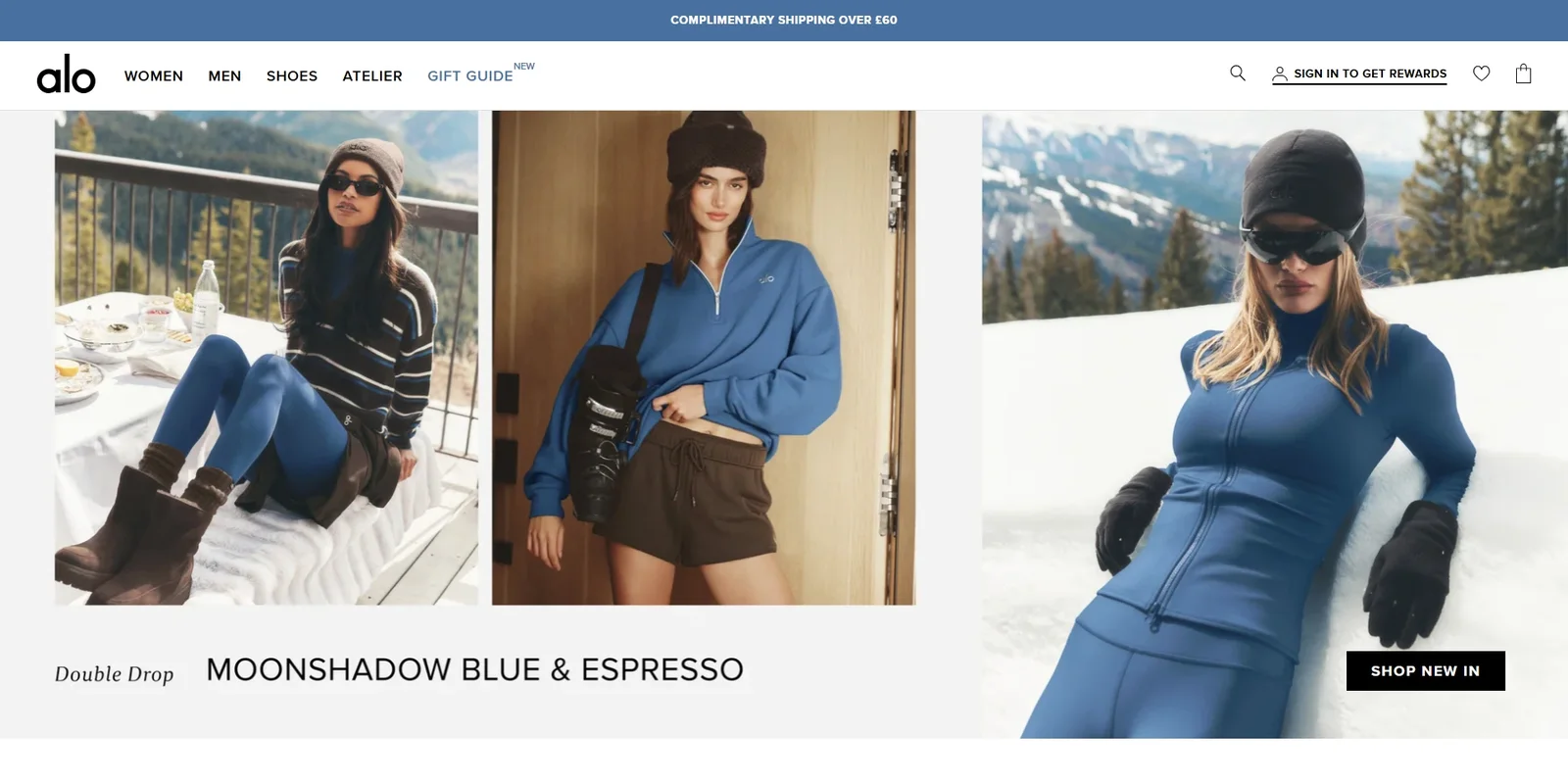
Alo starts shoppers from what they are doing, shows the full outfit and lets them buy it in one step. Each piece says how it fits, backed by what real buyers say.
Done: Shop by occasion · Shoppable looks · Buy the look · Styling guides · Fit notes · Fit from real people
Really Wild Clothing Co
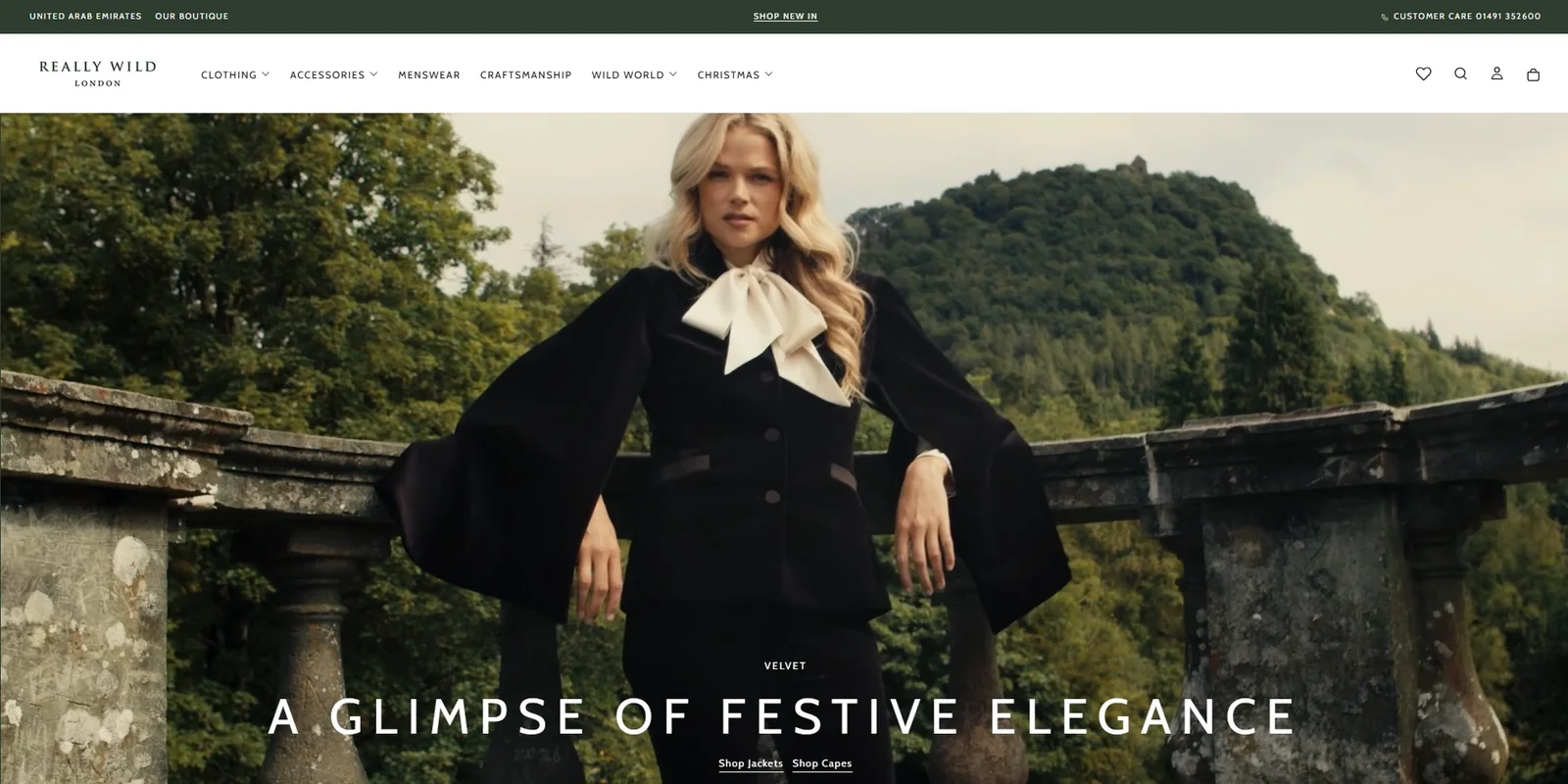
Every piece comes with a place to wear it and a way to wear it, and it is shown on more than one body. The occasion runs from the product description to the menu.
Done: Occasion in descriptions · Shop by occasion · Styling guides · How to style it · Body like mine
NRBY
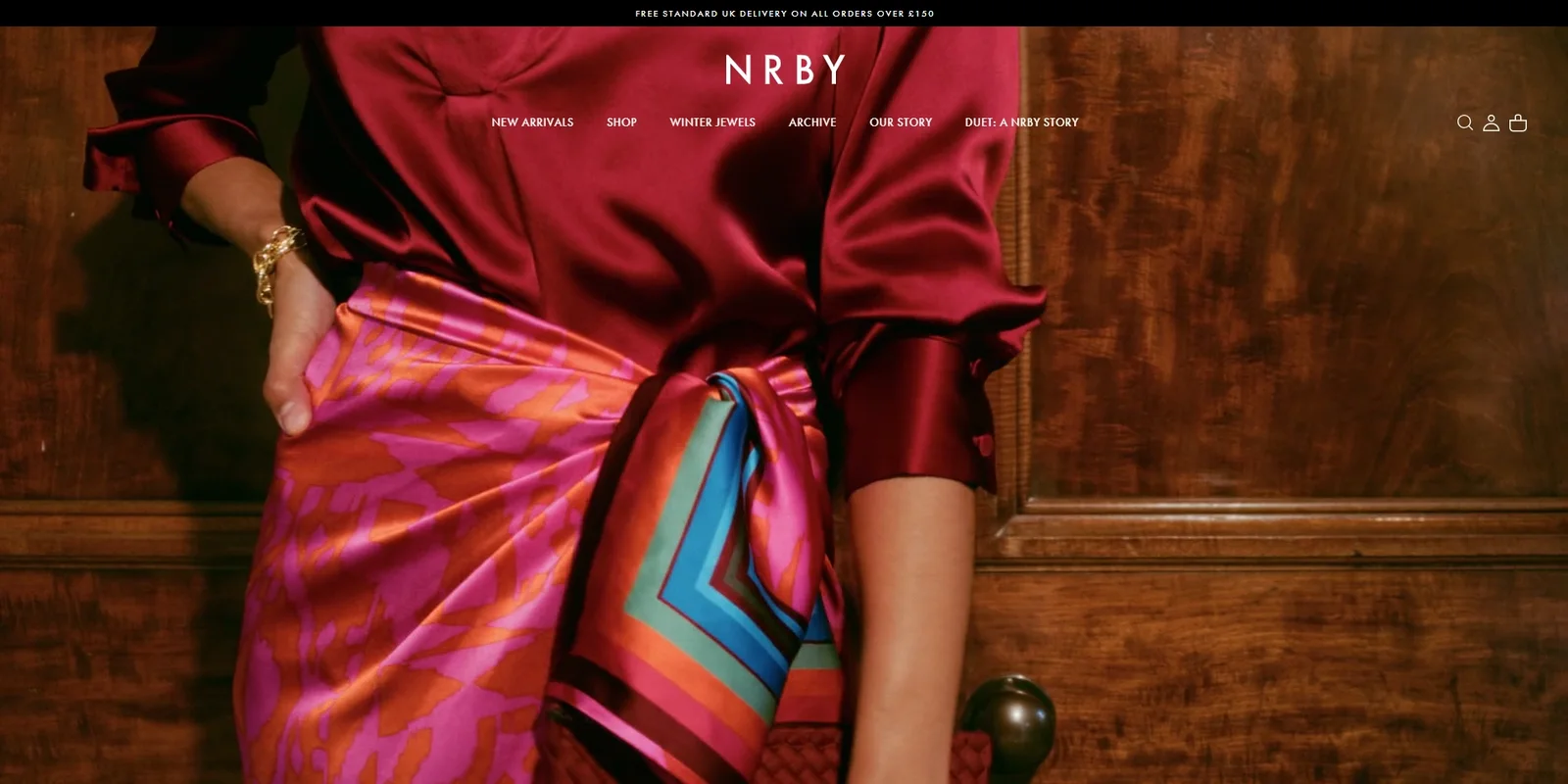
NRBY shows each piece worn from every angle, explains how to style it, then builds the outfit around it on the product page.
Done: Worn from every angle · Collection intros · How to style it · Complete the look · Fit from real people
Where does your store stand?
Count your Done factors and compare. The typical store in this pack had 6 of 22. The top third had 8 or more, and the top 10% had 10 or more. The most any store had was 13.
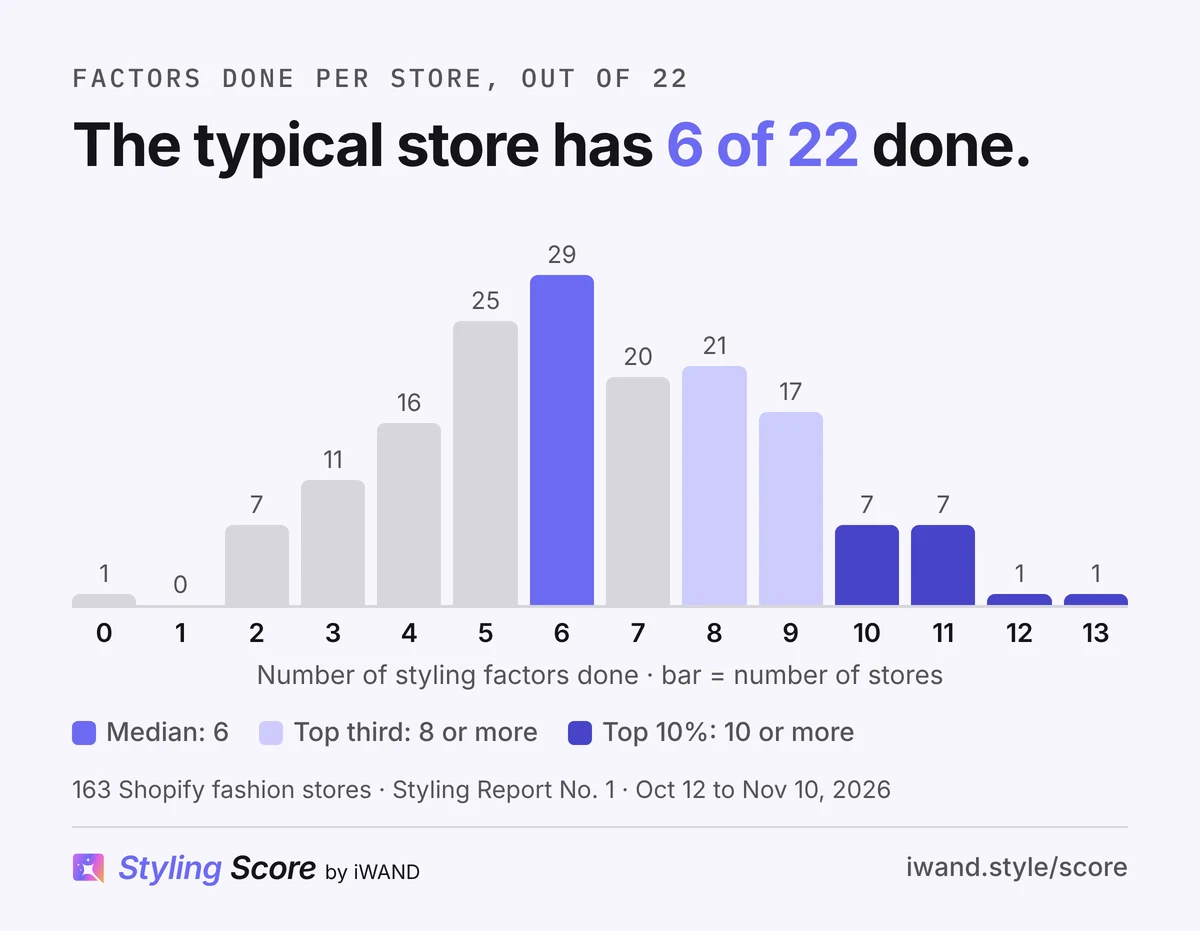
| Factors done (of 22) | Where that puts a store in this pack |
|---|---|
| 4 or fewer | Bottom fifth |
| 6 | The typical store |
| 8 or more | Top third |
| 10 or more | Top 10% |
Check five of them yourself in 2 minutes, one per stage:
- AI trafficDoes the first line of your product descriptions say when or where the piece is worn? If not: add an occasion line.
- EngagementCan a shopper start from an occasion or a full look, not only a product type? If not: add shop by occasion.
- ConversionDoes a best seller show what to wear it with? If not: add a styling tip.
- AOVCan she add the full outfit from that page in one step? If not: make the look buyable.
- ReturnIs there one line next to the size selector saying how it fits? If not: write fit notes.
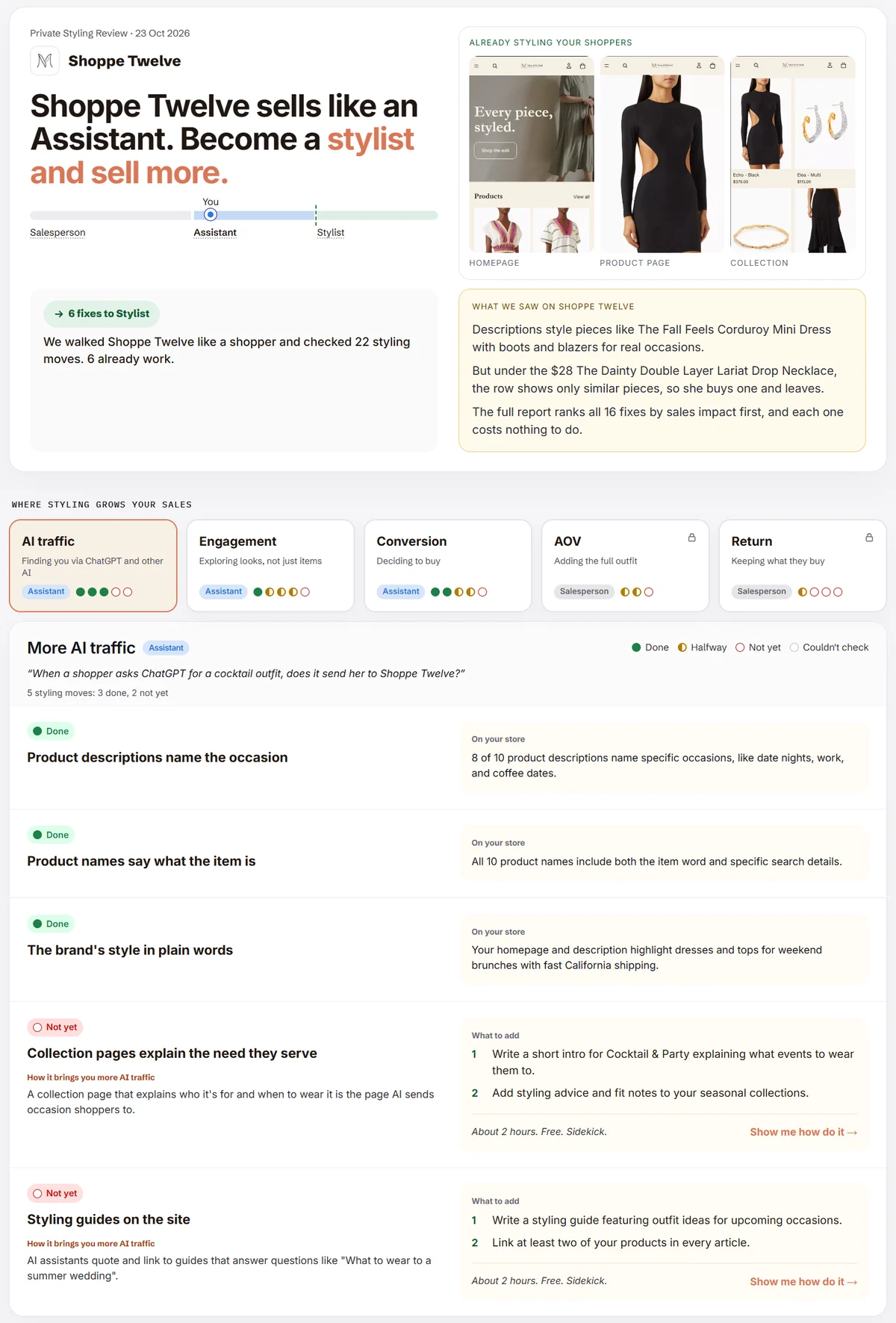
Get all 22 checks for your store
The free Styling Score shops inside your store like a customer would, marks each factor Done, Halfway or Not yet, and shows the fix for each one.
How did we review 163 Shopify fashion stores?
We shopped inside each store like a customer would, using public pages only: the homepage and menus, collections, about 10 product pages, size guides, reviews and the blog. Each store was checked against 22 styling factors across 5 stages and each factor marked Done, Halfway or Not yet.
| Sample | Stores |
|---|---|
| Set out to review | 172 |
| Could not be reviewed (region blocks, bot checks, a password page, one unreadable, one not on Shopify) | 9 |
| Reviewed | 163 |
| United States | 65 |
| India | 38 |
| United Kingdom | 20 |
| Canada, Germany, Australia and 12 other countries | 40 |
Read the numbers as this pack, not all of Shopify
The 163 stores are well-known brands and independent stores we chose to review, not a random sample. A factor a review could not read is left out of that factor’s count, so each percentage is based on 131 to 162 stores. The Styling Score does not yet check repeat purchase.
Download the factor table: styling-report-01-factors.csv (22 factors, Done, Halfway and Not yet shares, stores counted). Every edition is listed under Styling Reports.
What else do founders ask about this report?
What percentage of Shopify fashion stores offer complete the look?
In Styling Report No. 1, complete the look was done at 17% of 163 Shopify fashion stores and halfway at 70%, usually as a block of related products rather than a styled outfit. 7% let shoppers buy a full look in one step (Oct to Nov 2026).
What is the difference between a salesperson store and a stylist store?
A salesperson store starts with the product, shows one item at a time and points to a size chart. A stylist store starts with the shopper, shows complete outfits and says how the brand fits her.
Is styling the same as personalization?
No. Personalization changes which products a shopper sees, based on what she did before. Styling answers what she is asking now: what to wear it with, how it fits and whether it suits her.
How often is the Styling Report published?
Every one to two months, each with a new pack of Shopify fashion stores and one theme in depth. Every edition is listed under Styling Reports on the iWAND blog.
How to cite this report
Quote any number with a link to this page: iWAND, Styling Report No. 1, November 2026. 163 Shopify fashion stores reviewed with the Styling Score, Oct 12 to Nov 10, 2026. iwand.style/blog/styling-report-2026-11/
Styling Report No. 2 is planned for January 2027, with a new pack of stores.
Next read
Every Styling Report
A new pack of Shopify fashion stores every one to two months, each with one theme in depth.
Next read
How to raise average order value
The styling moves that turn one piece into a full outfit, stage by stage.